

ALEXANDRIA, Va.–The NCUA Board has voted 3-0 to maintain the federal interest rate cap at 18% for federal credit unions for the next 18 months, although the board made clear it has the authority to revisit the cap at any time prior to the end of that time period.
Congress set the cap at 15% in 1980, but the agency has the discretion to raise the cap for “safety and soundness” reasons for periods not to exceed 18 months.
Prior to the vote, as CUToday.info was first to report, the Treasury Department told NCUA it did not see any reason to raise the current 18% interest-rate ceiling for loans made by federal credit unions. NCUA staff told the board they were unaware of any similar letter from Treasury prior to other votes on the interest rate cap by the NCUA board.
John Nilles, senior capital markets specialist in the Office of Examination and Insurance, made the presentation to the board. According to agency staff, 2,177 federal credit unions, or 72% of all FCUs, are making unsecured loans at rates above 15%. The total amount represents 3.4% of all FCU loans.
All three NCUA board members offered different views on the cap, the agency’s responsibilities, the effects on credit unions and more during their remarks prior to the vote.
Harper: Three Views on Issue
Noting the various economic scenarios credit unions have faced since 1987, including four recessions, NCUA Chairman Todd Harper said industry assets have also grown to $2.1-trillion from $160 billion.
NCUA Chairman Todd Harper during board meeting.
“I think it's fair to say that all three board members are uncomfortable in their voting positions,” said Harper. “We view this issue in three different ways. Moreover, the views on whether to maintain the current interest rate ceiling, increase it or adopt some new methodology are strong and varied.”
Harper said the agency has heard from credit unions that want the ceiling raised to 21% or modified to become a floating ceiling. Others want the maximum loan rate for federal credit unions to remain at the current 18%, he said, adding NCUA has also heard arguments related to competitiveness and other issues.
Harper said his review of the Federal Credit Union Act has made clear reiterate nothing in the Federal Credit Union act precludes the NCUA board from acting on the interest rate ceiling earlier than 18 months, and he said he was committed to reviewing the matter on a rolling basis.
Harper further noted money market rates have indeed risen over the past six months, and that agency staff analysis concluded that lowering the interest rate ceiling below 18% would threaten the safety and soundness of individual credit unions.
‘No Compelling Data’
“As I noted earlier there's no compelling data at this time that shows that such a safety and soundness issue exists,” said Harper. “From my perspective, adjusting the maximum loan interest rate ceiling higher would place additional burdens on credit union members’ budgets already stretched thin by inflation and tighter credit conditions…So, this is yet another reason why the maximum interest rate on loans should not be raised at this time. An increased interest rate ceiling would place greater burdens on households who hold credit card debt and this could tip some family budgets into the red. We therefore ought to move carefully before acting.
Harper said the agency also needs to determine whether a variable rate is legally permissible, an issue the general counsel's office currently examining.
Whatever decision is made moving forward, Harper said will involve “prudent action grounded in sound reasoning.”
Hauptman: Context & An Example
Seeking to bring some context to the discussion around the interest rate ceiling, NCUA Vice Chairman noted that in 1980, when Congress raised the credit union interest rate ceiling to 15% from the statutory limit of 12%, it acted because at the time the Fed was hiking rates to unprecedented levels.
NCUA Vice Chairman Kyle Hauptman during board meeting.
“Immediately after that 1980 legislation, the board used that discretion to raise the maximum rate to 21% where it stayed for a few years. This is the context I’m working with when trying to understand congressional intent,” said Hauptman. “We know that Congress thought 21% was appropriate when the prime rate was 20.5%. I mention this because our job is to do what Congress says, not what we on the board think is the ideal policy.”
Indicating he planned to vote for the increase, Hauptman said he is “concerned” the agency may need more information than what was made available to board members to make this determination.
“We do know that Congress said we can only go above 15% if ‘the safety and soundness of individual credit unions as evidenced by adverse trends in liquidity, capital, earnings and growth’,” said Hauptman. “As of this moment, we do not have evidence that meets the rather-stringent criteria to raise the rate higher than the current 18%.”
The Need for ‘Head Room’
Hauptman said low-income and CDFI credit unions depend upon what he called the “head room,” or the ceiling provided above the statutory rate of 15%.
“With inflation and the increase of the cost of funds, these credit unions will have to make the hard choice of whether to serve their neediest members,” Hauptman said. “For some low-income community and CDFI credit unions, this could be most of their membership.”
Hauptman said some in credit unions have suggested that one solution is Payday Alternative Loans (PALs), a higher-interest loan allowed by NCUA.
“I don’t disagree the PALs product can be a useful option. But most credit unions don’t make PALs loans,” Hauptman said. “My informal research has revealed that it takes on average three to five days for a credit union to process a PALs loan. And this is often at a loss or breakeven due to the manual nature of the process. Some credit unions have found ways to provide these loans economically and quickly through technology – I’m aware of at least one CUSO offering a technology solution that shortens the response time to a matter of minutes.
“So, the PALs product often doesn’t work for either the credit union or their members. With inflation and rates rising, my guess is emergencies have gotten more expensive too,” he added.
The Government As a Predatory Lender
Hauptman pointed out that currently 18 states and Washington, D.C., impose a 36% rate cap or lower, and shared on-screen an “actual bill from state government” that featured an extremely high late fee (see below).
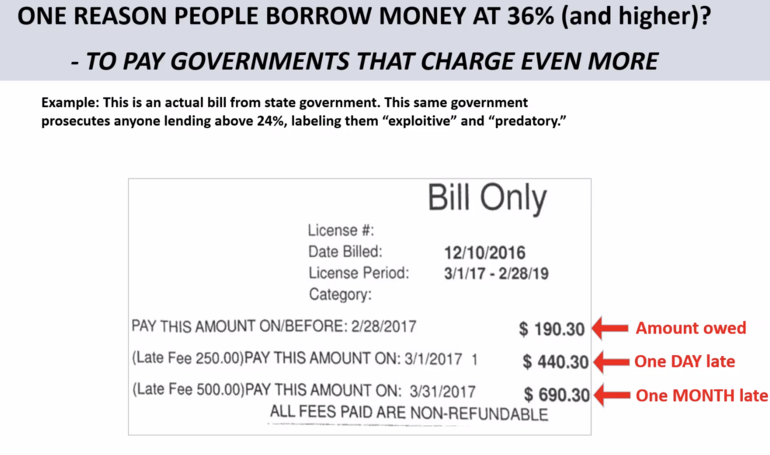
“Well, if you owe that government $190, it’s $440 if you’re one day late. One day. It’s $690 if you’re one month late. This is one example of why people get financially stuck sometimes,” said Hauptman. “They don’t want government to put a boot on their car for unpaid parking tickets, or their car towed due to not having the money to pay registration fees, nor their business shut down for unpaid permits.”
Returning to the vote on the interest rate ceiling, Hauptman said he believes further research is needed on the effect of the rate cap on the safety and soundness of individual credit unions.
Two Questions
“Mr. Chairman do you agree to have E&I reevaluate the interest rate ceiling in accordance with the Federal Credit Union Act and add that reevaluation as an agenda item at the April Board meeting?” asked Hauptman.
Harper responded by saying “yes.”
“Mr. Chairman will you also work to ensure that the analysis of whether a floating interest rate is legal is completed by the NCUA’s General Counsel’s Office by the April board meeting?” Hauptman asked.
Again, Harper said yes, saying NCUA’s general counsel is already researching the issue of a floating interest rate.
Hood: CUs And Members Must be Kept in Mind
NCUA Board Member Rodney Hood told the meeting that given the current rapid rate of increase in the prime rate, which has increased over 400 basis points since early March 2022, a closer examination of the issue before the board is required.
NCUA Board Member Rodney Hood during board meeting.
“You could certainly call today’s inflationary environment unstable,” said Hood. “I will begin by saying that I would prefer that interest rates be set by the market and not by government fiat.”
Hood added that his view is irrelevant, however, as Congress has directed the board to establish a loan rate ceiling and to justify any ceiling in excess of 15% after consulting with Congress and other federal financial agencies.
“A previous board surmised that any ceiling should be set to give adequate flexibility for independent credit union operation, so therefore a balance is needed to permit credit union management the flexibility to address the needs of credit union members. I agree completely,” Hood said.
A Trip to the Archives
Hood said in preparing for the meeting he had reviewed previous Board Action Memorandums and minutes from the 1980s to better understand the board’s logic in moving the rate to 21% from 18%, information he said he received one day prior to the meeting. Obtaining that information required a trip by NCUA staff to the National Archives in College Park, Md.
Hood asked NCUA staff about what analysis the agency has conducted on state-chartered credit unions that charge higher than 18% and whether those CUs pose any safety & soundness risks to the system and the NCUSIF if they have a rate higher ceiling than currently set for federal charters.
NAFCU Letter Cited
Hood cited a letter from NAFCU President and CEO Dan Berger in which Berger wrote that “various data shows that state-chartered financial institutions subject to even lower permissible interest rate ceilings, such as Arkansas’ 17% interest rate ceiling, have been slower than others to raise their rates as benchmark interest rates pushed higher over the past year.”
Berger wrote it can be enticing to conclude from these data that those financial institutions’ borrowers are better off than they otherwise would be.
“However, during this period, most financial institutions subject to even lower permissible interest rate ceilings grew their unsecured lending portfolios at below-average rates,” stated Berger in the letter shared by Hood. “These financial institutions’ most well-qualified borrowers did, in fact, likely enjoy lower rates than they would have otherwise. On the other hand, these financial institutions’ inability to grow their unsecured lending portfolios during a time of the year when consumer credit card spending is particularly intense strongly suggests less fortunate consumers and small businesses likely went without much-needed credit or, more likely, secured credit on much less favorable terms from other lenders.”
‘Complicated’ Scenario
Hood said he believes a variable rate could be complicated for credit unions, and especially smaller credit unions, to implement.
“This is exactly why we need to seek stakeholder input on the concept. I am glad, with the Chairman and Vice Chairman’s leadership, to be studying the legality of a variable rate issue and get an opinion from OGC and potentially move forward with an ANPR,” Hood said.
Other CU Concerns
Finally, Hood said that when talking about the interest rate ceiling it’s important to remember how the decision affects members.
“One credit union told me that their concern is that if the NCUA maintains the interest ceiling at 18%, as rates continue to rise, they would have to deny potential credit card applications unless the credit union member had an excellent credit score,” Hood said. “This credit union said they would prefer serving those potential members, while helping these members build better credit and reduce their interest rate. For members with no credit history or low credit scores, who are more often not younger members with income below the average, credit unions may no longer be able to price for this type of risk under the current interest rate environment, based on risked based pricing, for credit cards under the 18% ceiling.”