

ALEXANDRIA, Va.–By a 2-1 vote, the NCUA board has voted to again delay the effective date for its risk-based capital rules, pushing back to Jan. 1, 2022 rules that were to go into effect on Jan. 1, 2020. It is just the latest delay in a rule that was originally proposed in 2014 and finalized in 2015. The proposal is now out for 30-day comment.
During the two-hour meeting, Board Chairman Rodney Hood and Board Member J. Mark McWatters voted in favor of the delay, while Board Member Todd Harper voted against any further delay. Prior to the vote, Harper led a vigorous Q&A primarily with NCUA Director of the Office of Insurance and Examination Larry Fazio (see related story), including asking Fazio about prior statements to the board that he suggested ran counter to the recommendation agency staff was making, such as earlier compliance dates being more than adequate for CUs to comply with and for NCUA to enforce the standards.
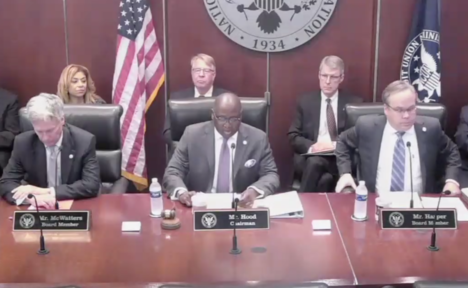
The NCUA Board at its June 20 meeting.
For McWatters, it is the third time he has voted on the risk-based capital rules, having initially cast the dissenting vote in a 2-1 vote, before joining then board member Rick Metsger in 2018 in voting in favor of the Jan. 1, 2020 implementation date (which was pushed back one year) while he was chairman, and then voting in favor of delaying it again at today’s meeting.
As it stands, if the Jan. 1, 2022 date remains in effect, only Hood will still be on the board. McWatters’ term expires later this year, while Harper’s term is to expire in April of 2021.
During his comments Harper stressed that the risk-based capital requirements—from which credit unions under $500 million in assets, or 90% of all CUs are exempt—will trail other banking agencies by a decade should the rules finally go into effect in 2022.
In a statement, the agency said based on Call Report data from the end of 2018, if the NCUA’s risk-based capital rule were to go into effect today, 545 complex credit unions would be subject to its requirements, but it added more than 99% of all complex credit unions would be considered well-capitalized.
The agency’s Prompt Corrective Action regulations remain in effect.
During the meeting, Hood also said he intends to ensure a proposal related to subordinate debt is put forward by the NCUA board before the end of 2019.
NCUA staff told the board they support the delay for several reasons, including providing more time to take into account changes involving credit unions using subordinated debt for capital standards, and also providing additional opportunity for the agency to research and evaluate asset securitization. Staff said time is needed to explore what supervisory regulatory framework needs to be put in place, and that standards will need to be modified to account for the change.
Agency staff told the board the “incremental risk of the two-year extension is manageable.”
‘Key Priority’
In his comments, Hood said that when he became chairman several months earlier he had identified several key priorities, including protecting the safety of credit unions and the Share Insurance Fund.
“The Federal Credit Union Act requires us to maintain a system of prompt corrective action that's based on its net worth,” said Hood. “The act also requires us to retain requirements for those institutions we deem to be complex credit unions. These are serious responsibilities which we must faithfully uphold and I would be derelict if I did not do so.”
Hood said the credit union system is vibrant, prosperous and enjoying net worth of 11.3%, which he said makes it a “good time” to reevaluate the RBC proposal, especially around subordinated debt and secondary capital for certain CUs. “It seems self-evident to me we would ensure the authorities are in place before it goes into effect,” he said.
Hood said he also wanted to comply with congressional direction that regulators provide simpler ways to comply with capital standards if strong capital levels are maintained. “It has the real potential to be a win-win for credit unions and the Share Insurance Fund,” said Hood.
‘Surgical Approach’
Hood also stated effective capital requirements, including, risk-based capital standards, are not a panacea for safety and soundness. He added that capital standards are to work in tandem with standards for liquidity and risk management, and that NCUA should take a “surgical approach” to look at the issue further and that it can do so without creating “undue risk.”
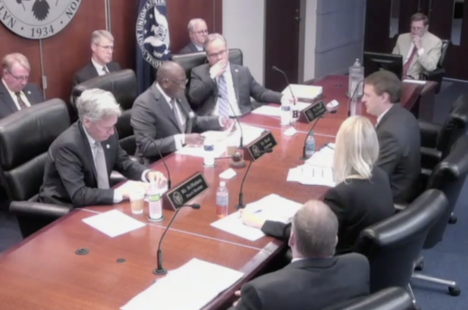
NCUA staff address board at June 20 meeting.
During a Q&A, Fazio told Hood the additional two years will give the agency time to consider “other improvements” to the RBC rules that can be deployed in a “well-sequenced” fashion. Fazio added the delay would also give NCUA time to look at rules in place for community banks.
Fazio said NCUA has identified five credit unions that have a capital deficiency and which represent a risk of $50 million to the insurance fund over the next two years, a risk he said is “manageable.”
Fazio also said no changes need to be made in order to comply with CECL.
McWatters’ Statement
McWatters asked Fazio, why, if risk-based capital is needed, a delay in capital requirement doesn’t pose “some sort of danger” to the NCUSIF?
Fazio responded by again saying it may have an effect, but it is an “incremental risk” that can be managed, as risk-based capital does a “better job with a certain class of credit unions in terms of having higher minimum requirements than the current system in place.”
McWatters also pointed to a CBO study, reported by CUToday.info here, that found in 2018 credit unions could face significant losses as the result of delaying or even eliminating the risk-based capital rules.
Fazio responded by saying some of the CBO findings were based on data from the financial crisis, and that the forecast was reasonable at the time but isn’t any longer.
Regarding his own history on the RBC proposal, McWatters said his earlier dissents were based on his view the rule violates the FCU Act, which he said remains an issue he’s like to see reviewed.
Harper’s View
Board Member Harper was the last person to speak on the issue, but his comments and questions took approximately half the meeting’s time. At the heart of his comments and his own dissenting vote were questions around why NCUA is taking so long to enact a rule other agencies implemented long ago, why NCUA staff seem to now be making statements at odds with statements made to the board earlier, and why a rule that affects so very few credit unions continues to be delayed.
‘In terms of this RBC effort we are forgetting the past repeatedly, like the characters in Groundhog Day,” said Harper. “After a decade of work, it is time for us to move ahead.”