

ALEXANDRIA, Va.–In response to court rulings, the NCUA board has voted 3-0 to amend its final rule on its FOM Chartering Manual, with one board member raising concerns over how competitive the federal charter is when compared to state charters.
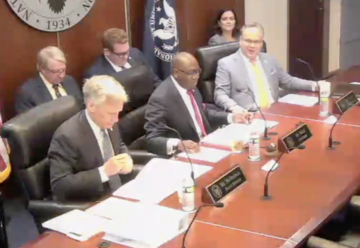
L-R: Mark McWatters, Rodney Hood, Todd Harper
The board was directed by the U.S. Court of Appeals for the D.C. Circuit in August to provide greater clarity and guidance around its rules allowing for expanded fields of membership for federal charters. That court’s decision, along with a lower court’s decision, were in response to a lawsuit filed by the American Bankers Association over the FOM rules.
The ABA has filed a petition for rehearing in the case, with NCUA’s response due Nov. 21.
In those decisions, NCUA and credit unions largely won on nearly all provisions, but the courts and other parties raised concerns that the way the rules were proposed would allow credit unions to essentially engage in redlining by not being required to serve the cores of statistical areas, which are often lower-income urban areas.
What the New Rules Do
In 2016, NCUA’s new rules approved FCUs to serve:
- Combined statistical areas of up to 2.5 million people within any contiguous portion of a “combined statistical area” recognized by the Office of Management and Budget (OMB).
- Core-based statistical area of up to 2.5 million people in a “core-based statistical area,” an OMB- designated area that includes an urban core and one or more adjacent counties, even if the core is excluded from a credit union’s field of membership.
- Adjacent areas of up to 2.5 million people in an area adjacent to and including part of a single political jurisdiction, qualifying combined statistical area or qualifying core-based statistical area.
- Rural districts of up to one-million people in an area where either at least 50% of the population resides in units the United States Census Bureau designates as “rural” or the population density does not exceed one hundred persons per square mile.
The Appeals Court ruled NCUA has authority to make the decision it made. But the court also remanded the portion of the rule—without vacating it entirely—that addressed core-based statistical areas “for further consideration of the discriminatory impact it might have on poor and minority urban residents.”
Rule Reinstated
Under the updated rule passed by the board, the combined statistical area definition was reinstated as was additional explanation around when the core of certain statistical areas can be excluded from a field of membership.
‘Phased Approach’
Prior to the vote, NCUA Chairman Rodney Hood repeated a point he has made previously, which is he intends for NCUA to take a “phased approach” to implementing the Circuit Court’s decision.
Hood said there are two objectives with the expanded FOM rules: increasing access to people of financial means, whether in rural or heavily populated areas, and providing greater flexibility for both FCUs and members.
“I want to emphasize I take access to financial services very seriously, and I am pleased this rule will clarify and enhance that,” said Hood.
Federal Charter Competitive?
While he did vote in favor of the new rules, NCUA Board Member Todd Harper said he remains concerned over the competitiveness of the Federal Credit Union Act, stating, "Today, of the 100 federally insured credit unions with the largest potential fields of membership, only eight are federal credit unions. This statistical imbalance indicates that the federal credit union charter has fallen behind compared to the desirability of the state charter."
Harper also said he has concerns around whether credit unions are complying with fair lending rules, and said he continues to want to see NCUA fund a robust consumer compliance program.
In response to a question raised by NCUA Board Member J. Mark McWatters, who is an attorney, over whether NCUA’s response meets the expectations of the courts, agency staff replied in the affirmative.
CUNA's Stance
CUNA said NCUA's proposal is "consistent with Chairman Hood’s stated approach to implementing the D.C. Circuit Court of Appeal’s ruling, and we thank the agency for moving quickly to address this issue. We have long supported NCUA using the authority granted by Congress to ensure credit unions are able to serve members throughout the country, and look forward to sharing our feedback with NCUA," stated Elizabeth Eurgubian, deputy chief advocacy officer and senior counsel.
NASCUS Response
In response, NASCUS CEO Lucy Ito, "While the proposed rule only applies to federally chartered credit unions, NASCUS appreciates NCUA’s efforts to strengthen the Federal charter by widening access to financial services for members of modest means and providing greater choice and flexibility for consumers and federal credit unions. We have long held that a competitive Federal charter is essential for a strong dual charter system, that benefits all credit unions – both state and federal.”