

ALEXANDRIA, Va.–NCUA appears to be close to adding an “S”—for Sensitivity to Market Risk—to its CAMEL rating system, although Board Member Mark McWatters is pressing for additional details, along with input from credit unions, before it makes the change.
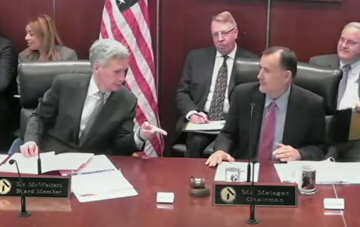
NCUA Board Member McWatters, left, and Chairman Metsger, right.
During a board meeting here at which the board voted in favor of two minor, technical additions to its regs, Chairman Rick Metsger hosted his second “Board Briefing” at which he and McWatters, along with NCUA staff, discussed an issue in front of the industry, in this case adding the S to the federal CAMEL rating system. All federal supervisory agencies other than NCUA added the Sensitivity to Market Risk measure to their ratings in 1997, and numerous state regulatory agencies currently include it.
During the briefing, NCUA’s director of the Office of Examination and Insurance, Larry Fazio, and others made clear they are in favor of making the change, which they said would primarily be an internal issue at NCUA that will help improve its ability to identify specific outliers when it comes to market risk.
Fazio noted significant changes have taken place in credit union size and complexity, with the number of CUs of more than $1 billion in assets up 500% since 2002.
“Credit unions have made important strides in improving their risk management platforms,” said Fazio. “Our supervisory approach for interest rate risk is in need of being updated.”
In 2012 NCUA implemented a rule requiring credit unions to have a written IRR policy and effective programs in place to manage the risk.
Reformatted Examination Guide
J. Owen Cole, Jr., NCUA’s director of Capital Markets, noted that the agency’s revised Examiners Guide has been reformatted for electronic use and is highly integrated with the new AIRES exam workbook, which uses a risk-based scoping approach.
“Our expectation is once this is fully implemented it should translate into a fairly limited exam for IRR for most CUs,” said Cole. He said the 3,700 credit unions under $50 million in assets will be able to use an automatically generated Net Economic Value (NEV) tool. Those between $50 million and $250 million will have a limited exam, while those over $500 million will have a full exam using the new standard, at least initially. Credit unions in that asset size group represent 72% of all assets insured by NCUA.
He said NCUA, as part of its research, has looked at CU NEV levels over the past two years involving 500 CUs greater than $100 million in assets.
“Non maturity shares represent more than 70% of today’s funding for credit unions,” said Cole. “So it is an inherent risk in most credit union balance sheet and income statements.”
Objections Anticipated
Cole said NCUA staff is already anticipating there will be some objections to a standardized test for interest rate risk, but it is necessary due to “significant underlying uncertainties.”

NCUA staff during agency meeting.
Cole noted that bank examiners have been measuring Sensitivity to Market Risk for some time and that he believes credit unions will benefit from the agency adding the measure to CAMEL, as well.
“The benefits are it increases clarity and transparency, enhances our trend analysis, and helps us improve our allocation of specialized resources,’ he said. “It presents a limited regulatory burden and is more of an internal issue for NCUA. It also aligns our approach more closely with how our peer bank supervisors are rating their institutions.”
He projected it would take several years for NCUA to fully implement the measure for federal credit unions. “At this time staff believes the increasing complexity does merit adding an S,” said Cole. “We believe it can be done smoothly and without significant disruption.”
The Q&A
During a Q&A following the staff presentation, Metsger noted how late the agency is in adopting the measure—and added that five more state supervisors are now making the move—and asked whether under the Administrative Procedures Act NCUA will be required to open the entire CAMEL system to review as a result of seeking to add the S measure.
Cole said it’s likely NCUA will need to do so, and Metsger concurred that it will likely happen.
Metsger then asked when would credit unions get specific guidance on the new IRR measure and change in CAMEL.
Cole responded by saying the plan would be to send a Letter to Credit Unions and attach to it excerpts of the exam scope questions and the guidance sent to examiners. “So there would be full transparency and credit unions can see what NCUA is telling its examiners and how they are to interpret the IRR implications,” said Cole.
The letter would be sent in late July or early August.
What Is Expected to Be Revealed?
And what will the new measure reveal? asked Metsger.
“Based on the very enviable level of capital we have in the system right now, nearly 11% net worth, and the complexion of our risk portfolios, the average level of risk is closely aligned with that level of capital,” answered Cole. “Our expectation is the number of credit unions rated low or moderate for IRR will be fairly substantial.”
Board Member McWatters, in noting that the agency has been working on IRR-related issues for some time, then asked, “If we have been at this for so long and have been so diligent, why are there any outliers today? Why do we need this new rule if we know where the outliers are?”
“We think these new procedures will do a better job of identifying these outliers and allow us to better focus on them,” said Fazio. “This will better calibrate to an enterprise view of risk, rather than the individual examiner’s lens of risk. It will provide better guidance on what (examiners) should do if they see higher levels of IRR. Just because a credit union has taken a high position of IRR, that doesn’t automatically equate to bad or unacceptable. What this does is calibrate our supervisory approach and how much time and energy we will spend in that credit union, making for a better allocation of our resources and reducing our footprint in that credit union.”
What About 'True Outliers?"
McWatters followed with a question about the term “true outliers.”
NCUA staff, board at meeting.
“That suggests that in the past we have identified something as IRR when it really wasn’t IRR, and we forced someone to sell an asset at a loss that they didn’t need to. It seems to me from what you’re saying today that under the NEV approach there will actually be less IRR in the system than there has been in the past.”
Fazio: responded by saying the risk in the system has not “objectively changed.”
But McWatters said he was dissatisfied with that response, reiterating that when he travels he often hears from credit unions lamenting that examiners forced them to sell assets and they are “apoplectic” as a result.
“It seems to me we’re putting a smaller number of CUs into the outlier category, so in the past we have put some in there that really weren’t there. It would seem to me we have a bit of a credibility issue, so I hope…we are thoughtful about this.”
“As to false positives, we certainly don’t want a credit union to take an action if it’s not necessary,” said Fazio. “We’re trying to be as accurate as possible in how we label that risk.”
'Scratching My Head'
All the discussion of the issue, said McWatters, has him “scratching my head and I am a little bit vexed that this IRR rule seems to be a fairly dramatic change. I have to wonder if IRR is truly a problem and if the better approach might be a regulatory approach where the community has a chance to comment. I’m not suggesting that. I would like to chat with you and get a better understanding of what this means. I don’t want a backdoor IRR rule that has not received the benefit of comment from the credit union community."
In response to a question from McWatters over what input the agency has sought out to date, Cole said it has assembled a credit union panel, a panel of state supervisory authorities, has beta-tested with 60 examiners using 90 CUs over $100 million, and has had discussions with some ALM vendors.
Also at the board meeting:
- The NCUA board OK’d technical amendments to Part 705 of its rules and regulations regarding its Revolving Loan Fund.
- The NCUA board OK’d a technical change to Part 747 of its rules and regulations related to civil money penalties and adjustments for inflation.