

ALEXANDRIA, Va.–The NCUA board has put out for comment a proposed rule related to credit union acquisitions of banks—although both Chairman Rodney Hood and agency staff stressed that credit unions do not technically purchase banks–with a focus on clarifying the process.
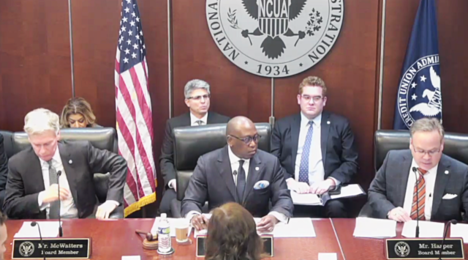
L-R: Mark McWatters, Rodney Hood, Todd Harper
The proposal is out for 60-day comment.
There have been approximately 30 such acquisitions of banks by CUs to date, and the agency indicated it has 17 pending applications for full or partial acquisitions of non-FICU assets and liabilities in its pipeline.
Formally known as Subpart D within Part 708a to establish requirements related to transactions where a FICU proposes to assume liabilities from an institution other than a credit union, the proposed rule seeks to “clarify and make transparent the procedures and requirements currently in place related to combination transactions,” NCUA said.
NCUA defines combination transactions as those where a federally insured credit union (FICU) proposes to assume liabilities from a non-credit union, including a bank. They also include a FICU’s merger or consolidation with a non-credit union entity. The new proposal also seeks to clarify the scope of section 741.8 of the NCUA’s regulations, which currently requires the NCUA to grant approval before a FICU may purchase loans or assume an assignment of deposits, shares, or liabilities from any institution that is not insured by the NCUSIF.
According to documents provided during the meeting, NCUA said it currently has nine transactions pending that include all of a non-FICU’s assets and liabilities, and has eight pending transactions that include part of a non-FICU’s assets and liabilities.
Chairman’s View
NCUA Chairman Rodney Hood said the proposal seeks to itemize the components of a complete application process and, among other things, ensures CU directors fulfill their fiduciary duties by certifying they received full information from management and do not have any conflicts of interest.
“When communities lose access to financial services providers it is like cutting off the oxygen to the local economy,” said Hood. “Small businesses suffer, jobs are lost and consumers, especially low-income households, are more likely to turn to less carefully regulatory predatory lenders,” he said.
Hood added the rule confirms former bank customers must be in a FCU’s field of membership before any transaction occurs, and that those customers must become full members of the credit union.
Examples Cited
Examples of expanded clarity under the proposed rule, according to Hood, include:
- Provides more information about what NCUA needs to approve transactions
- The rule lists the circumstances through which deposits qualify for coverage through the NCUSIF and explains process of becoming a member
- The proposal amends rules to include cross-references so it is clear which NCUA rules apply to transactions. “To be clear, these are not new requirements,” said Hood
- It incorporates the statutory factors the FCU act requires NCUA consider in approving or denying proposed transactions
“These transactions represent the free and open market system at work,” said Hood.
In speaking to staff presenting the proposal, Hood said “media descriptions” refer to such acquisitions as a credit union buying a bank, and asked if that is really true.
“It’s a catchy tagline,” responded Elizabeth Wirick, senior staff attorney. “The reality is a bit more nuanced. Credit unions cannot own banks or own bank stock. What is happening in these transactions is the credit union is assuming the liabilities of and purchasing the assets of the bank. The stock is redeemed and paid out. The credit union does not end up with the bank stock or the bank charter.”
Other Board Views
NCUA’s two other board members also weighed in on the proposal. Here’s what they had to say:
“This increase in deals has led some to suggest credit unions are abandoning their founding mission in the name of expansion and are risky,” said NCUA Board Member Todd Harper. “Those notions are misguided at best and misleading at worst, because we all know it takes two to tango. In fact, these deals suggest that banks whose assets are acquired by credit unions tend to be smaller and often with limited growth prospects. In addition, credit unions tend to enter into these deals to take advantage of economies of scale and provide services to underserved communities and deepen market footprints.”
Harper said he specifically requested guardrails be included in the proposal, specifically around ensuring board members certify they have no pecuniary or personal interest in a transaction, as any such self-dealing “would not only be a black eye on the credit union system, but it would also fly in the face of the credit union mission if a member of the board would personally benefit financially from these transactions…”
Hatfields & McCoys
NCUA Board Member J. Mark McWatters said his four decades of experience as a corporate and tax attorney and CPA make it “clear” market forces are driving the deals, which he said are often misconstrued by others. Some people, he said, have suggested “credit unions are using their tax exempt status as a means to gobble up community banks like a game of financial Pac-Man.”
McWatters added that any claims the playing field is not level due to the CU tax exemption do not take into account all of the limitations placed upon credit unions and are “inconsistent with the law.”
“In closing, I must admit the endless Hatfield McCoy carping between credit unions and community banks has grown with little purpose except perhaps as a marketing tool for some,” said McWatters. “Instead these financial institutions should acknowledge their future viability is not so much threatened by the other, but will rest and how they respond to the economic and operational challenges” they face.
CUNA Response
Following the board vote, CUNA released a statement saying, “As the specter of bank branch closures continues to threaten communities across the country with the prospect of becoming a banking desert, we absolutely stand behind credit unions reaching out to ensure that these communities retain access to local financial services. We look forward to reviewing the NCUA’s guidance on this topic, and offering our feedback on how to best equip credit unions to advance these communities.Between 2004 and 2018, banks have closed over ten thousand branches, creating a net loss of 1,700 bank branches—as well as 86 new banking deserts—making it more difficult for U.S. consumers to access local financial institutions. CUNA maintains that consumers benefit by gaining access to strong, responsible community-focused financial services."
NASCUS Response
In response, NASCUS CEO Lucy Ito said, "A credit union makes a business decision when deciding whether to acquire a bank. The role of state regulators and NCUA is to ensure that the resulting entity from a credit union’s acquisition of a bank is safe and sound and adequately capitalized. For state-chartered credit unions, NCUA’s authority should be limited to safety and soundness concerns and should not extend to governance questions which are the purview of state regulators. We are still reviewing the proposed rule to determine its impact on the state credit union system and look forward to engaging with NCUA to offer insights, as state agencies have evaluated a greater number and variety of these transactions.”
NAFCU Response
“When a credit union is approached by a selling bank seeking to merge, credit unions go through rigorous steps in order to make the best decision for their members and the local community,” said NAFCU Executive Vice President of Government Affairs and General Counsel Carrie Hunt.“We appreciate the NCUA’s commitment to market driven combinations for credit unions, and we look forward to commenting on the proposal.
"It is also important to note that if a bank-credit union sale is approved, the credit union remains a credit union and keeps its structure. It is subject to strict statutory prohibitions and limits on powers as set out in the Federal Credit Union Act. This includes field-of-membership requirements, business lending caps and capital limitations.”