ALEXANDRIA, Va.—The NCUA board Thursday, by a 2-0 vote, approved a proposed rule that would raise the threshold for commercial real estate loans needing appraisals to $1 million from $250,000.

L-R: Mark McWatters, Rick Metsger
The rule—out for a 60-day comment period—was primarily proposed, the agency said, to deliver regulatory relief to credit unions.
In April, the Federal Deposit Insurance Corporation, Federal Reserve Board, and the Office of Comptroller of the Currency jointly adopted appraisal changes for banks. Matching up the proposed rule with the new banking rules, Board Chair Mark McWatters agreed that the change would provide “substantial” regulatory relief to credit unions, while at the same time not exposing credit unions to undue risk.
NCUA Deputy Director Tim Segerson concurred. He noted that the rule change would significantly decrease the number of credit union commercial real estate loans requiring an appraisal.
“With the threshold raised, the number of loans exempted would increase from 27% to 60%, but the total dollar amount is relatively small, and would not expose credit unions to undue risk,” Segerson said.
Board Member Rick Metsger addressed a possible outcome of the proposed rule, that if made final, could create some issues for credit unions. Metsger noted that in part the proposal was drafted to help credit unions in rural areas in which there a limited number of appraisers, that are overworked, avoid any loan delays.
“But if I make my living as an appraiser in these areas now, and there suddenly is less business for me, do I move into the city where there is more business?” asked Metsger. “That, then, may still make it difficult for credit unions in rural areas to get an appraisal on a property if there are fewer appraisers.”
Larry Fazio, director of examination and supervision, said the agency does not foresee that issue occurring.
“This could lower the demand for appraisals in rural areas,” Fazio told the board. “But our analysis suggests there will still be robust business for appraisers.”
Metsger then asked if more appraisers did move out of rural areas, would it then cost credit unions more—pay a premium—when they had to get an appraiser from a nearby city to come out to do the work.

Redell Jones
“I will be curious to see if this alleviates a problem or exacerbates it,” Metsger said.
NASCUS Response
In response to the proposal, Lucy Ito, president and CEO of the National Association of State Credit Union Supervisors (NASCUS), issued a statement saying, "NASCUS commends NCUA for proposing a rule that would provide relief to credit unions by increasing the threshold for which appraisals would be required for commercial real estate transactions, incorporating S. 2155’s relief for rural communities, and restructuring the regulation to make it easier to determine what is required. NASCUS will be analyzing the proposal -- consulting with member state regulators and state credit unions -- to identify additional opportunities for the agency work with state supervisory agencies to provide relief while protecting safety and soundness."
In Other Business
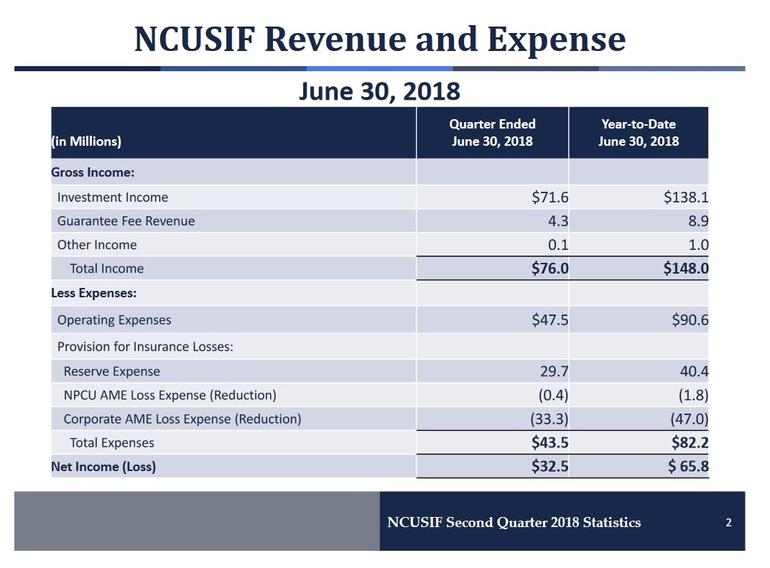
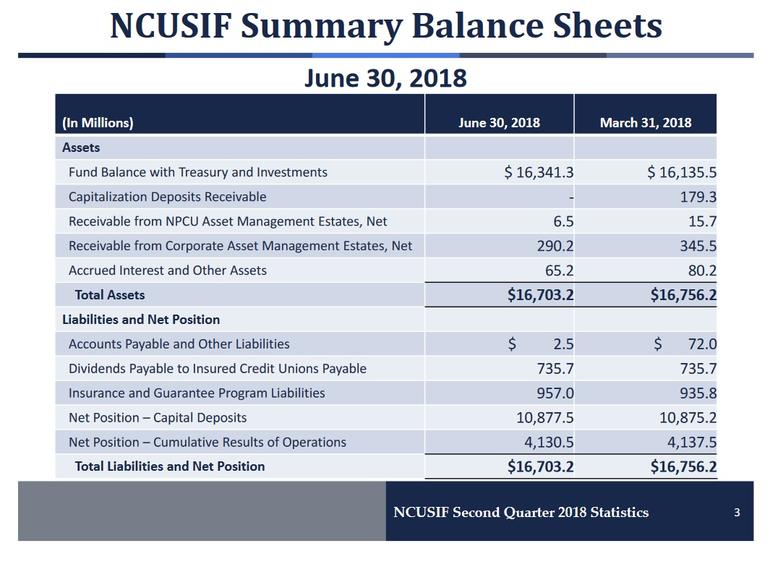
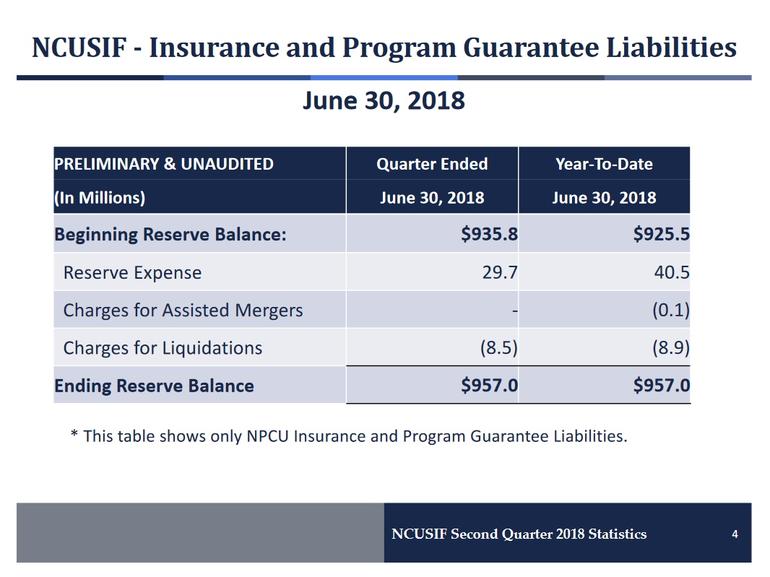
The National Credit Union Share Insurance Fund posted a net income of $32.5 million in the second quarter of 2018, primarily due to the strong investment income earnings. The Share Insurance Fund’s net position remained at $15.0 billion. As of June 2018, the calculated equity ratio is 1.35%, based on insured shares of $1.1 trillion. Second-quarter investment and other income was $76.0 million. Operating expenses were $47.5 million. The provision for insurance losses decreased overall by $4.0 million, NCUA reported.
For the second quarter of 2018:
- The number of CAMEL codes 4 and 5 credit unions increased 5.0% from the first quarter of 2018 to 210 from 200. Assets for these credit unions increased 40.2% from the first quarter of 2018, to $12.9 billion from $9.2 billion
- The number of CAMEL code 3 credit unions declined 2.1% from the first quarter of 2018 to 1,032 from 1,054. Assets for these credit unions increased 3.3%from the first quarter of 2018, to $59.3 billion from $57.4 billion
Three federally insured credit unions failed through the end of the second quarter of 2018, compared to two through the end of the second quarter of 2017. Total losses associated with credit union failures are $1.5 million through the end of the second quarter, compared to $3.8 million through the end of the second quarter of 2017, NCUA said.
Texas Member Business Lending Rule
The board Thursday approved a request from the Texas Credit Union Department to revise its member business lending rule to provide parity with the NCUA’s rule. Under the NCUA’s rule, states that wish to have their own versions must receive board approval. The NCUA board originally approved the Texas member business lending rule in 1999 and has approved subsequent changes, most recently in December 2016, the agency noted.mThe revised Texas rule will apply to both federally insured and privately insured, state-chartered credit unions in Texas, NCUA said.