ALEXANDRIA, Va.—At its board meeting this morning, NCUA has voted in favor of a final rule on involuntary liquidations and also put out for comment a proposal for a second type of payday alternative loans (PALs) program being called PALS II.
But what may be of most interest to federally insured credit unions was a statement by a member of the NCUA staff who indicated credit unions could see their NCUSIF distribution as early as July of this year. As the result of the merging of the Temporary Corporate CU Stabilization Fund into the National Credit Union Share Insurance Fund, NCUA will be returning some $735.7 million to federally insured credit unions.
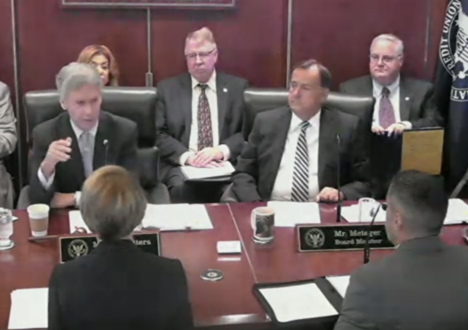
NCUA Chairman Mark McWatters and Board Member Rick Metsger at board meeting.
PALS Proposal
The payday alternative loans (PALS) proposal that is out for comment would create a second type of loan that would make it easier for a credit union to extend credit and for certain borrowers to qualify.
Under the proposal for PALS II:
- The membership requirement of one month would be eliminated
- Loan amounts of up to $2,000 would be permitted and the minimum loan amount of $200 under PALS I would not be required
- Loans would have a maximum term of 12 months
- FCUs would be permitted to make loans to any one borrower with no restrictions on number of loans. However, a loan would need to be fully repaid before the FCU can make another loan to that borrower
Where there is some minor complication is that under current BCFP rules, PALS I loans fall under that agency’s “safe harbor” provisions. PALS II would fall under the exemption for credit unions under BCFP rules and, as NCUA Chairman J. Mark McWatters noted, there is a difference between a safe harbor and an exemption, as the latter requires additional compliance.
But NCUA staff, in response to a question from McWatters, said any such compliance burden would be “relatively low” and would require the FCU to have to have policies in place that are already required, with some additional record-keeping requirement requirements.
McWatters and Board Member Rick Metsger said they plan to send a joint letter to the Bureau to seek additional clarification around the PALS II proposal.
In inviting feedback on the proposal, which is out for 60-day comment, McWatters said the plan right now is in the “sausage-making stage,” but the objective is to “end up with something simple for credit unions to implement.”
According to NCUA, at year-end 2017 there were 518 FCUs offering PALS loans, with 190,000 total loans outstanding and $13.3 million in outstanding loan balances.
Liquidation Claims
The board voted 2-0 to update and clarify its involuntary liquidation procedures by amending the current rule's payout priority provision relating to severance claims. The change would clarify the application of the NCUA's regulation on golden parachute payments to severance claims submitted by employees of liquidated credit unions.
In remarks to the board, staff said it would allow severance claims in cases where the claim is supported by documentation, such as a written handbook, and where it is calculated in a way available to all employees.
Quarterly Report on the NCUSIF & Payout Update
The NCUA board also received a report offering a quarterly update on the health of the NCUSIF. The big issue of interest for many CUs is when they might see their so-called “corporate rebate” on funds paid into the TCCUSF. NCUA staff confirmed the payouts will be made in the third quarter and could come as early as July.
As for the NCUSIF:
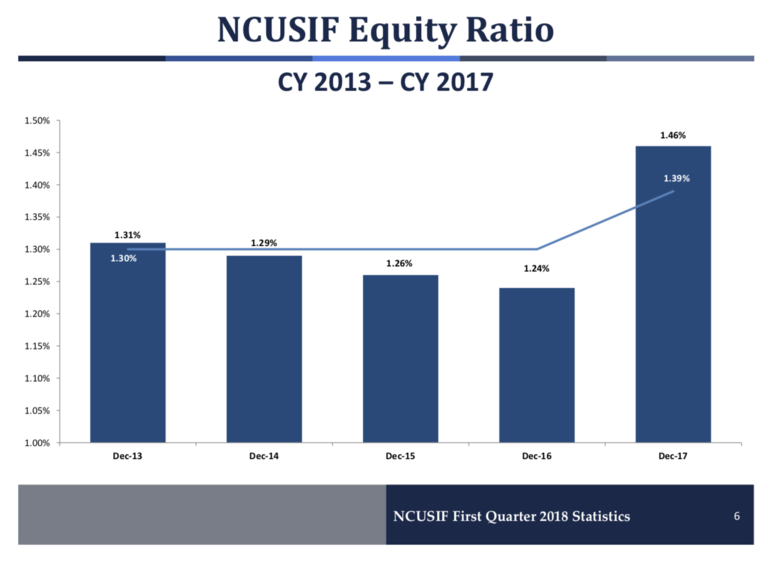
- For Q1, the NCUSIF reported $33.1 million in net income. The fund holds $16.75 billion in total assets. The equity ratio is currently at 1.46%.
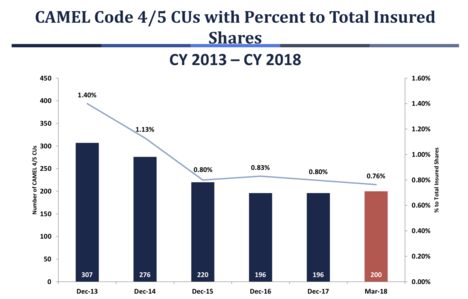
- The total shares in credit unions rated CAMEL 4 or 5 is $8.3 billion. There is one credit union of $1.4 billion currently rated as a 4/5. There are three credit unions between $500 million and $1 billion in assets that fall in the category.
- As of March 31, there were 1,054 credit unions rated CAMEL 3, which represent 4.65% of total shares insured, or $55 billion.
- There have been two credit union failures to date at a cost of $1.2 million; there were 10 in 2017 at a cost of $24.4 million. Fraud was not identified as the cause of the 2018 failures; it was the reason for three of the 10 failures last year.