

WASHINGTON–In testimony during his confirmation hearing before the Senate Banking Committee, NCUA Board Nominee Kyle S. Hauptman outlined what he said would be his three priorities while on the board.
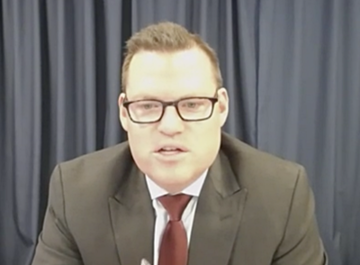
Kyle Hauptman
Hauptman said he would be focused on managing the fallout from the current pandemic, expanding technology’s role in reaching the underserved, and aligning incentives to promote sound credit union performance. The priorities were submitted in writing ahead of yesterday’s hearing.
Prior to offering his remarks during the virtual hearing, Sen. Sherrod Brown (D-OH) noted the confirmation hearing was taking place on the 10th anniversary of passage of the Dodd-Frank Wall Street Reform Act, which was precipitated by the collapse of Lehman Brothers, the firm at which Hauptman was working at the time. Brown said Hauptman has “spent his career railing against Dodd Frank.”
Brown expressed concerns the Trump Administration has been “chipping away” at rules NCUA had previously put in place to protect consumers, saying “now is the time for even stronger protections.”
Affinity Not a Qualification
Citing Hauptman’s written statement, Brown added that the NCUA board nominee had said in part he wants the job because members love credit unions. Brown said appreciation of members’ affinity for CUs doesn’t qualify someone to be an NCUA board member, it qualifies them to be a credit union member.
Senate Banking Chairman Mike Crapo (R-ID) asked Hauptman about his priorities. Hauptman responded by saying effective response to the coronavirus pandemic is number one, including the health and safety of NCUA employees and all credit union employees. He said he also wants to ensure all tools are made available to restructure debt, and further said lessons are being learned during the pandemic about providing remote delivery of services that could be used in serving remote and underbanked communities.
Hauptman is quite familiar to members of the committee. He currently is staff director of the Senate Banking Committee’s economic policy subcommittee, and also serves as economic policy advisor to Sen. Tom Cotton (R-AR), who is a member of the Banking Committee and who used his allotted time to give Hauptman a strong endorsement.
What About CECL?
In response to a question about CECL and capital, Hauptman responded by saying his priority is capital, capital, capital, capital, the “holy grail.”
In terms of CECL, he said he is aware if the new rules go into effect it will require credit unions to write down certain assets, even though capital levels didn’t really deteriorate. He said he fully understands CECL’s effects are an accounting issue.
As CUToday.info has reported, Hauptman has been nominated to fill the seat currently occupied by agency Board Member J. Mark McWatters. McWatters’ term expired in August of 2019. If confirmed by the Senate, Hauptman would serve the remainder of a six-year term that ends in August 2025.
An Opportunity to ‘Help’
In his opening statement, Hauptman, a native of Maine, says he views the position as an opportunity to help “more than 120-million credit union members achieve their financial goals. And if you encounter someone who actually loves their financial institution, there’s a good chance you’re speaking to a credit union member.”
Hauptman noted that “Twelve years ago, I was a mid-level employee working in Asia for Lehman Brothers, and wound up losing my job, my savings and my work visa all due to management that didn’t fully understand the risks they were taking. That experience showed me first-hand the risks associated with liquidity, interest-rates and balance-sheet management. This perspective should be both valuable and somewhat unique on the NCUA Board.
The Three Priorities
In terms of his three priorities, Hauptman said in his prepared remarks and statement:
- Managing the fallout from the current pandemic and economic downturn. “Over 50 million people have filed for unemployment since March. While the 2008 crisis began in the financial sector and then hit Main Street, our current crisis may be the reverse. Credit unions were chartered to serve those of modest means, and I plan to work with them, the Board and Congress on solutions for those facing financial stress.”
- Technology. “The pandemic created a test case on how many things, such as this hearing, can be done remotely or online. I’d like to expand technology’s role in reaching the underserved. If we recall the litigation years ago about Blockbuster Video’s late-fees and market dominance, the ultimate solution was American startups like Netflix. While this analogy doesn’t perfectly align with credit unions, I’m convinced innovation can provide more inclusive financial services.”
- Aligning incentives. “As we know from the last crisis, we get what we incentivize. One excellent policy that serves as a model here is the less- frequent exam cycle for credit unions that get the highest marks on their NCUA exams for safety and stability. This policy lets regulators focus on more problematic credit unions, while the well-run credit unions strive to keep earning that benefit. This is policy where safety and soundness are well-aligned with serving members. Do this correctly, and we’ll combat poor-quality high-priced products with better, lower-priced ones.”
Future NCUA Board Scenario
A former member of the NCUA board, meanwhile, has offered some insights on what the future of the board might hold. Geoff Bacino, who served on the NCUA board in 2001, noted in his newsletter that if Hauptman is seated, it will set up an “interesting dynamic” should Joe Biden be elected president. Bacino pointed out current Board Member Todd Harper would likely be elevated to chairman in 2021. But Hauptman’s term is to expire in August 2025 and current Chairman Rodney Hood is to serve through 2023—both are Republican appointees—meaning a Chairman Harper would be in the minority.
“It would make for some interesting horse-trading, or it could mean the chairman of NCUA could see few, if any, of their proposals come to fruition,” wrote Bacino.
NASCUS Response
NASCUS stated the association is pleased Hauptman would prioritize the recovery from the COVID-19 pandemic. "We agree with the steps the current NCUA board has taken to provide credit unions with the flexibility to serve their members during these unprecedented times and are encouraged that if confirmed, Mr. Hauptman would work with Chairman Hood, Board Member Harper and Congress to ensure credit unions will have access to the tools necessary to continue serve their members as they contend with the fallout of the pandemic," said NASCUS President and CEO Lucy Ito. “We agree with Mr. Hauptman regarding the importance of capital to credit unions and welcome the opportunity to collaborate with him and the other members of the NCUA board as they consider a broader, more flexible subordinated capital rule that will both benefit credit unions and their members and protect the share insurance fund.”