

ALEXANDRIA, Va.–Three people representing CU trade groups testified during the NCUA Budget Briefing here, with all providing recommendations for additional changes by the agency, and one person asking the two NCUA board members to ask themselves three questions.
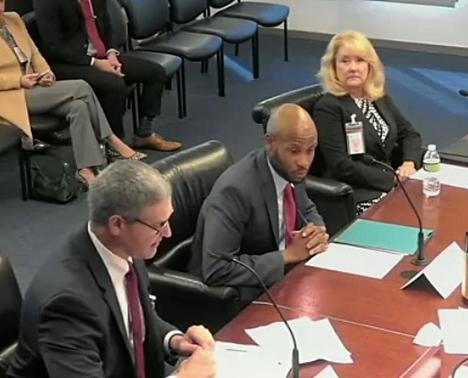
L-R: Mike Schenk, Shelton Roulhac, Jeanne Kucey
As CUToday.info reports here, the NCUA board members said the hearing was held as part of its ongoing efforts around greater transparency in its budgeting process.
Below is a look at what the NCUA board heard from the three witnesses:
CUNA’s View
Mike Schenk, chief economist with CUNA, told the board members “CUNA stood alone in advocating for these improvements – and – to your credit - the process, under the leadership of Chairman McWatters and Board Member Metsger, has been more transparent, more inclusive and the budget materials are easier to understand. Most importantly, direct linkage to the agency’s strategic plan is more clearly communicated and the budget is more obviously rationalized.”
Schenk said CUNA’s review of the budget justification and related documents indicates the agency is headed in the right direction, and said the proposed budget increase compares favorably to both increases in headline inflation and to increases in credit union operating expenses.
Reducing Staffing
In addition, Schenk noted CUNA has urged NCUA to decrease staffing and to reign-in fast-growing compensation outlays, and said the agency has been “receptive” to CUNA’s view, as manifested via a variety of changes that impact the budget through reorganization and needed updates to the examination process.
“Looking forward, we continue to believe that credit unions can and should play a more distinct, supportive and useful role in the agency’s merit pay process,” said Schenk.
Schenk said that while examiners spend a large percentage of their time interacting with the credit unions they supervise, feedback from credit unions on the performance of individual examiners – “to the extent it is collected at all - is obtained in a generally random fashion. The only formal feedback mechanism available is through the examination appeals process – but credit unions are loath to use that process mostly due to fear of retribution and a perception that the process is largely ineffective.”
For this reason, he said CUNA continues to support the agency funding an independent third-party review of field examiners.
While supportive of the reductions NCUA is making in staffing and in its regional offices, Schenk said CUNA still wants to see more budget detail around its Asset Management and Assistance Center.
Longer Exam Cycles (For All)
Schenk praised NCUA for the updates it has made to modernize its examination process, including the move toward implementation of an 18-month examination cycle for well-run credit unions. But he also noted the recently enacted Economic Growth, Regulatory Relief, and Consumer Protection Act (S. 2155) includes language that allows the Federal Deposit Insurance Act to increase the asset limit below which depository banks are eligible for an 18-month examination cycle (rather than a 12-month examination cycle) from $1 billion in assets to $3 billion in assets.
With the 18-month exam cycle in credit unions available only to those below $1 billion in assets, Schenk and CUNA called on NCUA to address this “regulatory disparity” with banks by moving to a similar threshold.
With regard to NCUA’s move toward electronic data modernization and on call report/profile content modernization, Schenk said CUNA is supportive of the efforts, but it also believes the agency’s Request for Information on data collection “applies a one-size-fits-all model to data collection that may be inappropriate for smaller credit unions, given the volume, quantity, and specialization of products and services offered, as well as technology resources and infrastructure constraints.”
The trade group said it is urging NCUA in data collection efforts to consider the impact that additional technology reporting and compliance would have on small credit unions’ ability to serve their members.
‘Confusing’ Changes
“The modernization efforts of the quarterly call reports as well as the Automated Integrated Regulatory Examination System (AIRES) are concurrent initiatives,” said Schenk. “As a consequence, many credit unions believe that the changes will be confusing – if not overwhelming – increasing rather than decreasing initial reporting burdens. While credit unions envision at least a one-year implementation timeline would be required to comply with the call report modernization requirements, there is also recognition that compliance with the anticipated AIRES data request changes would likely require a minimum of three years for processors to develop the tools, have them adequately tested internally and externally, and fully implemented, subject to examination.”
Schenk said CUNA fully expects the current proposed investments in capital, systems, and technology to lead to further improvements in efficiency, lower staffing levels, and additional relief for thousands of credit unions under NCUA supervision.
Other points made by Schenk on behalf of CUNA:
- CUNA expects the NCUSIF’s normal operating level to revert to the traditional 1.3% ratio.
- CUNA is urging the agency to adjust its funding of the Overhead Transfer rate and the Operating Fee accordingly and to address the fact that growth in the agency’s budget is “often obscured through changes to the OTR.”
The View From State Regulators
Testifying on behalf of the National Association of State Credit Union Supervisors (NASCUS), Shelton Roulhac, VP of communications at NASCUS, addressed three areas: continued evaluation of the Overhead Transfer Rate; funding to ensure better training around rules put in place by the Bureau of Consumer Financial Protection, and funding to ensure state supervisory agencies and NCUA adequately share information.
Roulhac said NASCUS supports recent changes made in calculating the overhead transfer, a long-time sore point between state and federal agencies, saying it “applauds” the principle-based approach taken.
In terms of access to training related to rules put in place by the Bureau, Roulhac said NCUA has historically budgeted for two training classes annually for state examiners, but that many have not been able to participate. He said NASCUS would like to see better availability of that training.
Finally, Roulhac said that as NCUA consolidates its offices it will become even more important that NCUA and state supervisors use technology to share information. “We urge NCUA to provide necessary funding to provide technology for the exchange of information,” he said.
NAFCU Testimony
Testifying on behalf of NAFCU, Jeanne Kucey, president and CEO of Jetstream Federal Credit Union in Miami Lakes, Fla., offered a number of specific suggestions around where the trade group needs to act or take further action.
Kucey said one “unfortunate” aspect of the proposed NCUA budget are increases for “contracted services.”
“Although it is a statement often repeated, every dollar spent by the agency is a dollar that credit unions are unable to put toward serving their members,” Kucey told the board.
She said that as a credit union CEO she is fully aware the agency needs a budget to execute on its responsibilities, but she also reminded credit unions are “constantly under attack by the very institutions that precipitated the worst recession since the Great Depression,” and that it is crucial credit unions have all the resources needed to respond.
“I caution you to stay vigilant to outside threats and to discover opportunities to promote sustained growth for credit unions,” said Kucey.
Credit unions need a strong NCUA, said Kucey, adding she and NAFCU are “not suggesting the budget be arbitrarily slashed.” Instead, she called on the agency to continue its efforts at reducing costs, especially duplication of services, and said NCUA’s ongoing desire to have oversight authority over third parties could “derail” those efforts.
Three Questions
Kucey asked the NCUA board members and the agency itself to ask itself three questions:
- Considering the proposed 2019 budget is a 71% increase over a decade ago, when does the NCUA envision seeing its budget showing a true long-term reduction?
- In a consolidating industry with a virtual supervision model, when, if ever, can the agency envision returning to the NCUSIF normal operating level of 1.30?
- What impact would third-party supervision have on the NCUA’s budget if such authority is ever granted?
Kucey told the board members that NCUA examines CUs, not assets, and suggested that balance sheet complexity has not reached a level that necessitates such a heavy regulatory hand that it no longer tolerates much risk.
Kucey praised NCUA for its efforts at budget transparency, and said in order to consider the trend in 2020, NAFCU is offering these recommendations:
- In 2017, NAFCU asked NCUA to extend eligibility for an extended exam cycle for all well run credit unions. “That appears to have positively influenced 2019 staffing levels. NCUA should take this one step further and consider extending an 18-month exam cycle to all well-run credit unions of more than $1 billion in assets.”
- NAFCU wants NCUA to consider ways to reduce expenses related to contracted services. “Contracted services for 2019 have seen the largest percentage increase relative to the 2018 budget,” Kucey said. “We worry that cybersecurity-related expenditures may be driving costs disproportionately and will continue to drive increases in the future. We also encourage NCUA to leverage the cybersecurity expertise of other regulators, including the FFIEC, to find a collaborative means of reducing cybersecurity expenditures.”
- Kucey said based on surveys conducted by NAFCU, many credit unions have yet to see a meaningful reduction in the number of examiners who come on site, and the trade group urges NCUA to ensure these reductions are actually occurring.
“Even though we believe the 2018 rebate was a good first step, we ask NCUA to focus on additional ways to return funds to credit unions and to return the NOL to 1.30% as soon as possible,” Kucey said. “A reduction in the normal operating level would be appropriate given overall improvement in the supervisory process.”