

ALEXANDRIA, Va.–With one board member saying he was doing so “begrudgingly,” the NCUA board has approved a final rule on the Complex Credit Union Leverage Ratio (CCULR) that sets a lower threshold than had been proposed and also sets out a new framework for Prompt Corrective Action (PCA) in 2022.
The rule has been in the works for two years, with NCUA staff saying CCULR (pronounced Cooler) provides a simplified calculation for complex credit unions to use in setting a risk-based framework. NCUA staff said the majority of credit unions will not have to raise their capital ratios as a result of the new rule, but two members of the NCUA board expressed concerns that as a practical matter credit unions using the CCULR standard will actually end up setting higher reserves than necessary at a cost to their members.
NCUA’s risk-based capital rule goes into effect in January 2022, but NCUA Board Member Rodney Hood saying CCULR at least provides an “off-ramp” for some.
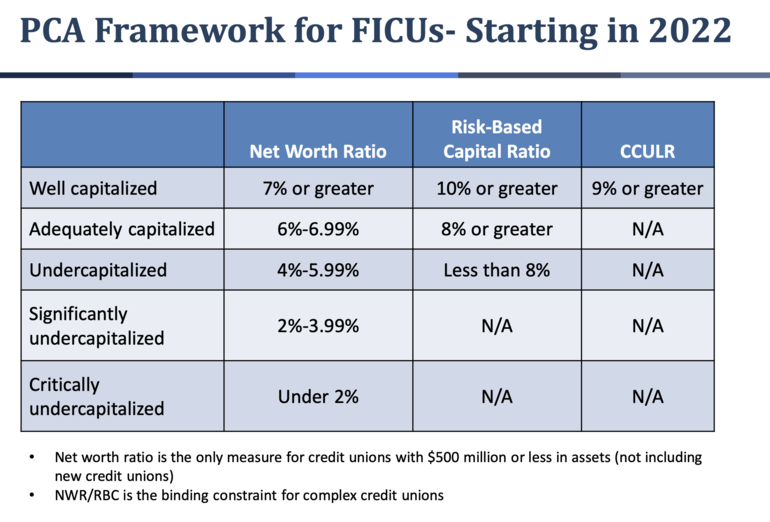
Under the new rules credit unions that are subject to RBC will be required to have a 10% risk-based (RBC) ratio to be well-capitalized, but CUs that are eligible can opt into the CCULR framework with a 9% net worth ratio and would not be required to calculate RBC ratios.
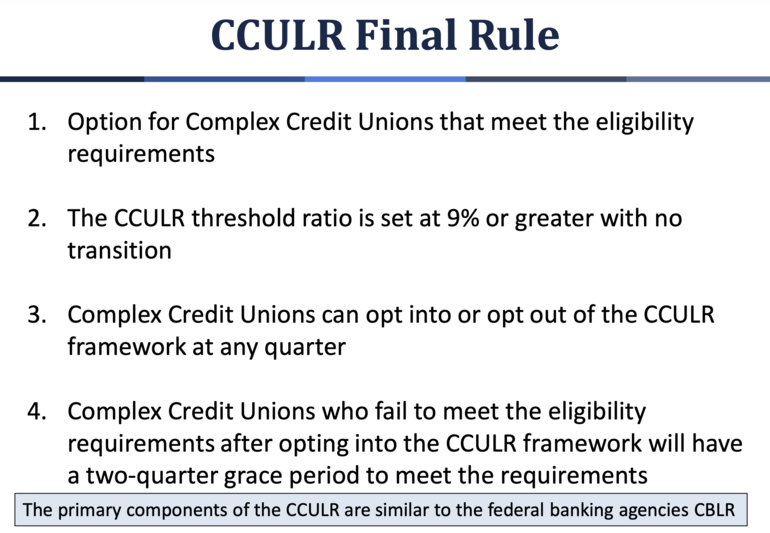
CCULR is an option for credit unions and not a requirement, according to the agency.
Four changes have been made in the final rule to the proposed rule, as shown below:
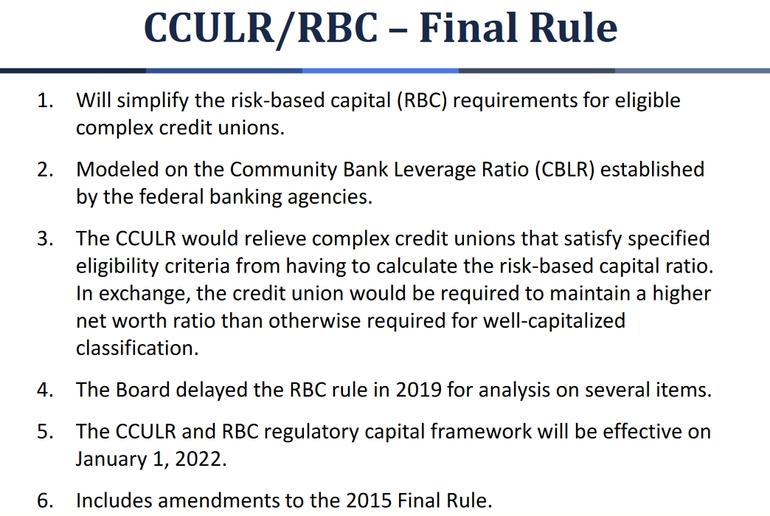
Four changes have been made in the final rule to the proposed rule, as shown below:
Starting in 2022, the PCA framework for credit unions is shown below:
Agency staff said that beginning in the first quarter of 2022 it will host webinars offering training, and staff will also be conducting outreach, training, and updating supervision guides.
Harper: Four RBC Standards & Greater Stability
NCUA Chairman Todd Harper said he has “long held that all financial institutions backed by federal deposit insurance, including federally insured credit unions, should hold capital equal to the risks held on their balance sheets. In the case of federally insured credit unions, if a credit union with greater risk fails, risk-based capital would help minimize losses to the National Credit Union Share Insurance Fund.”
Harper said the agency has a number of legal responsibilities when it comes to risk-based capital standards for credit unions, which “can be summed up in four words”: comparable, consistent, complex, and cooperative.
Harper said he believes the risk-based capital rule approved in 2015 met all those standards, and when finally implemented at the start of 2022 “it will provide the system with greater stability.”
“We must, however, also recognize several legislative, regulatory, and marketplace developments since the NCUA board approved the final risk-based capital rule in 2015,” Harper said. For example, in 2018, Section 201 of the Economic Growth, Regulatory Relief, and Consumer Protection Act directed the other federal banking agencies to propose a simplified, alternative measure of capital adequacy for certain federally insured banks. The result of that effort became known as the Community Bank Leverage Ratio framework, which became effective in January 2020.”
Harper noted the new Complex Credit Union Leverage Ratio for federally insured credit unions is comparable to the Community Bank Leverage Ratio.
“In essence, both standards seek to strike a balance among several objectives, including maintaining strong capital levels, protecting safety and soundness, and simplifying compliance. So long as an eligible credit union in the CCULR framework maintains the minimum net worth ratio, it would be considered well capitalized,” said Harper.
Harper added that he wanted the CCULR ratio to be set at 10%, while others wanted it set at 8%. He said the 9% ratio is the final rule is “just right.”
Hauptman: A ‘Holy Grail’ With a Caveat
NCUA Vice Chairman Kyle Hauptman, noting he has always called capital the “holy grail,” said it must nonetheless also be “appropriate.”

Hauptman said there are four reasons he is not a fan of risk-based capital:
- It's a political process by definition and political appointees from various countries advocate for whatever risk weightings most advantage that country’s institutions
- Risk weights that are appropriate for one institution may not be suitable for others
- RBC forces capital decisions today based on risk weights that may not be appropriate in the future
- RBC often doesn't work and it even produces the opposite effect being sought, such as in the European debt crisis
“I'll confess that I don't have an easy solution to offer except to say that some level of capital computed in a simple manner should be enough to allow a credit union to bypass the hazards that are inherent in risk based capital,” said Hauptman. “We have before us the complex credit union leverage ratio that is intended to provide a meaningful RBC alternative for well-capitalized, complex credit unions. It is a difficult process and it's a process that I know I didn't make any easier. This CCULR rule isn't exactly what I envisioned but it does offer a choice.”
As of Sept. 30 of this year, 71% of credit unions subject to RBC had a net worth ratio greater than 9% and will be eligible for the CCULR framework not withstanding any other eligibility requirements, noted Hauptman.
He added he believes a scenario will play out under CCULR that while the rule sets a 9% threshold, in practice most credit unions will set a “buffer” several percentage points above that point, which will lead to more capital being held by credit unions.
Hood: Calls for Repeal of RBC, Revisiting CCULR’s Effects
NCUA Board Member Rodney Hood noted both risk-based capital and the Complex Credit Union Leverage Ratio have long been priorities of his, saying, “The framing of the issue today is really about capital adequacy and credit unions have shown through history they have sufficient capital to serve members while facing various risks.
“I will readily acknowledge the Federal Credit Union Act requires the NCUA to maintain a system of prompt corrective action for federally insured credit unions that is based on an institution’s level of capital, that is, its net worth. Those levels are set in the Act,” said Hood. “The Act also requires us to maintain a risk-based net worth requirement for those institutions that are deemed to be complex credit unions. We have that now with a Risk Based Net Worth requirement.
‘Serious Responsibilities’
“The law gives this board serious responsibilities, which we must faithfully uphold. But this does not mean that since the bank regulators established a risk-based capital regime, we must follow them,” Hood continued. “I worry that once we decree that 7% may no longer be adequately capitalized, then whether this board of future boards settle on 8, 9, or 10% net worth in the Complex Credit Union Leverage Ratio, as some say in North Carolina, the barn door is now open. I worry that we have set an arbitrary standard above the law that a future board can change at any time.”
Hood called the RBC rule “very complex and burdensome. And that is why we have a CCULR rule, which will be an offramp to RBC, so long as credit unions with $500 million or more in assets hold 9 percent or more in net worth and meet some other qualifying criteria. The RBC rule is so tragic that, yes, we need an off-ramp.”
Hood said NCUA should not “dictate” that 9% or higher net worth is needed for complex credit unions over $500 million if they choose to opt out of RBC with CCULR, saying it should be thought of as a “regulatory tax.”
Like Hauptman, Hood said the practical result of the new rule will be credit unions reserving more capital than they actually need.
“I would be derelict and reckless in my responsibilities if I did not support a risk-based net worth requirement for complex credit unions ‘to take account of any material risks against which the net worth ratio required for an insured credit union to be adequately capitalized may not provide adequate protection’,” Hood said. “That is what the law requires. But I do not agree with the premise that the current capital regime has proven inadequate nor that we should throw out the current RBNW regime for RBC.”
A Call for Repeal
Hood said his current stance remains the same as it did when the proposed rule was before the board, “so I contend that after serious study and consideration, my preference is to consider repealing the RBC rule outright and fine tuning our existing Risk Based Net Worth rule.
“While RBC may require higher net worth ratios at so-called complex credit unions over $500 million based on how we risk-weigh their activities, we cannot assume that RBC would prevent a credit union failure and we cannot assume since risk itself evolves that the risk weights are fixed and set for all of time,” Hood continued. “If anything, RBC creates a moral hazard because we, as regulators, are weighting risk. We're giving a stamp of approval on the weights of risk, but we should recognize that since risk evolves, it's not stagnant. Risks will never be captured by formula to manage a balance sheet.”
As it is December 2021 and the rule goes into effect after the turn of the year, Hood said he was voting in favor of the rule “begrudgingly,” and called for the agency to monitor the outcome to see if the rule is really needed in the months and years ahead.