ALEXANDRIA, Va.–An update on the state of the National Credit Union Share Insurance Fund shows it remains healthy, with its balance sheet improving in part due to increased cash flows from certain corporate CU asset management estates.
NCUA board members had numerous questions for agency staff, including CFO Eugene Schied, related to the NCUSIF’s investment strategy during NCUA's open board meeting Thursday.
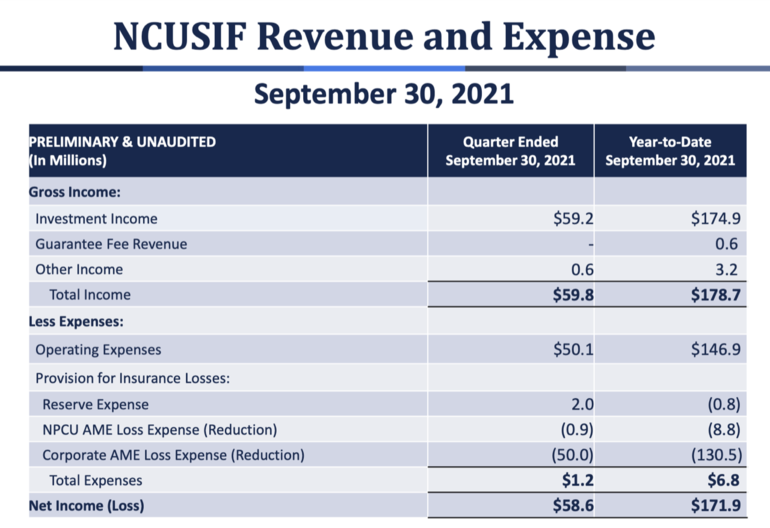
The NCUSIF posted net income of $58.6 million, primarily from Treasury holdings. Overall, total assets were up $1.1 billion in the NCUSIF to $20.914 billion as of Sept. 30, up from $19.8 billion on June 30.
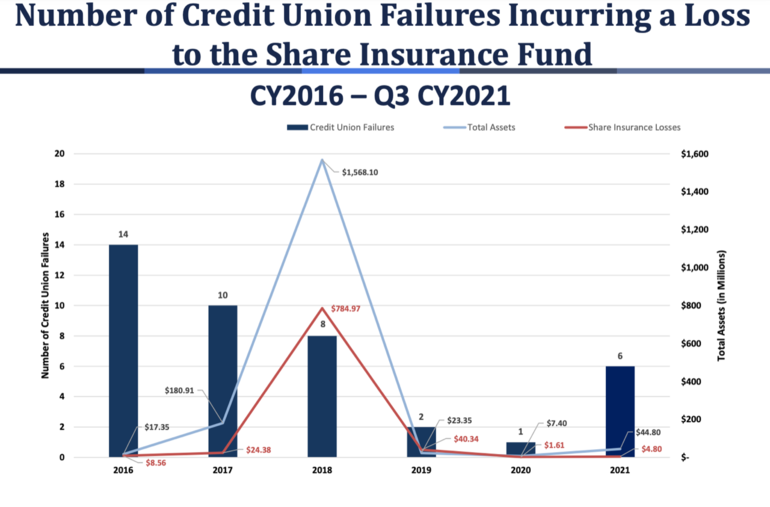
During the third quarter there were six credit union failures that led to losses for the NCUSIF, two of which were involuntary liquidations and two of which were assisted mergers. Through Q3, the NCUSIF has seen $4.8-million in losses due to those failures, three of which were the result of fraud, according to Schied.
The NCUSIF incurred one failed credit union during 2020.
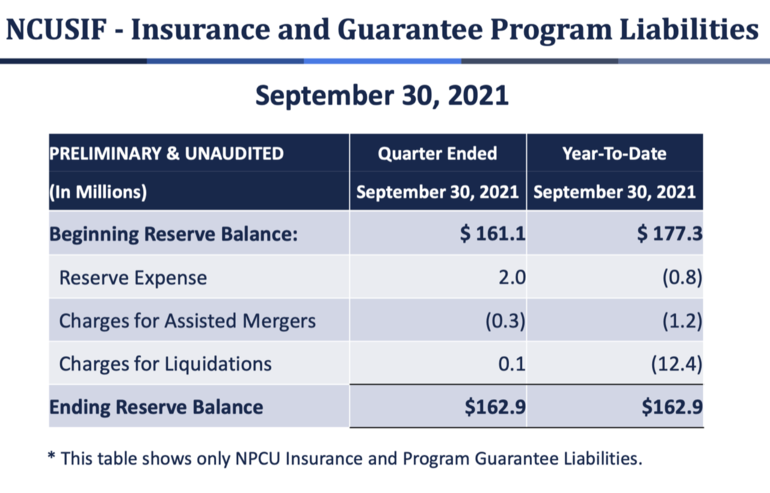
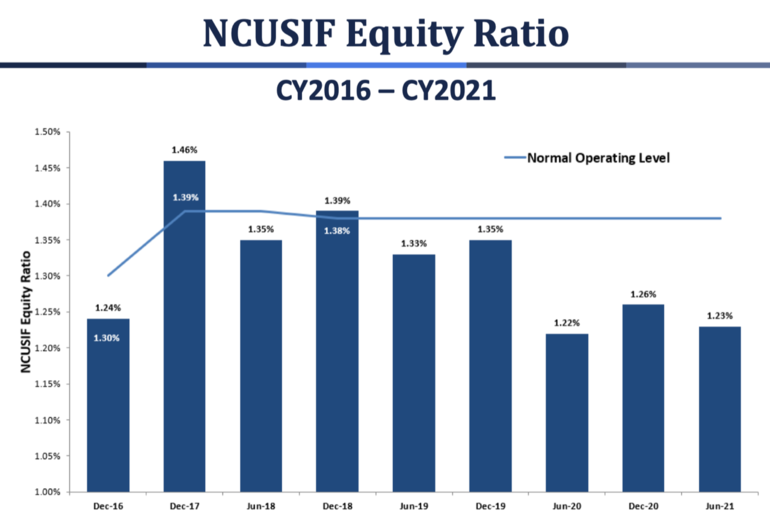
The fund’s equity ratio as of June 30, which is updated twice annually, was 1.23%, three basis points below where it stood at year-end 2020. The projection for year-end 2021 is 1.28%.
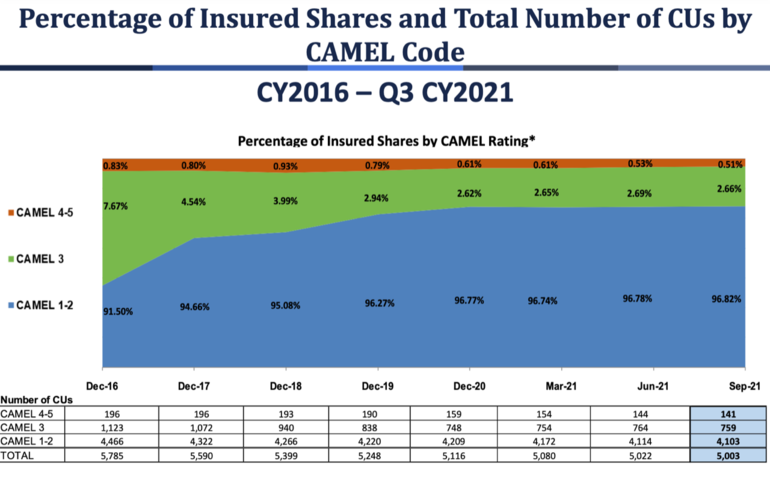
According to Schied, there were 141 credit unions that were CAMEL CODE 4-5 as of Sept. 30, while there are 759 CAMEL Code 3 CUs, and 4,103 in CAMEL Code 1-2 credit unions. The charts below break out the assets represented by CAMEL code.
Harper: Need for Caution Remains
NCUA Chairman Todd Harper noted that the Share Insurance Fund now stands at more than $20 billion in assets, almost double its asset size a decade ago, a strength he said “reflects the growth and stability of the credit union system over the last decade and the steady management by staff and oversight of the fund by this and previous NCUA boards.
“However,” added Harper, “I must caution everyone not to let their guard down. With the end of several pandemic-relief measures, many credit unions could see a rise in delinquencies and charge-offs as their members experience financial stress.”
Harper said that while the Share Insurance Fund is showing solid performance and the equity ratio is projected to rise to 1.28% at year-end, NCUA “must continue to monitor credit union performance and economic developments. Additionally, the stresses on the equity ratio from continued share growth, the low interest-rate environment, at least historically, and insurance losses remain.”
Hauptman: Good News, Review Pays Off
NCUA Vice Chairman Kyle Hauptman called the NCUSIF update “good news,” saying the “agency’s understandable concerns about the decline in the SIF’s equity ratio were balanced with restraint which allowed credit unions to focus on the needs of members. That isn’t easy for an insurer, but credit unions have consistently reminded us that what we do here has a direct impact on members.”
Hauptman noted that during the September board meeting he joined with Board Member Rodney Hood in asking staff for a review of the share insurance fund’s investment policies, and that with the fund crossing over the $20 billion mark that review remains critical.
Hood: Review of Investment Strategy is Important
Hood followed the NCUSIF update report by offering comment on the just-updated proposed NCUA budget for 2022 (see related story).
In terms of the NCUSIF, Hood noted the credit union deposit insurance model is a very different premium model than the FDIC’s model given insured banks do not submit contributed capital like credit unions, and that under the FCU Act, credit unions are legally committed and bound to update a large majority of the fund’s equity contribution –1% of the credit union’s insured shares.
“I have repeated this statement at previous NCUSIF quarterly board updates. Why do I believe it’s worth repeating this again? Because I believe it is helpful for all of us to remember that the one percent capital deposits – which comprise most of the Fund’s equity – is also an asset of the credit union,” said Hood. “Keeping this as our North Star only helps us be more effective stewards of the fund we oversee.”
Hood repeated a point he has raised earlier, that he believes the board should consider changes to the agency’s investment strategy and to make this strategy public, as in his view the NCUSIF investments serve three important purposes.
Three Purposes
Hood said those three purposes are:
- Manage funds to optimize yield to cover the operating costs of the fund
- Manage funds to ensure liquidity is sufficient for forecasted needs pursuant to Title II of the Federal Credit Union Act – meaning the board’s responsibilities as deposit insurer
- Manage funds to pay equity above the Normal Operating Level to credit unions, and ultimately the credit union member owners, as a dividend in addition to our principal obligation under the Act to provide for deposit insurance for credit unions including resolving and paying insured claims of failed credit unions
‘Greater Focus Needed’
After asking NCUA staff members several questions related to the NCUSIF investment strategy, Hood said, “As I consider our investment strategy, we should note that examining portfolios and managing investments in the portfolio are two different skill sets. The NCUA has over $20 billion in investments under management, so I think we should have an even greater focus on this during our Share Insurance Fund updates.”
Corporate Update
In response to a question from Hood, Schied said the corporate asset management estates have returned $1.4 billion in depleted member capital to credit unions through August of 2021. Schied said the current projection calls for an additional distribution of up to $1.1 billion could be distributed to credit unions.
The timing and amount of future distributions will depend on future performance, lawsuit settlements and other issues, said Schied.