ALEXANDRIA, Va.–The equity ratio of the National Credit Union Share Insurance Fund rose at year-end 2022 over the prior quarter, but there has also been an increase in the number of credit unions with CAMELS codes 3, 4 and 5, according to updated data provided to the NCUA board at its meeting here.
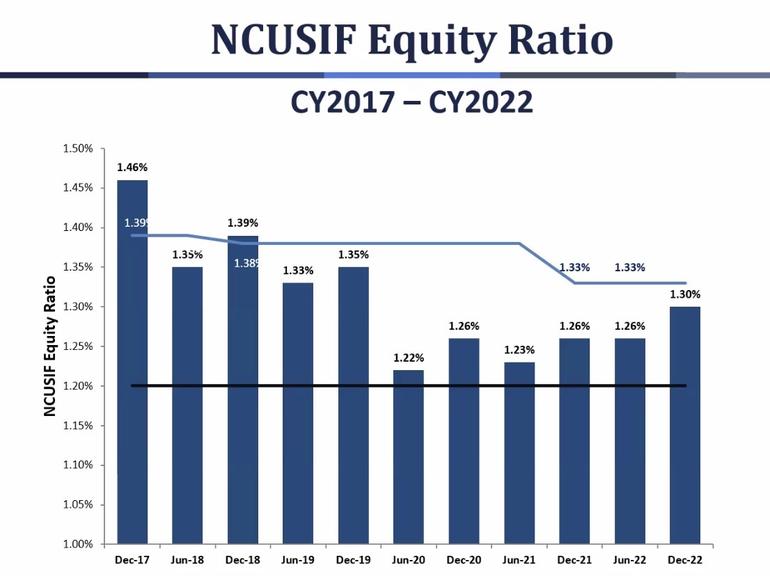
The insurance fund closed the year with an equity ratio of 1.3%, up from 1.26% one year earlier, due in part to deposit outflows. Some credit unions will also be seeing a distribution of approximately $220 million in March from funds recovered as part of the estates of the failed corporates.
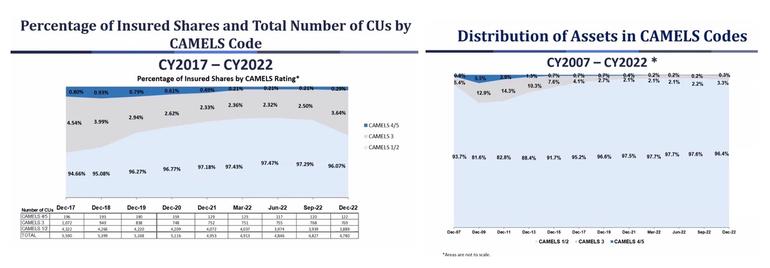
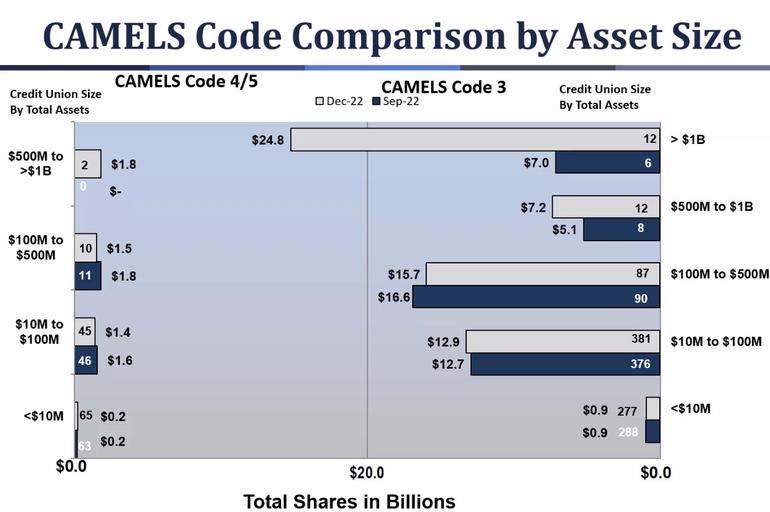
The NCUA board was told the vast majority of CUs in those CAMELS codes ranges are smaller, but it has seen a significant increase in the number of CAMELS code 3 credit unions, which stood at 769 at year-end, most are below $500 million in assets, according to NCUA CFO Eugene Schied.
There are two “large” CUs with CAMELS codes ratings of 4 and 5, according to the agency. NCUA staff said liquidity and interest rate risk are the most common reasons for downgrades in CAMELS codes.
Losses From Fraud
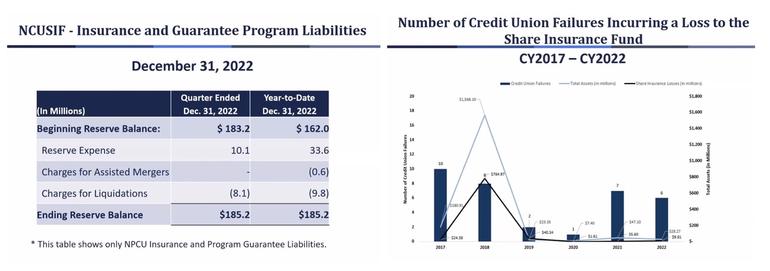
The NCUSIF took a hit from six CU failures at a total cost of $9.8 million during 2022, most of which were due to fraud, an issue several NCUA board members touched on in their remarks.
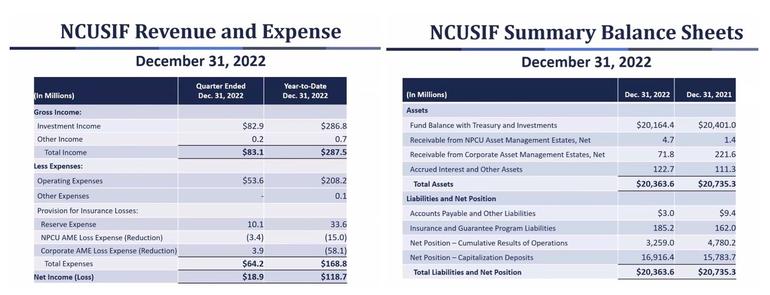
Schied outlined the performance of the fund, which has $20.735 billion in assets, as illustrated in the slides below. The fund reported net income of $118.8 million for 2022. It is increasingly holding more funds in overnights as rates rise, with a goal of getting to $4 billion in overnight investments by the fourth quarter, according to Schied. The agency currently has $1.67 billion in overnights, and the fund’s investments have an average weighted maturity of 3.25 years.
Details around the fund’s status as of year-end are shown in the slides below.
Harper: Strong Performance But Also ‘Internal Control’ Issues
NCUA Chairman Todd Harper, who noted that NCUA’s four funds each recently earned another unmodified or “clean,” audit opinion in 2022, the 40th year the funds have been given such a score, said the performance is worth noting as the economy has been through strains in recent years and yet the Share Insurance Fund has performed well.
“As noted earlier, the rise in interest rates increased the Share Insurance Fund’s income, a welcome departure from the low earnings we have seen during the last decade,” said Harper.
The chairman pointed out insured share growth moderated during the second half of 2022 as members drew down some of the savings, which has boosted the Share Insurance Fund’s equity ratio to 1.30% at year-end 2022, up from 1.26% at the end of 2021.
He further noted the fund’s assets, however, declined due to unrealized losses of approximately $1.5 billion during the year, which was expected. “That’s because as interest rates go up, the value of the bonds held in the Share Insurance Fund’s portfolio goes down,” Harper added.
The chairman pointed out that over the last few quarters the agency has seen growing stress within the system because of interest rate and liquidity risk.
“Additionally, we have begun to identify more instances of internal control problems at credit unions, which can lead to the uncovering of fraud, credit union liquidations, and losses to the Share Insurance Fund,” said Harper. “That is why some element of onsite examinations remains so very critical to identifying safety- and-soundness issues and risks to the Share Insurance Fund,” Harper continued. “Onsite exams facilitate discussions about how best to address liquidity and interest risk. Onsite exams also allow for better testing of internal controls and closer review of loan documents.”
More Downgrades Are Likely
Harper said that as the agency’s examiners return onsite — while continuing to conduct some portions of the exam process virtually — and as interest rates continue to rise, it is likely the industry will see more composite CAMELS rating downgrades in all asset classes.
“The NCUA board will, as such, closely monitor credit union performance in 2023 and take any necessary actions to maintain the stability of the system and ensure the strength of the Share Insurance Fund,” Harper said.
Harper expressed regret that Congress declined to make permanent the enhanced authority the CARES Act temporarily provided for the Central Liquidity Facility.
“As a result, 3,322 credit unions — all with less than $250 million in assets — lost access to the CLF when the agent-membership provision expired on Dec. 31,” Harper said. “In addition, the expiration of the CARES Act provisions reduced the CLF’s borrowing capacity by nearly $10 billion.”
Hauptman: Improved Investment Income Deserves Recognition
NCUA Vice Chairman Kyle Hauptman also praised the fund for its performance despite persistent economic uncertainty this past year.
Hauptman pointed to the improved investment income, no significant credit union failures, and a decline in insured shares as factors that caused the equity ratio of the Share Insurance Fund as of Dec. 31, 2022, to reach 1.30%, the highest it’s been since before the pandemic, but also noted it is still below the approved normal operating level of 1.33%.
“I appreciate the work that my fellow board members and the OCFO staff did after the 2022 Q2 report to review and update the SIF’s investment portfolio which meant subsequently increasing the percentage of investment in overnight funds,” Hauptman said. “Just like any credit union board, the NCUA board has the responsibility to regularly review its investment strategy, and I’m glad the money parked in overnight funds means we’re less likely to sell other investments at a loss.
“But regardless of the fund’s performance or what happens with interest rates, it is interesting to note that last year, of the six times a credit union failed and incurred a loss, five of those involved fraud,” Hauptman continued. “Thus, protecting the SIF also means watching for fraud.
Hauptman said in March there will be another distribution to credit unions resulting from the failed corporates of approximately $218 million.
‘Getting a Heads Up’
“That’s good news. But from a communication perspective, we are now informing these credit unions about their distributions beforehand,” said Hauptman. “I made a priority of this two years ago – that we help credit unions plan by giving a heads up about these distributions. On Monday, credit unions receiving funds got an email stating the approximate amount and date of the distribution. I’m proud to take credit for small operational improvements that can make a big difference to credit unions.”
Hood: Questions Around the ‘True-Up’
NCUA Board Member Rodney Hood opened his remarks with a question for NCUA CFO Eugene Schied: “What is the equity ratio of the share insurance fund once the true-up issue is accounted for?”
In response, Schied said it will have the effect of slightly lowering the ratio to 1.29% as the result of a refund of about $63 million to CUs as the result of the decline in insured shares.
“While the shares fell in the last quarter of 2022, something we haven’t seen in quite some time, this is causing the equity ratio to be higher by about three-tenths of a basis point than what it would be if we factored in the true-up adjustment,” said Hood. “In other years, the true-up adjustment has a much more material impact. I think this really gets to the timeliness of data.”
That led to another question from Hood over the status of an assessment of "true-up" issue and how it affects the timeliness and accuracy of reporting the equity ratio.
Schied said a draft of the report is complete and the board will receive an update in the next month.
Regarding the goal of getting to $4 billion in overnights, Hood asked what kind of liquidity event would drive a need for so much liquidity.
‘Not a Crisis’
Citing a slide shown earlier that had indicated some adverse trends regarding CAMELS data, Hood said, “I think it would not be wise at this time to try to interpret the numbers or the trends at this point in time. I will say, however, it is clear this is not like the financial crisis when I was last on this board, so we should not manage this situation like we are dealing with the last crisis. We are clearly not.”
Hood did note the risk profile in the system appears to be changing, especially the increase in CAMELS 3 ratings for credit unions with $1 billion or more in assets, but said the industry also holds much more capital than during previous crises.