

ALEXANDRIA, Va.–During the NCUA board meeting Thursday, updates were provided on the state of the insurance fund, how credit unions now break down according to CAMEL rating, what inflation could mean, and more.
Here’s a look at some of what was discussed:
The NCUSIF
The National Credit Union Share Insurance Fund reported net income of $67 million for Q1.
The net receivables from the remaining corporate asset management estates was $422.7 million, and the loss expense was adjusted down due to improving cash flows from the legacy assets.
Total assets in the NCUSIF were $18.7 billion, up from $19.1 billion at year-end 2020, most of which are held in treasuries at par value. The fund has a reserve balance of $177.2 million, a slight reduction over year-end.
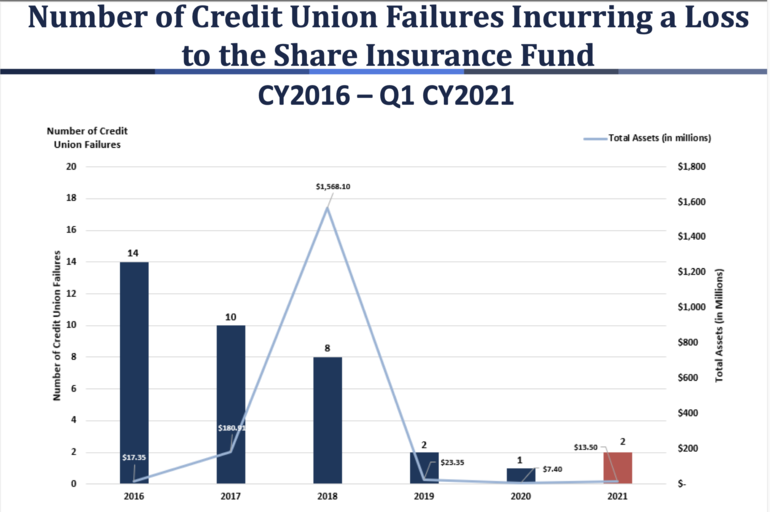
The agency spent $900,000 on assisted mergers during the quarter, and took an $800,000 charge for the liquidations of two credit unions, as CUToday.info reported here.
CAMEL Codes & CUs
As of March 31, there were 154 CUs that were rated CAMEL 4 or 5, 754 that were rated CAMEL 3, and 4,172 that were rated as either CAMEL 1 or 2. Total shares in CAMEL 4 or 5 CUs were $8 billion, or .61% of insured shares (see chart, below).
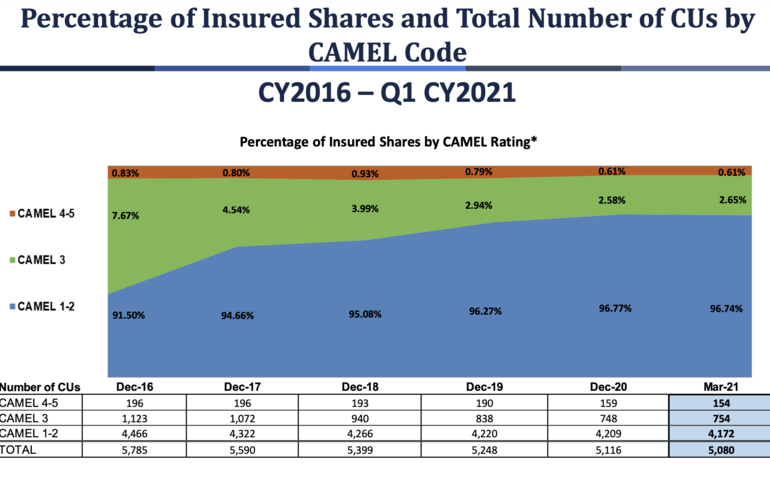
Agency staff said there was a shift of $2.5 billion in assets in credit unions rated CAMEL 3, but it is not believed to be part of a larger “trend.”
Inflation & The NCUSIF
Inflation has been the subject of considerable discussion recently in many circles, and the issue was also raised during the NCUA board meeting.
Vice Chairman Kyle Hauptman asked the agency’s chief economist, Andrew Leventis, what inflation might mean to the share insurance fund should the inflation rate rise to 3% or 4%.
“Inflation should drive up interest rates, which would generally help the equity ratio,” responded Leventis. “However, there are competing effects, one of which is NCUA’s expenses would probably rise. The other effect would be share growth would be above where it would be otherwise. I think there would be competing effects, so a lot depends on what happens with inflation-adjusted interest rates. It’s very difficult to predict.”
The Move From LIBOR
Hauptman also questioned staff over what the transition away from LIBOR—the subject of a recent Letter to Credit Unions—might mean. The vice chairman, who earlier in his career worked on Wall Street, including as a repo trader, noted the main recommended alternative rate is SOFR - a repo rate - and thus represents the price of a loan secured by U.S. Treasury securities.
“But while repo rates are common funding cost on Wall Street, they may not represent the cost of funding for some Main Street lenders who rely on unsecured funding markets,” said Hauptman. “While I’m aware there is an adjustment to attempt to replicate unsecured markets, my question is if NCUA has restrictions on using an unsecured rate like Ameribor if credit unions felt it better suited their needs?
“Derivatives are the greatest exposure to LIBOR, but not for credit unions,” responded NCUA CFO Eugene Schied. “Derivatives are marginally used by 30 CUs as of the last call report. They have to transition. What the new rate will be is not NCUA’s call. We do not support or endorse a rate, but it would have to be a U.S. dollar rate. We know the nuances of SOFR vs. LIBOR. We know new rates are being developed. It’s important to know LIBOR is ending. Credit unions need to make plans today for the end of LIBOR.”
Davis Exiting Agency
Johnny Davis, special advisor to the chairman on cybersecurity, is leaving NCUA for another position. Where Davis is headed was not disclosed, but Board Member Rodney Hood, who hired Davis when he was chairman, indicated it will be an upper-level position.