

ALEXANDRIA, Va.–The NCUA Board heard an update on the status of the Central Liquidity Facility (CLF), with all three board members urging Congress to extend the now-expired authorities it was granted during the first years of the pandemic, even as one board member noted it has not made a “significant loan” in a dozen years.
The CLF was given enhanced borrowing authority and other powers as part of the CARES Act.
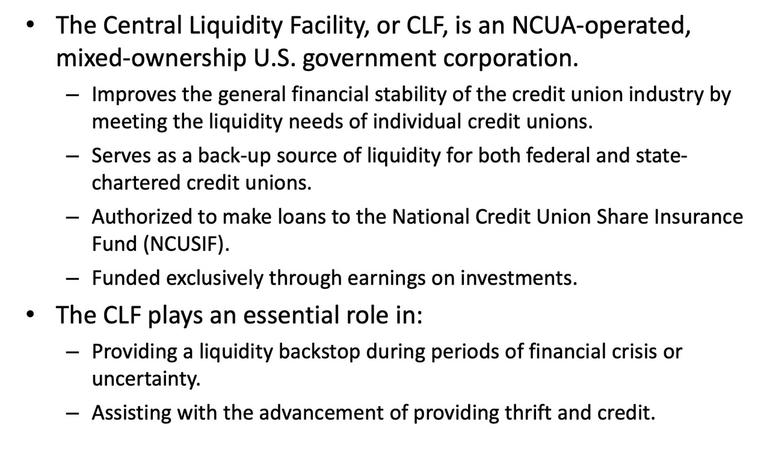
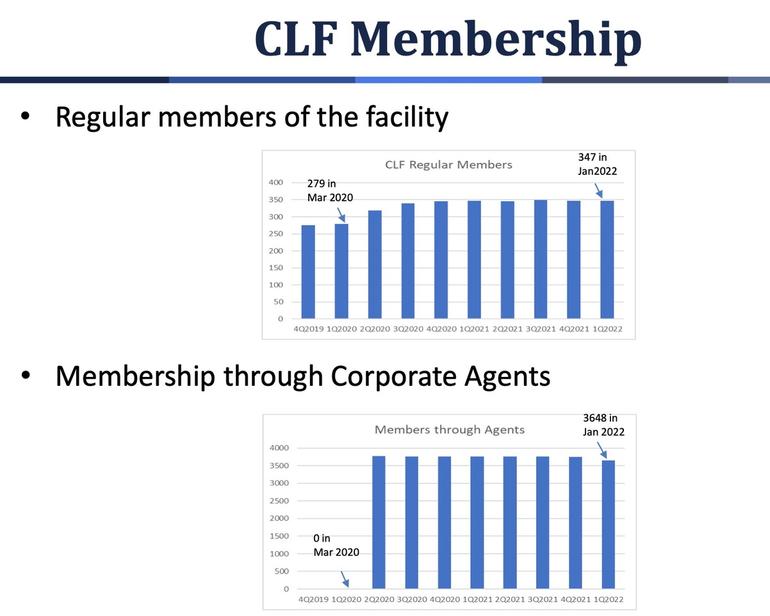
Offering the update to the board was Anthony Cappetta, who was just named president of the CLF this week. He outlined the general role of the CLF and other details, including CLF membership, during his presentation, which can be seen in the slides below. The full presentation can be found here.
Moving forward, Cappetta said the objectives of the CLF include:
- Ensure a smooth transition and support changes in membership
- Communicate with members
- Bolster CLF membership to better serve individual CUs, the Share Insurance Fund, and the system overall
- Increase access to liquidity
- Continue to advocate for permanent reform
Harper: Ongoing Stresses Show Need for CLF
NCUA Chairman Todd Harper called the CLF a “strong source of emergency liquidity” for credit unions, but expressed concerns over the expiration of the enhanced borrowing authority and other CLF provisions in the Coronavirus Aid, Relief, and Economic Security Act, or CARES Act.
As he and other NCUA board members have done in the past, Harper again called on Congress to make permanent the CLF provisions in the CARES Act.
“In times of economic prosperity, the U.S. financial system often has ample liquidity available for those that need it,” said Harper. “However, as we have seen during times of economic and financial stress, like in 2008, that liquidity can quickly dry up, leading to significant risks for credit unions and the broader financial system if the lack of liquidity is not quickly addressed. That is why the financial system has federal liquidity backstops built in — like the Federal Reserve’s Discount Window and the NCUA’s CLF — to provide essential liquidity to maintain stability and confidence during economic downturns and periods of financial stress.”
Harper said those stresses include the omicron variant and higher rates of inflation.
“We also know from painful experience that we can expect credit unions’ liquidity to increase any time there are economic contractions,” Harper. “Like firefighters responding to a blaze, the NCUA needs to be ready to provide that emergency liquidity quickly before the lack of liquidity spreads and undermines the strength and stability of the credit union system. The return to a pre-CARES Act structure for the CLF will impede the NCUA’s ability to respond effectively to future shocks.”
Hauptman: A Matter of When, Not If
NCUA Vice Chairman Kyle Hauptman noted credit unions remain awash in liquidity, and that it’s a matter of when, not if, another financial crisis will occur, and as such the CLF must remain “ready.”
“Corporate and credit union participation plays a direct role in the CLF’s ability to borrow,” said Hauptman. “Credit unions supply the capital upon which the CLF’s borrowing capacity is determined. Greater participation means greater borrowing capacity – which we have seen can be critical in a major liquidity event.
“When a credit union has a liquidity crisis, time is of the essence. Time – or should I say – lack of time is what makes liquidity issues a crisis,” he continued. “As we know, many credit unions participate in the CLF through their corporates. This saves money and time up front, and we are grateful to the corporate system for playing such an important role. It also makes it important that documentation and agreements are up to date. Up to date documentation by all parties could save days of waiting in a crisis. Conducting test loans to confirm systems – the corporate’s, the credit union’s and ours – are ready, could also save precious time.”
Hood: World Has Changed, CLF Has Not
While repeating the call for Congress to act, NCUA Board Member Hood said he does not “view the CLF’s issues as just a legislative problem. The problem is that it hasn’t made a significant loan since the financial crisis, which was now over 12 years ago.”
“When the CLF was created in the 1970s, credit unions were completely outside of the Federal Reserve clearing system,” Hood continued. “There was no credit union access to a lender of last resort at that time. The corporate system also wasn’t yet created. But the world has changed significantly since the creation of the CLF. While the CLF may need to be a lender of last resort, especially during times of crisis, we need to revamp the system. We need to sit down with the corporates and credit unions to create a cooperative facility that reflects the realities of today.”
Hood urged Harper to ensure the NCUA board is briefed on the status of the CLF at least once a year.
In response to a question from Hood, Cappetta said the CLF earned $4.5 million and paid out dividends of $1.6 million during 2021, with the latter figure based on what the Federal Reserve pays on reserve balances. Other funds were used to pay operating expenses and to contribute to retained earnings.