

ALEXANDRIA, Va.–The NCUA board has received an update on the agency’s supervisory priorities in 2022, with each of the board members weighing in on issues that included where CUs have been expressing frustrations, consumer protection, plans for reviewing overdraft programs, the recording of meetings with examiners, and other matters.
Staff offering the update to the board included Kelly Lay, director, and Naghi Khaled, policy officer, in the Office of Examination and Insurance, and Matt Biliouris, director of the Office of Consumer Financial Protection.
NCUA staff said the supervisory priorities include:
- Credit risk management
- Information security (cybersecurity)
- Payment systems
- BSA/AML/Countering terrorism financing
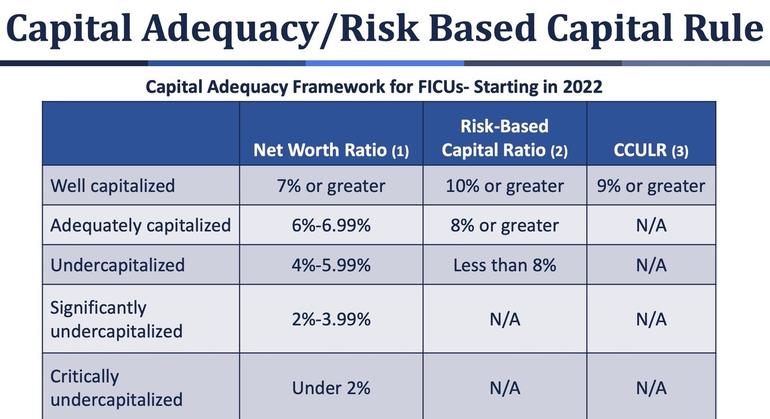
- Capital adequacy/RBC rule
- Loan-loss reserving
- Consumer financial protection
- Loan participations
- Fraud
- LIBOR transition
- Interest rate risk
- NCUA Connect & MERIT
- Recording of official meetings
- CAMELS update
Additional detail on each of the points can be found in the agency staff presentation here.
Harper: Focusing on the ‘Greatest Risk’
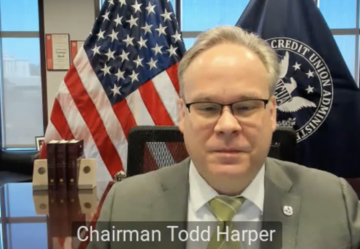
“During the last year, I have frequently noted the agency’s top priority is to ensure the credit union system and the National Credit Union Share Insurance Fund can adapt to the evolving nature of the COVID-19 pandemic and its financial and economic disruptions,” said NCUA Chairman Todd Harper. “The NCUA’s supervisory priorities in 2022 reflect that need by focusing on the areas of the greatest risk to credit unions, members, and the broader system.
Harper noted everything from supply chain disruptions to the omicron variant are stressing CUs and agency examiners will “look at credit unions’ loan loss reserving practices to ensure they are correctly accounting for potential losses commensurate with their risk and internal policies.”
Harper further noted the 2015 risk-based capital rule and the recently approved Complex Credit Union Leverage Ratio became effective at the start of this year, adding examiners will remindful mindful of the effects of recent share growth on credit unions’ net worth and risk-based capital ratios.
“The pandemic has increased cybersecurity exposures for all parts of the financial services sector, including federally insured credit unions. I cannot stress this point enough: All credit unions, regardless of size, are vulnerable to potential cyberattacks. As a result, we must remain laser focused on these issues,” Harper said.
Other Points Raised
Harper additionally noted:
- The agency is committed to strengthening the readiness of the credit union system to respond to these risks through its supervisory program and with tools like the ACET Toolbox, training, and more.
- Several “critical” consumer financial protection matters are also included in this year’s priorities, and in 2022 examiners will focus on areas related to the pandemic, such as fair lending, the Servicemembers Civil Relief Act, the Fair Credit Reporting Act, and credit union overdraft programs.
- In 2020, NCUA examiners found weaknesses in credit unions’ compliance management system, particularly in complying with the Fair Credit Reporting Act, the Electronic Fund Transfer Act, and the Truth in Lending Act. “If left unchecked, these problems could lower consumer credit scores, lead to expensive fees, and increase the cost of credit,” he said.
- In 2022, examiners will identify fair lending policies and practices that indicate discrimination risk or loan portfolio and underwriting discrimination risk, as well as whether a credit union has the proper policies and procedures to evaluate the consistency, fairness, and accuracy of the appraisals it obtains.
- In supervising overdraft programs, examiners will request information about credit union overdraft policies and procedures, as well as the monitoring tools and audit of credit union overdraft programs. “Credit union communications with members about these overdraft programs will also be reviewed,” said Harper. “In my view, the overdraft practices of some federal credit unions are fundamentally detrimental to members and inconsistent with the definition of federal credit union in the Federal Credit Union Act. We anticipate using the documentation gathered this year for a more thorough review of credit unions’ overdraft programs in 2023.”
‘Refrain From Criticizing’
Harper said he is urging all credit unions to continue working with their members experiencing financial difficulties.

“To support your efforts, the NCUA has instructed its examiners to refrain from criticizing a credit union’s efforts to provide prudent relief for members when conducted in a reasonable manner with proper controls and management oversight,” Harper said. “As credit unions navigate the next phase of the pandemic, such efforts will help ensure that credit union members, local businesses, and communities are able to recover and prosper.”
Hauptman: The ‘Benefits’ of Recording Exit Exams
NCUA Vice Chairman Kyle Hauptman told the meeting one of the reasons he took the job was to “address the issue of communication between the regulator and the regulated. You’ve heard me say before that we do not always realize the impact of our words on the credit unions.”
Hauptman said he was happy to see the section on “Recording of Official Meetings.”
“This is something the NCUA has allowed for years provided that the agency gets a copy of the recording,” he said. “Until the pandemic-forced experiment on remote access, however, we didn’t have an easy and less awkward way to do recording. Now we do. Recording meetings benefits the credit union, the examiner, and the agency. It provides a record of exactly what was said – maybe not what was meant – but there is no argument about the words used. It also provides a historical record of past exams which should be useful to new board members, CU executives, and examiners. It’s also never been easier to record exams given the use of programs like Zoom and Teams. It’s already common practice at many government agencies as well as in the private sector, and I’m sure it will prove to be a godsend in many situations.”
‘May Seem Self-Evident, But…’
On the issue of communication, Hauptman also weighed on other supervisory priorities, including participation loans and call report changes. On participation loans, Hauptman said while it may seem self-evident that credit unions must utilize safe and sound practices in managing loan portfolios, he has over the past year heard from several credit unions who have “expressed frustration over our lack of clarity on due diligence and confusing definitions for reporting. I’m concerned that because we haven’t been crystal clear about the details of our expectations and definitions, some credit unions have chosen not to utilize this helpful option. Now that participation loans and eligible obligations are part of our supervisory priorities, we owe clarity to the credit unions and to examiners.”
He called the section of NCUA’s supervisory priorities letter on capital adequacy and risk-based capital requirements that referenced call report changes “a flat out better product.”
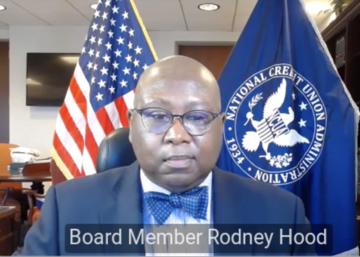
Finally, Hauptman encouraged credit unions to watch NCUA’s Feb. 10 webinar on the revised call report.
Hood: ‘Time to Account for Fintech’
Board Member Rodney Hood said he believes “going forward we have to better account for the changes that fintech is doing to the cooperative business model. For example, fewer and fewer members are applying for loans at a branch. More and more loans are being acquired by credit unions through loan participation through fintechs. These data should be updated and refined in our call reports.
“In the months ahead, I’ll be calling on the agency to consider a comprehensive fintech rule so credit unions can best compete in today’s marketplace while also making sure the NCUA understands how rapidly the business model is shifting before our eyes so that we too have data necessary to keep the system safe and sound,” Hood added.