

ALEXANDRIA, Va.–The NCUA board has voted 3-0 in favor of its 2022-26 strategic plan, with two of the board members stressing that while the plan speaks to risks from climate change, the agency is not mandating any related actions by credit unions, with agency staff also addressing issues related to NCUA’s plans for overseeing CU overdraft programs.
NCUA staff addressing the board on the strategic plan were Melissa Lowden, deputy director, and Lindsey Courage, management analyst, both in the Office of the Chief Financial Officer.

Melissa Lowden
Lowden described the strategic plan as a “roadmap” for the path the agency plans to pursue over the next five years.
The plan was put out for comment in November of 2021 and resulted in 15 comment letters being filed. Those letters, said Lowden, primarily focused on several areas, including:
- Addressing climate-related strategic risk, particularly that the plan not discourage service to certain industries such as agriculture.
- Adopting additional flexibilities for reducing burdens related to the examination program.
- Improving agency support for new CU chartering and new minority depository institutions.
Changes Made
Based on the comment letters, Courage said changes were made to the strategic plan related to revising the narrative around climate-related risk; adding additional strategies for supporting small and low-income CUs in underserved areas; addressing partnerships to improve the success of small and underserved CUs, such as with technical assistance grants and loans; addressing risks from emerging financial technologies, and adding updates to the economic outlook section to reflect current events.
Harper: Need to Continue to ‘Evolve’ Examinations, Other Areas
NCUA Chairman Todd Harper, noting the size and complexity of credit unions, of financial transactions and related to the growing digital and mobile space have only increased over the past few years, said NCUA must continue to “evolve” its examination program and administrative operations to ensure the fulfillment of the agency’s statutory obligations to maintain a safe and sound credit union system where credit union members are protected.
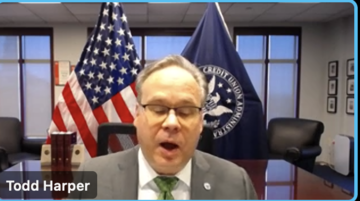
NCUA Chairman Todd Harper during board meeting.
“The NCUA developed this strategic plan through collaboration between board members and input from and coordination by staff,” Harper said. “This final strategic plan also incorporates the feedback and recommendations of stakeholders throughout the credit union system.”
In his comments during the board meeting, Harper said that under its revised plan the strategic goals continue to focus on three areas to:
- Ensure a safe, sound, and viable system of cooperative credit that protects consumers
- Improve the financial well-being of individuals and communities through access to affordable and equitable financial products and services
- Maximize organizational performance to enable mission success.
Support for Each Goal
To meet our first strategic goal, Harper said NCUA examines credit unions to ensure they operate in a financially sound manner and comply with all laws and regulations, including those related to consumer financial protection and fair lending.
To meet the second goal, he said the agency develops rules, regulations, and initiatives designed to expand access to safe, fair, and affordable financial products and services. Harper said that work includes chartering new credit unions, a priority for Vice Chairman Kyle Hauptman, and facilitating changes to credit unions’ fields of membership, a priority for Board Member Hood.
Meeting its third goal, said Harper involves accomplishing its mission on behalf of credit union members through “teamwork. A critical part of this goal is building a diverse and talented workforce and creating an inclusive environment where all employees have a sense of belonging and can bring their full and true selves to their work. Diversity, equity, and inclusion are priorities for the NCUA.”
The plan further seeks to strengthen and advance financial inclusion, as well as economic equity and justice within communities of color, rural places, and underserved areas, a priority he said both he and Hood share.
“In sum, our efforts to implement the 2022–2026 Strategic Plan will ensure that the nearly 130 million Americans who place their hard-earned savings and financial dreams in the hands of our nation’s system of cooperative credit are protected and able to utilize credit unions for many years to come,” said Harper.
Hauptman: Guaranteeing Protection, But Also Choice
Noting NCUA’s mission is to “protect the system of cooperative credit and its member owners through effective chartering, supervision, regulation, and insurance,” NCUA Vice Chairman Kyle Hauptman said the agency will continue to focus on safety and soundness, effective supervision and improving the financial well-being of individuals and communities through access to affordable and equitable financial products and services.
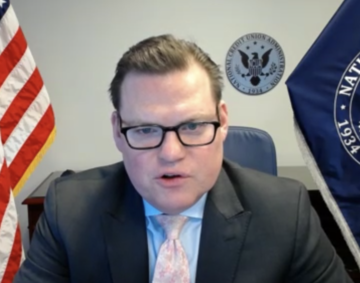
NCUA Vice Chairman Kyle Hauptman during board meeting.
“It is no secret that I believe that choice is one of the best guarantees of consumer protection,” said Hauptman. “Not only the choice of what type of financial institution to use, but also the choice to form a financial institution dedicated to the specific needs of its community – a credit union.”
Hauptman said the strategic plan, along with the Annual Performance Plan (see related story), continue to address the vulnerability of new and smaller credit unions, an issue the vice chairman has made a priority.
“Work remains on clarifying and streamlining the chartering process for new credit unions,” he said. “More resources have been directed toward for small credit unions and minority depository institution (MDI) credit unions.”
Clarifying Agency Position on Climate Change
As for language in the plan related to risks from climate change, Harper stressed the “NCUA board wants to emphasize that nothing in this Strategic Plan should be construed as discouraging activities related to agriculture or fossil fuels.
“We add no value by informing credit unions in Florida that they have damaging hurricanes, nor those in agriculture that droughts are harmful,” he continued. “The agency does not intend to micromanage credit union lending decisions for climate financial risk, including lending to family farms and others in the agricultural sector as well as businesses tied to the fossil fuel industry. Any micromanaging or ‘putting NCUA’s thumb on the scale’ may end up adding, not subtracting, risk to the SIF.”
Hauptman added that the plan also continues to recognize that credit unions “must have access to evolving technology to remain viable. Clear guidance and regulation that allow for innovation will allow credit unions to move forward confidently.”
Hood: Plan ‘Does Not Change Policy’
NCUA Board Member Rodney Hood, the former chairman of the agency, said while it is up to the board to approve the strategic plan, it is his view the chairman should be given more leeway to “set the vision for how and where he would like to take the agency. The strategic plan is an aspirational document, and while I certainly believe that climate change is an issue, I simply do not believe it's an issue for the NCUA as a safety and soundness financial regulator at this time.”
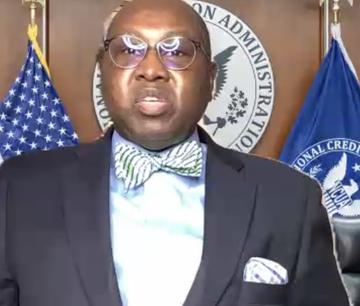
NCUA Board Member Rodney Hood during board meeting
Hood said that while he further believes credit unions know best how to manage and mitigate the risk in their respective communities, “in the spirit of bipartisanship, I deferred to the chairman on the climate change language in the strategic plan and I did so knowing that, again, this strategic plan, as an aspirational document, does not change any NCUA policy or supervision for climate change.”
Hood said NCUA received “many” comments related to climate change, including from the governor of North Carolina, Doug Burgum, who called the plan to address “climate-related financial risks “ill-conceived, politically motivated, anti-agriculture rhetoric that threatens to cause serious harm to the farmers and ranchers who form the backbone of rural America.”
Pleased to See Statement Added
Hood indicated he was pleased to see a statement in the plan that, “The agency does not intend to micromanage credit union lending decisions for climate financial risk, including lending to family farms and others in the agricultural sector as well as businesses tied to the fossil fuel industry. The NCUA board underscores that nothing in this Strategic Plan should be construed as discouraging activities related to agriculture or fossil fuels.”
Questions Posed
Hood also posed several questions for agency staff, including:
- Can you discuss the ACCESS initiative in the strategic plan and any lessons learned from the recent GAO report?
Lowden said support for ACCESS is a strategic tenet of pillar two of the plan. The annual performance plan also inlcudes performance indicators tied to the ACCESS program.
- While overdrafts are not mentioned specifically in the strategic plan, I want to speak about overdrafts fees since this has been getting lots of press coverage lately. Can you confirm that the overdraft data collection highlighted in the 2022 NCUA supervisory priorities letter is only a data collection effort at this point in time?
Scheid responded by saying it is difficult to answer with just a yes or no response, noting that in 2002 NCUA implemented a Risk Focused Examination Program under which examiners could adjust each exam scope based on those areas that present a higher risk profile based on seven categories of risk.
“There are a few situations where an examiner may criticize a credit union’s overdraft program,” Scheid explained. “For example, if a credit union has a higher risk profile regarding overdraft practices – maybe a credit union has had issues in the past with overdrafts, has overdraft-related consumer complaints, or may have some litigation risk with pending class action law suits regarding their overdraft practices – an examiner has the discretion to enhance their exam scope to do a more in-depth review. This could happen during any exam cycle regardless of the overdraft document request we’re specifically requiring them to do this year.”
Scheid added that for exams conducted in 2022 the agency has instructed examiners to obtain the overdraft policies and procedures from credit unions but has not instructed them to review the overdraft policies and procedures during 2022 as part of the minimum scope requirements.
“However, an examiner may elect to review these materials as part of the risk-focused exam,” said Scheid. “Any violations noted by an examiner – such as a credit union lacking any formal written overdraft policies and procedures – may appropriately lead to some level of criticism and corrective action.”
Scheid said the goal in obtaining overdraft policies, procedures and disclosure documents this year is to have OCFP perform a more “holistic review” of overdraft protection programs to identify any heightened risk and develop necessary education/outreach to the industry.
- Can you confirm that any changes made to NCUA’s oversight of overdraft fees require future board approval?
Scheid said NCUA board approval would be required for any changes to supervision policies related to overdrafts.