

ALEXANDRIA, Va.–The National Credit Union Share Insurance Fund (NCUSIF) finished 2021 with $20.735 billion in assets, up from $19.128 billion one year earlier, and while the overall news around the NCUSIF has been good, one board member is questioning the agency’s investment strategy.
The data was shared during an update on the status of the NCUSIF during the NCUA board meeting. The fund recently received a clean audit from its outside auditor, KPMG, as did three other NCUA funds. The NCUSIF closed year-end with an equity ratio of 1.26% on an insured base of more than $1.3 trillion.
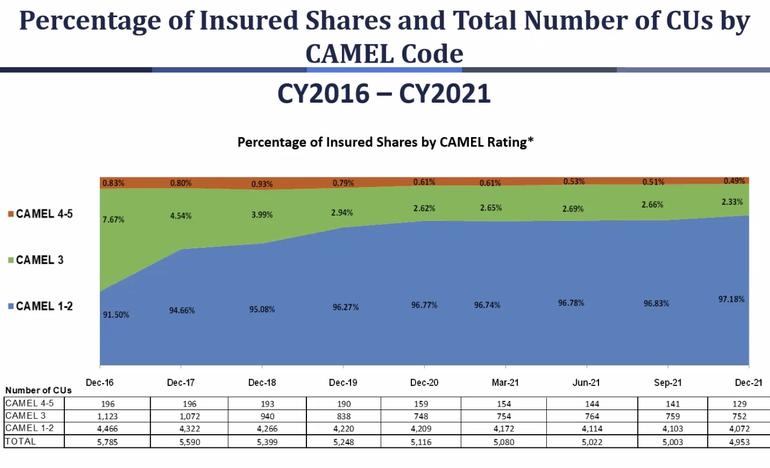
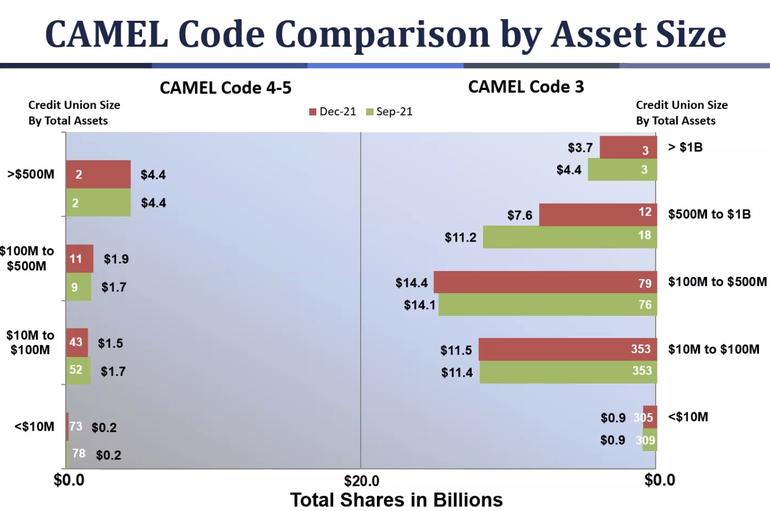
The number of CUs that are CAMEL Code 1 and 2 has hit a new high, according to NCUA, while the number of CUs CAMEL Code 3 decreased. There were 129 CUs that were CAMEL Code 4 and 5 at year-end, nearly all of which are below $100 million in assets (see graphics, below).
The fund’s performance can be seen in the slides below.
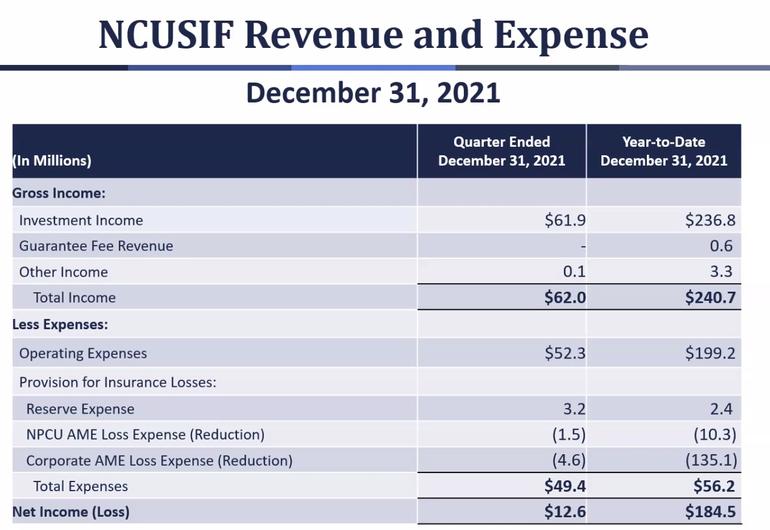
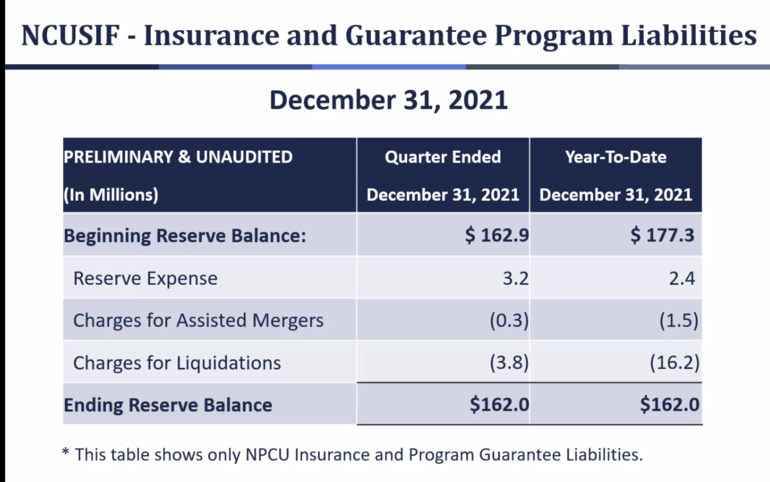
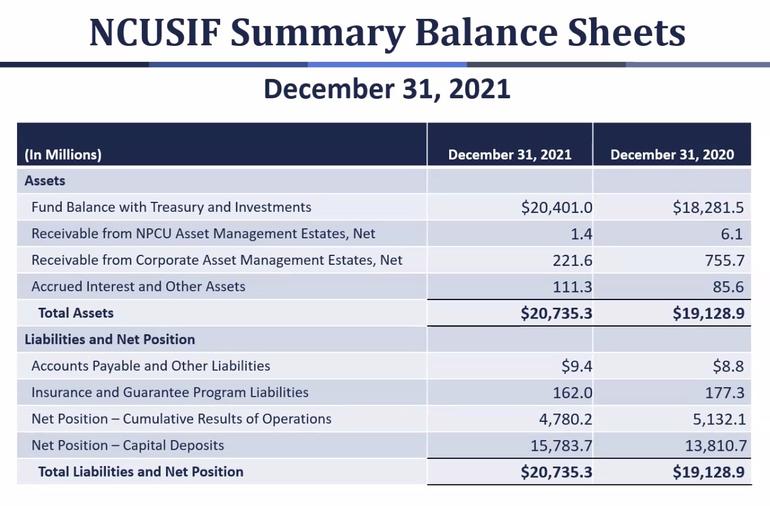
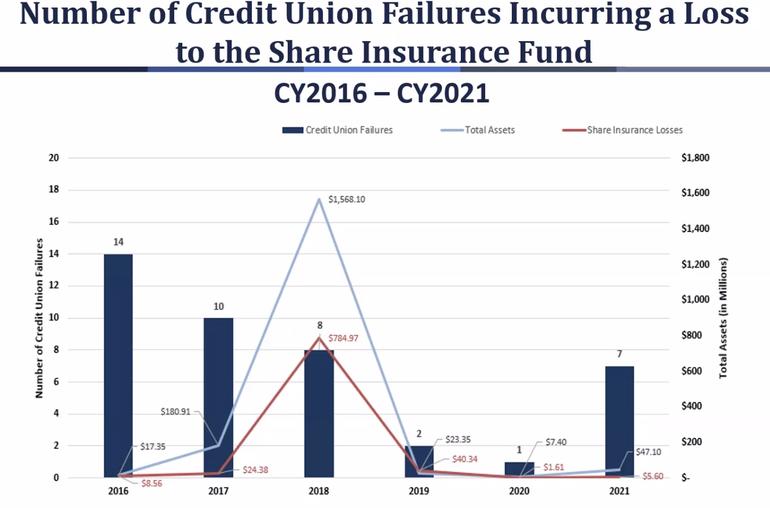
Seven failures led to losses to the NCUSIF during 2021, with fraud a contributing factor in four of the failures, according to NCUA CFO Eugene Scheid.
“After another challenging year, the Share Insurance Fund continues to perform well and remains on a solid footing,” said NCUA Chairman Todd Harper. “Overall, the credit union system has also, thus far, withstood the pandemic’s evolving economic fallout. This is a testament to the strength of the credit union system going into the pandemic and the skillful management of credit union CEOs, boards of directors, and staff over the last two years.
“Nonetheless, the credit union system and the Share Insurance Fund continued to experience elevated insured shared growth in 2021,” Harper continued. “To illustrate this point, the insured capital deposit for the Share Insurance Fund was $12 billion at the end of 2019. Two years later, the insured capital deposit increased to $15.8 billion at the end of 2021, a nearly 32% increase since the pandemic began. If the elevated growth of insured shares continues, we can expect a further erosion of the Share Insurance Fund’s equity ratio. So, we must remain watchful.”
Harper cited risks from rising inflation and the expectation the Fed will move to increase interest rates in March, saying NCUA and credit unions must be ready to adjust to these changes.
“Additionally, the NCUA must continue to monitor credit union performance because, in my view, the system has not experienced the full extent of the pandemic’s financial and economic disruptions just yet,” Harper said. “With this added level of uncertainty, the NCUA board will need to continue to analyze the Share Insurance Fund’s risk exposure and remain prepared to act, consistent with our statutory and regulatory obligations.”
Asked about the potential effects of interest rate increases by the Fed, Schied said he expects any rise in rates to have a “positive” effect on the fund, and that the average yield on the portfolio should improve as longer-term rates increase.
Hauptman: Questions About Investment Strategy
Seeing much “good news” in the NCUSIF update, NCUA Vice Chairman Kyle Hauptman noted the percentage of assets held in CAMEL 1 and 2 credit unions continues to inch up and is at a record level of 97.5%, and losses to the share insurance fund are at extremely low levels in 2020 and 2021.
“And despite larger than expected growth in insured shares during the second half of the year, federally insured credit unions have maintained an average net worth ratio in excess of 10.2%,” said Hauptman. “Of course, this leads me to the issue of the NCUA’s investment strategy. The portfolio as shown on slide 7 (of the presentation shown during the board meeting and available at www.ncua.gov) was just under $20 billion at the end of 2021—the largest it has ever been. Although I’m grateful we finally made our current investment policy public, it is time for us to re-evaluate our strategy.”
Noting the fund is a mutual asset—both reported and controlled by the NCUA, and an asset reported by the credit unions, Hauptman said the agency has a “responsibility to regularly review its investment strategy. And for the sake of transparency and clarity, to do so at an open board meeting.”
In response to a question from Hauptman about critics who believe some of our recent investments were ill-timed, resulting in the NCUA “leaving money on the table,” NCUA’s Rick Mayfield said the investment strategy does not try to time the market and instead seeks to use a ladder strategy over a seven-year time period. He said time has proven it is the right approach.
Hood: ‘No Getting Around Reality’
NCUA Board Member Rodney Hood, who praised the fact NCUA’s NCUSIF investment policy has been made public, asked NCUA CFO Schied why the net position of the cumulative results of operation decreased during the year and the impact it has had on the equity ratio.
In response, Schied said the decreases seen were due to an unrealized gain in the investment portfolio, which has since been eliminated. It did not change the equity ratio, he added.
Hood, noting the strengthening economy, said there is also “no getting around the reality” that inflation has been spiking, which he said poses a real concern around interest rate risk. He further expressed concern over the growing national debt and how it will eventually impact the overall economy, although he said he remains optimistic overall.
“But we do need to look reality squarely in the face to recognize that the conditions are still challenging and will likely continue to be so for the immediate future,” said Hood. “We need to be planning accordingly for an environment that’s marked by tremendous uncertainty.”
The ‘True-Up’
Speaking to the issue of the so-called “true-up” and its effects on the equity ratio of the NCUSIF, Hood said “it is perhaps one of the most important issues for the credit unions whose assets comprise the fund.
“In simple terms, the equity ratio has a numerator and a denominator,” Hood stated. “The denominator is insured shares and the numerator is contributed capital and retained earnings. There is a timing difference that is important to discuss in calculating the equity ratio at year end. While insured shares are as of December 31, NCUA has not yet billed for the new capital deposit balance from the December 31 insured shares and thus we use June 30 data at year end for this piece of the equation. This causes a timing issue.
“The true-up is relevant because today we report the equity ratio at 1.26% and year end,” Hood continued. “However, if the equity ratio calculation did not have the timing difference, such that both components were derived from December 31 data, then the equity ratio would be approximately 1.29%.”
The result, said Hood, is that credit unions are directly affected by assessments of premium charges and distributions, and in my view, the practice could lead the public to misunderstand the true strength of the fund.
Basis Points & High Water Marks
In response to a question from Hood over how many basis points has the subsequent “true up” been since 1999 and what was the high water mark in basis points, Schied said the subsequent true-up has been about two basis points on average with the overall range from slightly less than one basis point to six basis points.