

ALEXANDRIA, Va.––The NCUA Board was given an update on a proposed “provisional charter” aimed at addressing a “Catch-22” facing those looking to start a new CU: organizers seeking funding to start new credit unions need a charter to do so, but in order to get a charter they must first obtain the funding.
To resolve what two NCUA board members acknowledged is a chicken-or-the-egg dilemma for new credit union charters, the provisional charter concept has been developed by agency staff, with plans to begin to pilot the program by the end of the third quarter of this year.
NCUA Chairman Todd Harper said the object of the provisional charter is to allow organizing groups to demonstrate the capacity to start a credit union, which would, in turn, facilitate their efforts to raise needed capital.
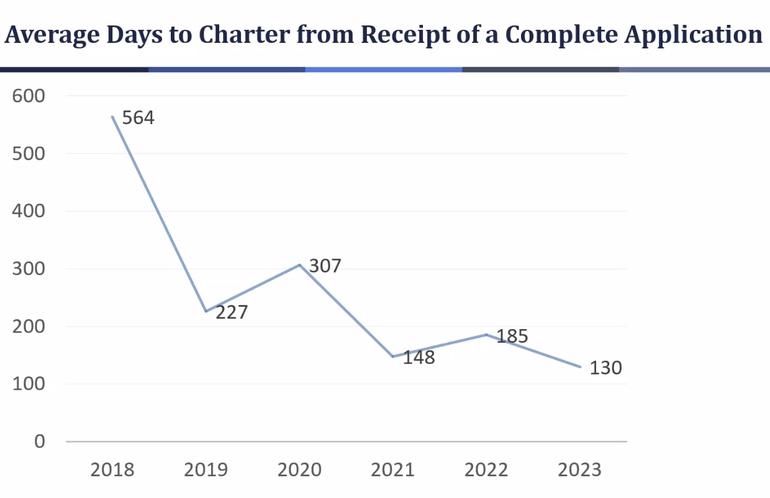
Agency staff noted NCUA previously created a team to assist groups in forming new credit unions, but the process has often been slow and it did not resolve the challenge outlined above. Staff said the agency has sought to make the process more transparent and easier to follow, creating a faster approval—with the goal being 100 days from receipt of application to charter issuance if all requirements are met.
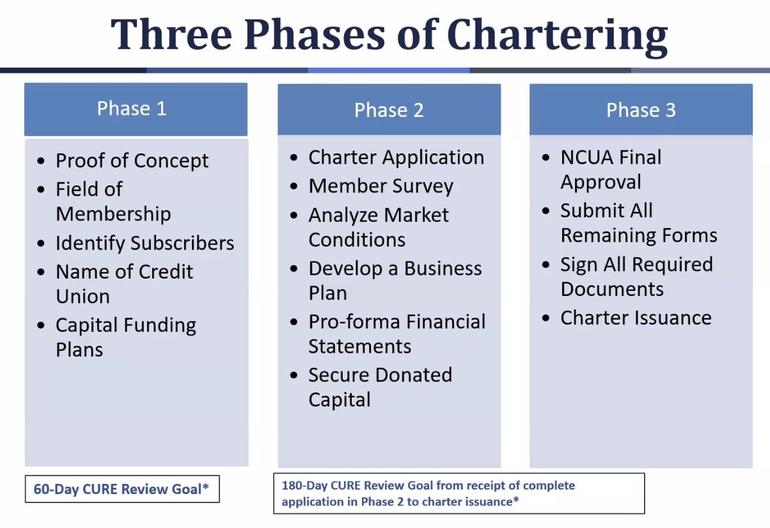
Agency staff provided the chart, below, as an overview of the chartering process.
The agency has also created a new charter web page that includes a number of resources. The results of all that can be seen in the slides below, according to staff.
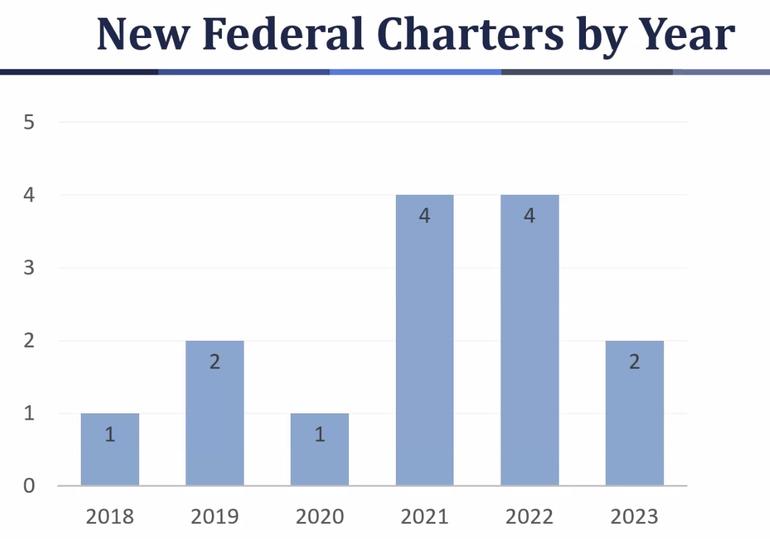
From 2018-23, NCUA staff said 29 groups submitted applications for FCU charters, 14 of which were approved, 13 of which are still operating. One of the applications was withdrawn.
The agency’s CURE office—which has championed the new provisional charter-- has also developed a dashboard for measuring where new applications are in the process, staff told the board.
Harper: New Charter Apps are in Pipeline
Chairman Harper called the chartering of new credit unions a “core mission” of the agency, saying new CUs are “vital to maintaining a dynamic financial system — one that is growing, thriving, and meeting the evolving financial needs of our citizens and their communities.”
Harper said NCUA has taken several recent steps to “modernize and improve” the chartering process, including overhauling the Federal Credit Union Charter Application Guide and its supporting documents, which he said has reduced the time to review and approve a complete application to approximately 130 days from start to finish.
“As such, the number of new charters increased from just one in 2020 to four each in 2021 and 2022,” Harper said, adding that 13 more applications are in the approval pipeline and nearing completion.
Which Comes First?
“We have been exploring how to address the catch-22 of chartering: Which comes first, the capital or the charter?” said Harper, whose observation would be echoed a few moments later by NCUA Vice Chairman Kyle Hauptman. “The organizers need capital to get a charter, but they can’t get a charter without the capital. This chicken-or-egg dynamic often leaves organizing groups discouraged…A provisional charter is an excellent solution to the chicken-or-egg chartering problem, but I also know that it’s hard to raise capital even if you have a charter.”
Harper asked NCUA staff to explore the pooling of capital for starting new credit unions like the FDIC’s Mission-Driven Bank Fund that was launched in 2021.
Hauptman: NCUA Appears More ‘Supportive of Mergers’ Than New Charters
NCUA Vice Chairman Kyle Hauptman noted the de novo chartering process has been a priority for him since even before his first board meeting in 2020, as he had mentioned it six months prior during his Senate confirmation hearing.
“As one of the original solutions for financial inclusion, the formation of a new credit union is the ultimate demonstration of this agency’s dedication to diversity, equity, and inclusion. I am fond of the saying that ‘what gets measured, gets done.’ Today’s report is a measurement of progress. And, as the first report of its kind, it also provides a baseline for future reports.”
Hauptman said he sees the improvements that have been made over the last two years and that the move to divide the chartering process into three distinct phases provides some clarity, as does putting the chartering manual online.
Work ‘Not Yet Done’
“But our work is not yet done. We’re working on the process here, but the measurement of success will always be new, stable charters,” Hauptman said. “As you know, getting to a completed charter application can take years. I believe we must measure the time it takes from initial application to completed application to find out where organizing groups are having difficulty. Although chartering a new credit union is very different than the merger of a credit union, both processes are (rightfully) complicated. Somehow, the agency has managed to streamline the difficult merger process. From the outside looking in, it appears the NCUA is more supportive of merging credit unions than supporting the groups that want to form them. If chartering new credit unions is important, our processes should reflect that. Going forward, we can look at easy-to-fill out templates, examples of prior successful charter applications – the sort of things that franchise companies provide to people interested in opening a new Shake Shack, Panera Bread, etc.”
Like Harper, Hauptman said he also sees good news in that the new provisional charter responds to what he also called the “chicken or egg challenge of getting capital.”
How Would You Respond?
Hauptman cited a posting on LinkedIn in which someone wrote in part, “The NCUA has made it extremely difficult. Their job is to protect the insurance fund, not to start new credit unions, … and making is near impossible to start one, the insurance fund is nice and safe. … And if credit unions go away, CUSOs go away, leagues go away...and what are we left with? ... Back to the beginning.”
He then asked agency staff how they would respond to that?
NCUA staff answered by saying it is hopeful the industry sees the new provision charter is evidence the agency is “making strides” in improving the new chartering process.
Hood: ‘Not Earth-Shattering, But…’
“Moving from one new charter a year to four is not earth shattering but is a significant step in the right direction,” said Harper. “And the new CURE management system for chartering should make an impact here as well and, perhaps most significantly, so, too, should the provisional charter concept, which we plan to launch by quarter four of this year.
“Credit unions give a hand up to people of modest means, creating opportunities to build wealth for working families and marginalized communities, and nurturing a strong sense of local control and ownership,” Hood continued. “We aren’t saying chartering a credit union should be easy, but it shouldn’t feel impossible for many organizing groups. I am delighted of the progress we are making to significantly streamline the process of chartering.”
In response to a question from Hood over what the biggest challenge is for groups seeking to start a new credit union, staff said it is “demonstrating economic viability.”
In response to a separate question over whether any credit union organizer has utilized the new subordinated debt rules in obtaining a new charter, staff responded by saying no, but the provisional charter would extend that authority to them, as well.