

ALEXANDRIA, Va.–The NCUA budget is currently projecting a $5.1 million surplus for 2023, even as the agency is beefing up its staffing and it has fewer vacant positions.
During the NCUA board meeting agency CFO Eugene Schied provided the board with a mid-year update on the state of the budget. The agency’s board voted 3-0 to accept the report.
According to the Office of CFO, NCUA is:
- Estimated to have a $1.6 million pay and benefits surplus, even when factoring in six new positions for NCUA’s CURE Office and new positions in cybersecurity
- There is an estimated $3.5 million surplus in non-payroll expenses
The 2023 surplus is actually likely to be smaller due to fewer vacant positions and higher travel, according to Schied. At the 2022 mid-year report, the agency had projected a $9 million surplus.
The agency’s staffing/hiring efforts can be seen in the slide below.
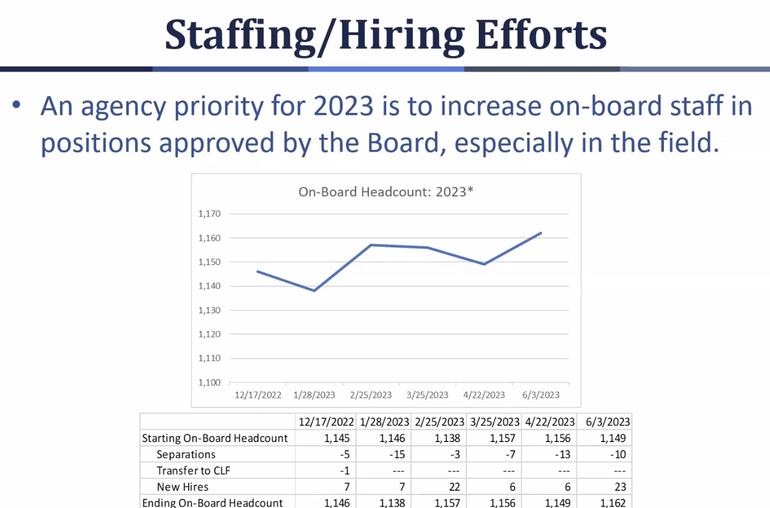
According to Schied, the costs for the two new CURE positions and four new cybersecurity positions are estimated at $394,000 for 2023 and $1.7 million for 2024.
The proposal also calls for spending $343,000 for increasing funding for reasonable accommodations for job applications, and $143,000 for additional background for security investigations. That will be offset by a reduction of $343,000 in the travel budget, Schied said.
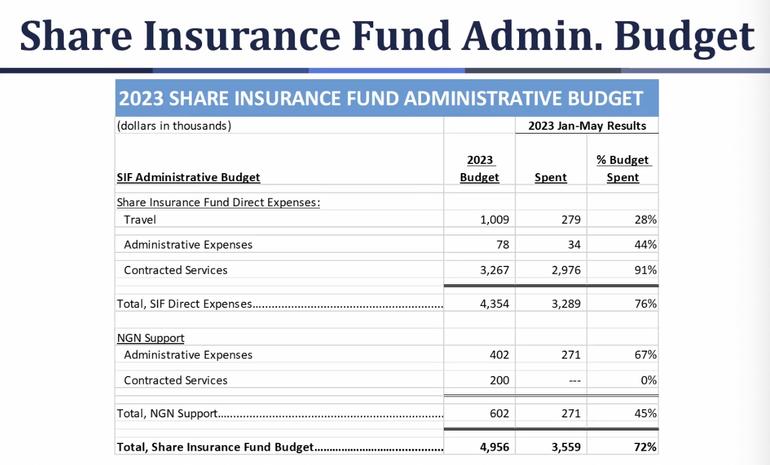
Schied also provided an update on the NCUSIF budget, as shown below.
Harper: ‘Mission Critical’ Factors
NCUA Chairman Todd Harper noted that as part of the midsession budget review process, NCUA program offices have also identified “several priority and mission-critical areas needing additional funding or positions to meet current operational needs and address potential risks to the agency.” Those budget changes for 2023 will cost $737,000.
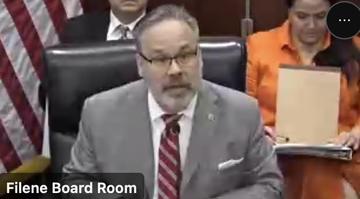
NCUA Chairman Todd Harper during meeting.
“Specifically, we need to increase funding for the agency’s reasonable accommodations program,” Harper said. “The NCUA has made strides in workplace inclusion and accessibility for individuals with disabilities. We now need to provide additional funding to support their work. That’s just common sense.”
Other Mid-Year Developments
Over the last six months Harper said:
- NCUA has made strides in it efforts to return examiner staffing to budgeted levels, and as a result needs additional funding to pay for background check
- The agency has made additional investments in cybersecurity operations and procedures. “Through recent independent third-party assessments, we have determined that we need to add four positions to our cyber squad,” Harper said
- The NCUA board has agreed to add two additional positions within the Office of Credit Union Resources and Expansion. “CURE’s workload associated with approving field-of-membership expansion requests, charter conversions, bylaw amendments, and other related work has more than doubled in the last five years,” said Harper.
Hauptman: Process Improvements Needed
NCUA Board Vice Chairman Kyle Hauptman, who participated in the meeting virtually from Albuquerque, N.M., noted he has been “very vocal” about the budget, which represents credit unions’ money.
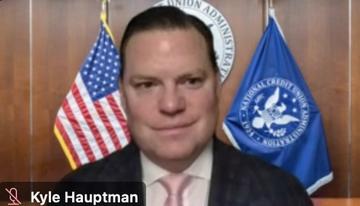
NCUA Vice Chairman Kyle Hauptman at board meeting.
“Credit unions by and large are doing well, but margins are shrinking, interchange and fee income are flatlining or declining, and expenses continue increase,” said Hauptman. “We must always keep in mind credit unions operate in a very different environment than we do. We must also continually work to improve the viability and safety of America’s credit unions.”
Hauptman said he supports the hiring in NCUA’s CURE Office, saying it supports the growth of current and new FCUs.
“I also believe that more staff will not improve long-term productivity before a reengineering of processes that may be out of date,” Hauptman said. “It is critical that we ensure the most efficient use of resources to help staff do more with less. I would like to thank Chairman Harper, Board Member Hood, and management for their commitment to a coordinated effort for process improvement within CURE.”
Hood: Questions for the CFO
NCUA Board Member Rodney Hood had a number of questions for Schied, including:
Hood: Can you discuss how some of CURE’s workflows will be streamlined based on today’s agreement?
Schied: One example is how CURE is streamlining through automation its document management through the use of templates and automated workflows for every transaction. CURE is also continuing to work on changes to the FOM regulations that address materials submitted by credit unions and the required reviews by CURE staff. Streamlined applications will ensure efficient reviews and timely responses. And finally, as noted in the BAM, CURE will support customer service by implementing technical changes that will reduce duplicative or unnecessary administrative requirements, follow the time requirements for certain field-of-membership transaction codes, and implement enhancements to the CAPRIS system that will allow CURE to process all occupational and associational common bond groups, regardless of potential membership size.
Hood: I want everyone to know that staff is drafting the 2024 budget right now as we speak. At the midyear point, what options do we expect the board to have when we consider the 2024 budget?
Schied: Along with the executive director, my staff and I are starting this week to review office proposals for the 2024 budget and develop our initial recommendations for the board’s consideration. The themes of the budget are likely to be similar to past years – and guided by the 2022-2026 Strategic Plan that the board approved last year.
The agency is continuing to build out its efforts promoting access and innovation among credit unions and continuing to strengthen its field workforce through specialist positions in the three regions.
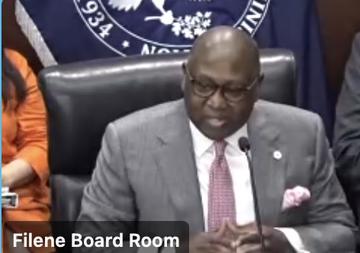
NCUA Board Member Rodney Hood at board meeting.
I would also note that because we see agency travel gradually approaching pre-pandemic levels, and the fact that we have been successful at reducing the level of vacant positions throughout the agency, I do not expect as significant of an operating budget surplus in 2023.
Hood: During a previous midsession budget, we discussed the large amount of funds in the cash operating fund, which ultimately led to the NCUA issuing a refund to federal credit unions. Can you discuss the cash operating fund since that refund?
Schied: The May 2023 financial statement, which is available on the NCUA website, shows that the NCUA’s estimate of cash and cash equivalents in the operating fund was $184 million, which was approximately $8 million lower than the amount in May 2022. This cash is used for the NCUA’s on-going operating and capital expenses through the end of 2023, resulting in progressively lower the cash balance as the year progresses. To manage cash flow cyclicality in the operating fund, my office works to maintain an unencumbered cash balance of equal to roughly three months of agency operating expenses, or approximately $25 million.
As you mentioned, in the 2023 budget the NCUA provided federal credit unions that pay the operating fee a $15 million credit on the operating fee calculation, which was essentially a refund of prior-year collections. As we come closer to the end of 2023, I will ensure that the board offices have up-to-date information about cash balances in the operating fund so that we can determine what adjustment, if any, should be made to the operating fee that will be billed in 2024.
Hood: How much more in income do we expect to make this year because of the increase in interest rates relative to last year’s baseline?
Schied: We invest a portion of our operating fund cash holdings in overnight Treasury bills. This approach allows us to earn a modest amount of interest on the cash that we do not immediately need to pay the NCUA’s bills. In the 2023 Budget we estimated that the agency would collect approximately $1.9 million in interest revenue in the operating fund. We based that estimate on the actual interest revenue collected in 2022.
However, given the rapid increase in short-term interest rates, we have collected more interest revenue than projected. Through May, 2023, we have collected approximately $2.4 million in operating fund interest revenue.