

ALEXANDRIA, Va.–The NCUA board has put out for 60-day comment a proposed Interpretative Ruling and Policy Statement on its Minority Depository Institution Preservation Program.
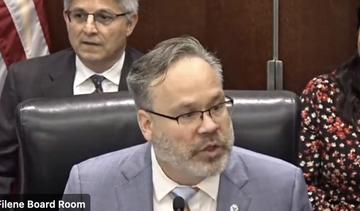
Todd Harper
The proposal is designed to amend the IRPS to reflect changes in the agency’s structure and administration of its MDI preservation efforts program, which is overseen by the agency’s Office of Credit Union Resources and Expansion (CURE).
NCUA said the revised policy statement would also improve the preservation program by simplifying the definition of “community it services, as designated in its charter” to refer to an MDI credit union’s field of membership.
The board was given the update on the proposal by Pamela Williams, program manager-credit union development, in the CURE office.
Harper: A ‘Moral Imperative’
Saying that Congress created the credit union system to meet the credit and savings needs of credit union members, especially those of modest means, NCUA Chairman Todd Harper, who noted at several points during the meeting that he is a strong supporter of MDIs, said providing under-resourced households with access to financial services is “not only a statutory requirement, but it is also a moral imperative. An essential component to achieving that statutory mission is the work of minority depository institution credit unions, or MDI credit unions for short.”
“For several years, I have had concerns about the process used during an NCUA-assisted merger or liquidation of an MDI credit union,” said Harper. “Under this revised policy statement, in the event of the potential failure of an MDI, the agency would contact MDI credit unions in the NCUA’s merger registry, which qualify to bid on a particular failing institution, to measure their interest. Agency staff would then offer technical assistance to any MDI credit union desiring to bid, in addition to providing MDI credit unions with an additional two weeks to submit a bid, whenever possible.”
Harper said the changes will bring NCUA’s emergency merger process in line with that of the FDIC, while also increasing the likelihood of preserving the character of the merged-out MDI credit union.
Apples & Oranges
The chairman said the agency has also taken other steps to support MDIs, including launching the Small Credit Union and MDI Support Program. In 2022, 136 MDI credit unions received assistance representing 5,500 hours of NCUA staff time.
“For years, the NCUA has compared MDI credit unions to non-MDI credit unions. This was an apples-to-oranges comparison. The unique business models of MDIs often allow for higher expenses and higher delinquencies compared to other federally insured institutions,” said Harper. “Plus, the imbalance created by measuring MDIs with peer metrics intended for other credit unions could have a negative effect on MDI credit union operations and development.”
In response, Harper noted NCUA has begun using new examination procedures that measure an MDI credit union’s performance against other MDI credit unions. In addition, he said NCUA will host an MDI Symposium in the fall.
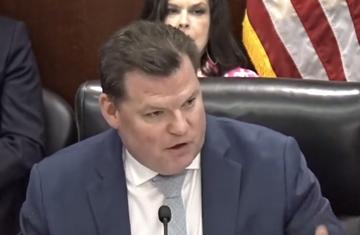
Kyle Hauptman
Hauptman: Something ‘Remarkable’ in the Numbers
NCUA Vice Chairman called it “remarkable” that while the total number of credit unions in America is similar to the total number of banks, when it comes to Minority Depository Institutions (MDI) there appears to be four times as many credit unions that qualify as MDIs.
“The data I’ve been given is roughly 500 credit union MDIs vs around 125 bank MDIs. This could be a function of size, in that credit unions tend to be smaller institutions and that’s also true of MDIs, or perhaps it’s the nature of the field of membership and affinity groups,” said Hauptman. “Either way, it’s important that any group that succeeds in forming a credit union has every opportunity to keep that credit union alive as long as feasible.”
Hauptman said he believes if a given FOM wants their own, separate financial institution, an agency that “cares about inclusion should take every appropriate step to allow that group to keep their institution alive.
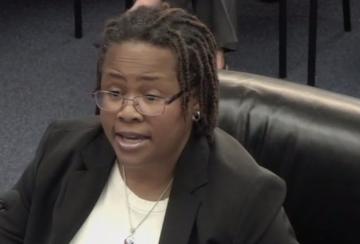
Pamela Williams
‘Shouldn’t Be Too Small to Succeed’
“That means the NCUA shouldn’t push for credit union mergers unless it’s absolutely necessary. That means NCUA has internal accountability around our chartering process,” Hauptman continued. “While no financial institution should be too big to fail, they also shouldn’t be too small to succeed. Today’s board item touches on ways to help a group continue to have their own financial cooperative. Someone, at some point in the past, put in a lot of effort to start a new credit union. This board item speaks to resources to keep those credit unions alive and thriving.”
Hauptman said one issue he likes to see addressed is how the agency can make credit union management comfortable asking for assistance even though it’s the same agency that is grading its management’s abilities.
In response, Williams said it’s an excellent question and the small credit union program at NCUA is designed for that purpose.
“But it has to provide it in a number of areas and in a number of means,” including succession planning, said Williams, adding the NCUA program provides that kind of assistance on multiple issues.
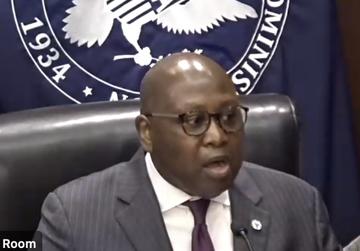
Rodney Hood
Hood: ‘Don’t Want to See Further Contraction’
NCUA Board Member Rodney Hood said the overall trend toward consolidation and growth in financial institutions and the loss of diversity within the financial services system “has not necessarily been beneficial for consumers or communities.
“I don’t want to see further contraction in the number of smaller and mid-sized institutions, and that includes MDIs and CDFIs, which is why I believe we need to be talking about ways to shore up and protect smaller financial services providers,” Hood continued. “We have about 500 MDI credit unions, which I believe is about double the amount of MDI banks, and today’s board action is a positive step.”
Hood stressed he does not believe in “propping up weak institutions just for the sake of propping them up,” but he also believes “healthy financial ecosystem needs smaller institutions, particularly if our goal is financial inclusion and extending access to financial services more broadly to under-served communities.”
‘Worrisome’ Trend
“From that perspective, the trend toward consolidation and ever-larger financial institutions is worrisome, because it runs the risk of taking us further from that goal of full financial inclusion,” he said, adding that his remarks are not intended to be a critique of larger institutions. “They serve an important role in the financial ecosystem as well, and thanks to economies of scale they’re able to do things smaller institutions cannot. I’m not at all hostile toward large financial institutions – after all, I’ve worked for some of those institutions in my own career.”
Questions & Answers
The core question, according to Hood, is how to best ensure that smaller and mid-size financial providers, and especially MDIs and CDFIs, flourish in this challenging environment?”
Answers to that question, Hood said, include:
- From a policymaking standpoint, regulators and lawmakers need to focus on what can be done to shore up small institutions so they can compete effectively and flourish, and to help them to maintain their position within the financial services ecosystem.
- Encouraging credit unions to explore and embrace the world of financial technology. “I think these new tools can be a great boon for smaller institutions, if they’re approached with prudence and care, and they could make a huge impact in terms of helping us to reach under-served communities, particularly younger consumers and the 26 million credit invisible and the nearly 40% of households unable to obtain $400 in a family emergency.”
- Recognizing the importance of smaller institutions in the financial ecosystem. He pointed to North Little Rock, Ark., where NCUA approved a new charter last year for the People Trust Credit Union. “This is a minority-led institution founded by a gentleman who started his career as a barber and later went on to establish a barber college to serve his community,” Hood said. “Recognizing the needs of his students and their families, he launched a non-profit loan fund to provide people in the community with loans and build up their credit scores. Then he took the leap of launching a credit union to provide a fuller array of financial services. That’s a remarkable story of someone seeing a need in the community and taking action to create opportunities for others.”