

ALEXANDRIA, Va.–Credit unions that have gotten used to only seeing their examiner in a virtual environment need to get ready for in-person visits once again.
One NCUA board member is also calling for the agency to bring back its staff to work at its headquarters.
During its November board meeting, NCUA staff and the agency’s board all indicated plans call for a return to in-person examinations, saying the virtual examinations may be efficient and represent cost-savings for NCUA, but they are not as effective as being on-site when it comes to truly understanding everything about a credit union, especially when it comes to uncovering fraud.
The comments were shared during the board meeting during a presentation on what the COVID-19 pandemic has meant for NCUA and credit unions. Presenting the update to the board were Cherie Freed, regional director of NCUA’s Western Region, and Heather Phelps, program analysis officer-virtual examinations, in the Office of Executive Director.
The board was told NCUA has understood the challenges COVID has presented and it has responded with relief and guidance during “this time of uncertainty.” The top priority has been to ensure safety of employees and serving members in prudent and safe way, staff said, noting NCUA has also made grants available and recently said credit union annual meeting can continue to be held virtually in 2022.
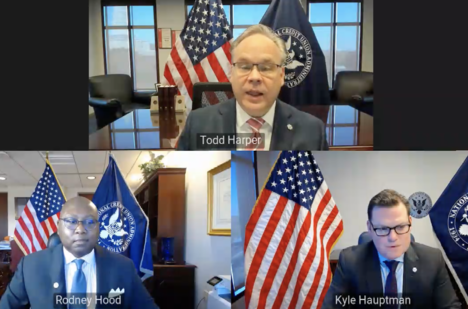
NCUA board members during November's virtual board meeting.
Not All Smooth Examining
But the virtual environment hasn’t been all smooth-sailing, according to NCUA staff.
Phelps told the board NCUA was able to conduct more examination work off-site than it had thought possible, noting that prior to the pandemic approximately 10% of exams were done remotely. Since the pandemic’s onset, however, about 3,800 examinations have been conducted, with nearly 100% done virtually.
But many of the level of review in many exams was not complete, according to Phelps, due to credit unions unable to provide information electronically or the examiner finding the process of reviewing the CU was difficult.
Phelps said many examiners/CUs reported technical issues, struggles with the secure transfer portal, and the ability of some CUs to convert paper files to electronic files.
Examiners believe examinations are more efficient and effective when on site, Phelps said.
Staff told the board the agency is now working with examiners to transition them back to on-site work.
During the pandemic NCUA has also seen an uptick in credit union that were late-filers with their call reports, with approximately 60 missing the deadline each quarter, up from approximately 20 prior to the pandemic, staff said. While NCUA has waived the late fees for late-filers over the past 18 months, it plans to reimpose fines on CUs for doing so beginning with the Dec. 31, 2021 reporting cycle, unless something dramatic related to the pandemic takes place, staff said.
Harper: ‘Tremendous Resilience’ Shown
Noting no one at NCUA could have anticipated the “extraordinary circumstances we found ourselves in these past 20 months,” NCUA Chairman Todd Harper credited the NCUA team for exhibiting “tremendous resilience.”
“By swiftly pivoting to a telework environment and continually working to address emerging risks, we have met the many challenges posed by the pandemic, including its economic fallout,” said Harper.
Steps Taken
Harper noted NCUA has:
- Increased the aggregate amount of loan participations
- Waived minimum earnings retention requirements and simplified net worth restoration plans for certain credit unions
- Suspended the required time frames for the occupancy or disposition of properties not being used for federal credit union purposes.
- When appropriate, extended expiring temporary provisions.
Harper further noted Congress enhanced the capacity and powers of the Central Liquidity Facility, and said he is hopeful the temporary enhancements as part of the CARES Act will become permanent.
Hauptman: Acknowledging a Burden on Small CUs
NCUA Vice Chairman Kyle Hauptman repeated a a point he noted he has made previously, that COVID-19, with all its terrible downsides, created a forced experiment that accelerated innovation and forever changed our thinking on working remotely.
“Remote flexibility is one of the few upsides from the pandemic,” Hauptman said, adding that it is still not “business as usual” and he is urging credit unions to work with the regions if they feel the need.
Hauptman said he has also heard concerns around the changes being made to call reports.
“While we believe the more streamlined reporting will ultimately be beneficial for credit unions, the burden of change falls heavily on smaller institutions,” Hauptman said. “NCUA must take this into consideration and adjust expectations accordingly. As we inch our way back to normal – whatever that turns out to be – I expect NCUA to remain flexible.”
Hood: Time to Return to the Office
For his part, NCUA Board Member Rodney Hood said he has been heartened over the past two years by how people have met the challenge of this pandemic. But there is a change he wants to see.
“With the agency now enforcing a vaccine mandate, I am now, for the second time, calling on the agency to bring back NCUA employees onsite,” Hood said. “We should move to normal operations in this ‘new normal’ environment as soon as practical but definitely by the first quarter of next year. In fact, when my office recently spoke to the head of our union, many of our examiners are eager to return onsite now. They have felt this way for months.
“Many of our credit unions want to have the examiners back,” Hood continued. “I have quite frankly been surprised by how many credit unions have told me that these one-on-one interactions makes them a better credit union and this interaction cannot suffice on video chats.”
‘Fears’ Shared
Hood said he “fears” that if the agency does not soon return to normal operations soon NCUA “will miss fraud and other safety and soundness issues that will not be found on the telephone or video conferencing. Further, I worry that new employees are not getting the same onboarding experience in a digital world. You cannot replace face-to-face human interaction.”
Preparing for Change in CLF
While Harper said earlier he would like to see changes made to the Central Liquidity Facility’s authority to borrow extended by Congress, Hood said NCUA must prepare for a world in which those authorities are not renewed.
“If that happens, we must plan for what will happen when our borrowing multiplier decreases for the CLF,” he said. “I also am concerned that we will no longer be able to have corporate credit unions act as an agent to make membership more economically feasible, so we need to communicate to credit unions what is going to happen if the provision is not extended in the law.”