

ALEXANDRIA, Va.–The NCUA board has approved 3-0 a new rule that updates the derivative investment authority for credit unions, but emphasized boards at CUs investing in derivatives must educate themselves and be knowledgeable about what’s involved before the agency will approve.
According to NCUA staff, approximately 30 credit unions are currently using derivatives to manage risk, but feedback indicates that number will now grow. To take advantage of the new authority, credit unions below $500 million in assets must apply to the agency, and all CUs must apply to use derivatives if they have a management rating below two.
NCUA staff said the application process will be “pretty simple” and will require an ALM model that incorporates a swap or a cap.
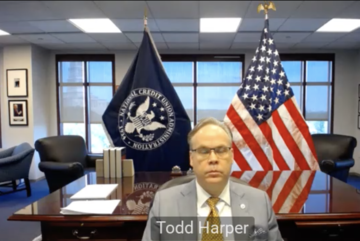
NCUA Chairman Todd Harper during hearing.
When the final rule, parts 701, 703, 741 and 746 was put out for comment at its October 2020 meeting, NCUA said it was seeking to “streamline and modernize” the authority and to help address mismatches brought on by the extended low-rate environment. The agency has stressed credit union use of derivatives must be backed by the appropriate expertise, and that it is looking to develop training for credit unions.
NCUA staff said the new rule is more “principals based” than the agency’s prior rules.
Three Changes
The agency, which adopted its first derivatives rule in 2014, said it received 17 comments on the proposal.
Staff said those comments led to three “substantive changes” in the final rule from the proposed rule, including:
- The final rule no longer has collateral requirements for cleared derivatives
- The new rule reverts back to the permissible counterparties requirement of the current rule
- The final rule will allow FCUs to engage in written options for the management of interest rate risk
Innovation & Scale
NCUA Chairman Todd Harper, who said that as the credit union industry grows and becomes more complex, the final derivatives rule is a good example of the agency working to innovate and scale its regulations, noted credit unions likely face a prolonged period of very low interest rates, meaning the ability manage interest-rate risk will be “crucial” to financial performance.
Harper said the rule also provides a way for smaller credit unions that demonstrate proficiency and obtain regulatory approval, to use simple derivatives to hedge their loan portfolios.
“Increasingly, the credit union system has turned to mortgage lending and the industry now has half of its assets in long-term real estate loans. A vast majority of those loans are at fixed rates,” said Harper. “The savings-and-loan crisis taught us what happens when an industry lends long at fixed rates and borrows short. Problems can happen when a depository institution moves from a low interest-rate environment, like we are experiencing now, into a higher-rate environment.
“In that regard, this final rule is forward-looking,” Harper continued. “More federal credit unions will gain access to the tools they need to manage interest-rate risk. So, this rule will help position credit unions for future success, provided they do so prudently.”
Board Education Needed
Harper said credit union board members must be the “first line of defense for the Share Insurance Fund,” and must have a “firm understanding” of derivative hedges and that that knowledge must be “reinforced from time to time through regular training and briefings in order to conduct effective oversight.”
Harper noted the new rule requires strong internal controls, including themseparation of duties to ensure effective governance.
Hauptman: There’s a Reason for the ‘S’

NCUA Vice Chairman Kyle Hauptman during meeting.
If some credit unions didn’t face significant interest rate risk, NCUA wouldn’t be talking about adding an “S” to its CAMEL ratings to specifically grade credit unions’ sensitivity to interest rates, noted NCUA Vice Chairman Kyle Hauptman.
During his remarks, Hauptman agreed derivatives are indeed a powerful tool, and “anything that’s powerful can likely cause harm. But there’s also harm in not allowing folks to use the best available tool. For example, you can try to manage interest rate risk without using derivatives, but it can be a bit like dealing with a fly on the window by throwing a brick at it. So it’s great to see that credit unions have already demonstrated safe derivatives usage.”
Since 2014, when NCUA first permitted limited usage of derivatives, Hauptman said there have not been material losses as a result and the agency has learned along the way, as well.
Like Harper, Hauptman also cited the long terms of mortgages as another reason credit unions need derivatives to better manage risks.
Hood: Not About ‘Speculation’
NCUA Board Member Rodney Hood said he “enthusiastically” supports the new authority, stating that “any tool that can efficiently and effectively improve financial performance and strengthen liquidity and capital is a sound pursuit, provided it can be done safely and affordably.”
Hood, who was chairman when the derivatives proposal was being developed, stressed the agency is only permitting the kind of derivatives that offer straightforward interest rate risk protection, such as interest rate swaps, futures and caps, and the agency has never “contemplated permitting speculation.”