

ALEXANDRIA, Va.–The deterioration in CAMELS code ratings among credit unions is evident in new data related to the National Credit Union Share Insurance Fund’s performance, even as the fund’s equity ratio ticked slightly up in the second quarter, according to a report made to the NCUA board.
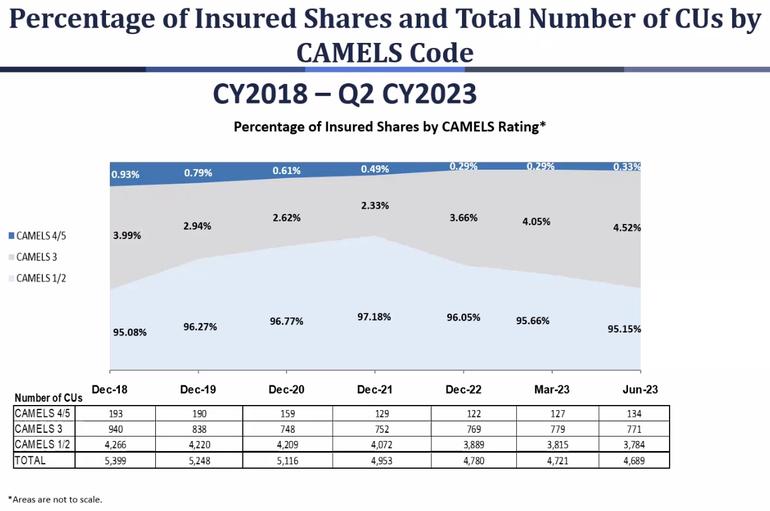
The erosion in CAMELS codes is especially evident in the growth in the number of CAMELS Code 3 credit unions, and reflects a variety of bottom line pressures most credit unions are feeling.
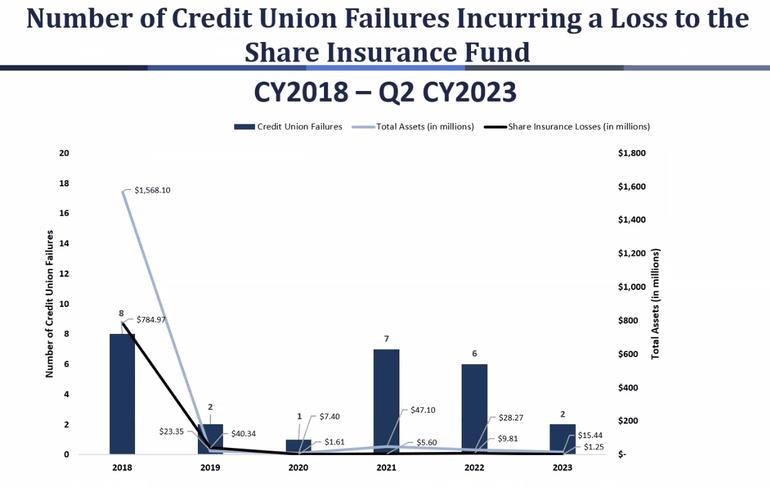
NCUA Chairman Todd Harper said during the meeting that the additional $6 million reserved since Q1 is “tied directly to the number of troubled credit unions we are seeing.” To date in 2023, there have been just two CU failures, both by small credit unions. Both of those failures occurred in Q1 at a cost of $1.5 million to the fund, with fraud playing no role in the failures (see chart, below).
“I cannot emphasize this enough: credit union executives, supervisors, and boards of directors must remain ahead of this trend by remaining diligent in managing the potential risks on their balance sheets,” cautioned Harper, who said additional deterioration in CAMELS Code ratings are expected for the remainder of 2023 and into 2024.
The Performance
Overall, insured shares have grown by $31 billion, or 1.8%, to $1.72 trillion, as of Q2, according to NCUA CFO Eugene Schied, who updated the board on the NCUSIF’s performance, balance sheet composition and more.
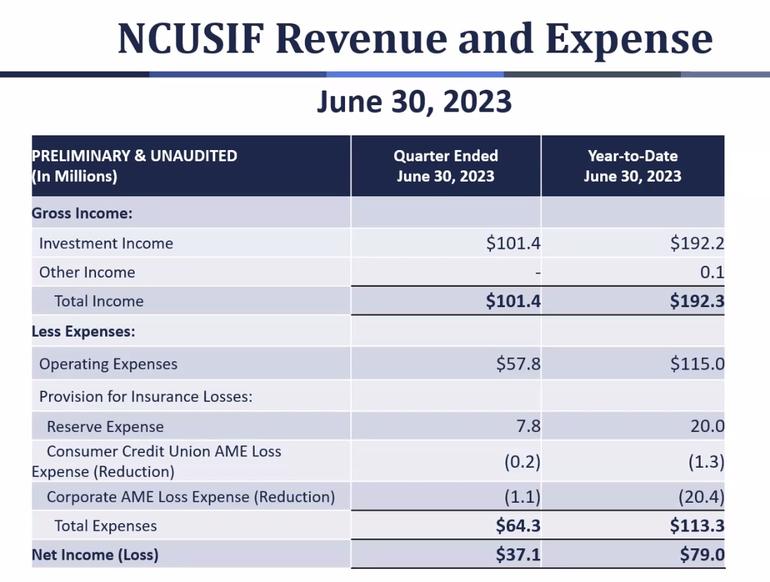
The fund’s performance is outlined in the slide below.
The NCUSIF’s balance sheet as of Q2 is shown below.
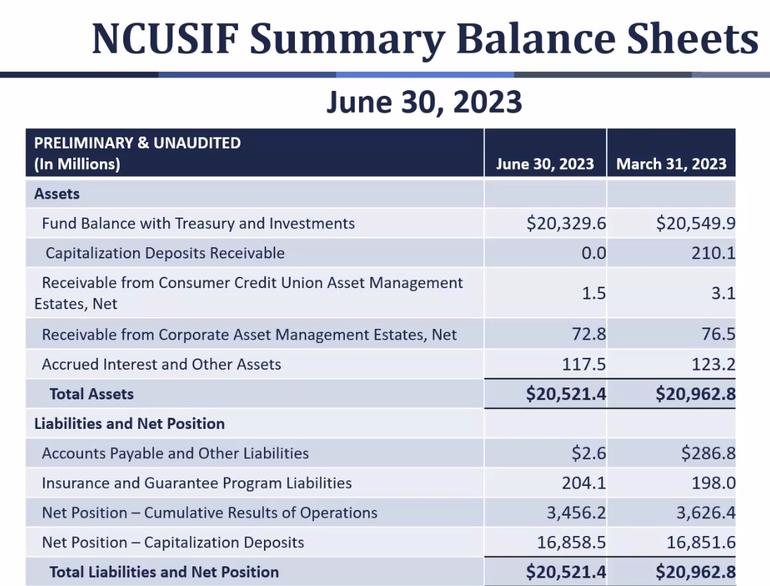
The fund had an ending reserve balance as of June 30 of $204.1 million.
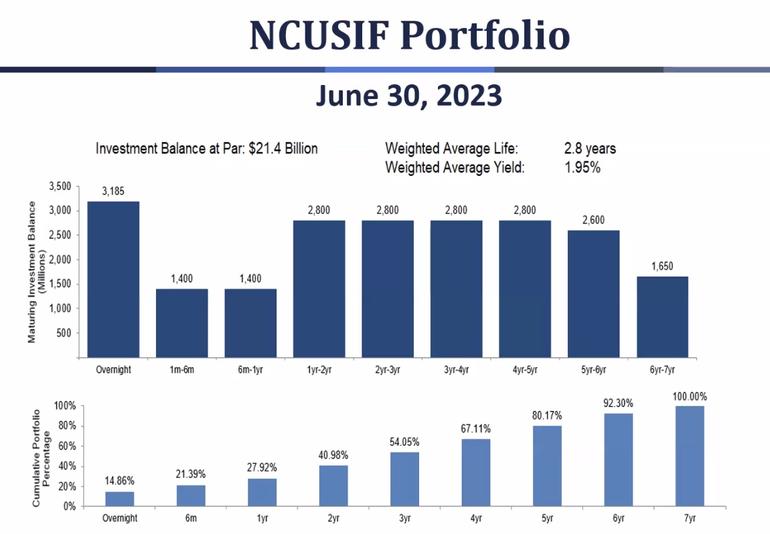
There is $3.99 billion in overnight investments as NCUA prepares to fund greater liquidity needs by credit unions.
As of Q2, the equity ratio for the fund was 1.27%, compared to a one-time high of 1.39% in 2018. Schied said the agency is projecting the equity ratio will be at 1.27% at year-end.
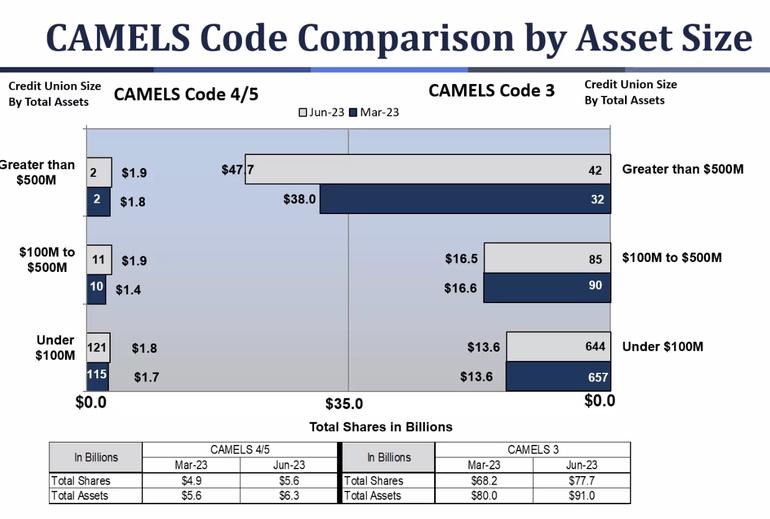
Schied shared data on CUs according to CAMELS code below, noting percentage of insured shares in CAMELS codes 3, 4 and 5 all increased.
Harper: Good News & Warning Signs
In his remarks following Schied’s update, Harper said the good news in the numbers is the rising interest rate environment boosted the Share Insurance Fund’s investment income to $101.4 million in the second quarter, up more than 50% compared to the same point one year earlier. He credited NCUA’s shift to overnight investments, where maturities are yielding more than 5%, for the improved income, as well as a decline in losses related to failed CUs for the fund’s performance (see slide, above).
Harper further noted the equity ratio is 1.27%, down three basis points from year-end 2022, but slightly higher than our initial projection of 1.25% earlier in the 2023.

NCUA Chairman Todd Harper during meeting.
Meanwhile, Harper said some stakeholders “may be concerned” with the reduction in the Share Insurance Fund’s total assets during the quarter, with $400 million reflecting unrealized losses, a product of the rising interest rate environment and the NCUA’s use of mark-to-market accounting methods.
Schied said he agreed that in the long term the fund shouldn’t incur any losses on these assets, as the NCUA intends to hold them until they reach full maturity.
The ‘Warning Signs’
On the other side of the equation, Harper said there are “warning signs” for the fund’s performance, including a slowing economy and stresses already being seen within credit unions related to rising interest rate risk and liquidity risk.
“We also see signs of emerging credit risk, especially among families with increasingly stressed household budgets and the post- pandemic uncertainties in the commercial real estate market,” said Harper. “These risks are playing out in rising delinquency rates for various loan types, including auto loans and credit cards, that are reflected in the latest publicly available call report data.”
Stresses can also be seen in the increasing number of composite CAMELS code 3, 4, and 5 credit unions, as outlined above. In particular, Harper noted the CAMELS Code 3 institutions increased sizably in the last quarter, especially among those complex credit unions with more than $500 million in assets.
Earnings Pressures
The pressure on earnings can be seen at several credit unions, including those with more than $1 billion in assets, Harper added.
In response to a question from Harper over whether he expects to see the number and level of assets in composite CAMELS codes 3, 4, and 5 credit unions to increase in the coming months, Schied cited the slide shown above on the percentage of insured shares in CUs by CAMELS code, and said he believes the factors currently being seen will continue the trend in CAMELS code erosion.
Be Prepared
“All of us should be prepared for a deterioration in the system’s composite CAMELS ratings later in the year and into next year,” cautioned Harper. “So, I cannot emphasize this enough: credit union executives, supervisors, and boards of directors must remain ahead of this trend by remaining diligent in managing the potential risks on their balance sheets and when monitoring economic conditions and the interest rate environment.”
Hauptman: Attention, Smaller CUs
Hauptman, who highlighted the growth being seen in credit unions in members and assets, said that as the NCUSIF hits its target of $4 billion in overnights over the next two months, it will be time to reevaluate the investment strategy.
“As a reminder, credit unions have access to a wide range of liquidity sources,” said Hauptman. “The small credit unions out there may not have liquidity options set up, so I implore those institutions to seek out liquidity options.”
NCUA Board Member Rodney Hood engaged in a lengthy Q&A with agency CFO Schied, which is reported separately here.