

ALEXANDRIA, Va.–The NCUA board has voted 3-0 to put out for 60-day comment a proposal related to providing more clarity—including additional graphics and charts--around how the overhead transfer rate (OTR) is determined. Comment is not being sought on the methodology itself, an issue on which the agency seeks input every three years.
Following the 60-day comment period and then consideration by staff of the feedback, NCUA said it would likely be mid-2024 before the proposal would be put before the agency’s board and would then apply to the 2025 OTR.
Prior to a vote by the NCUA board, agency staff explained that the objective is to provide clarity and transparency around the four principles behind the OTR methodology.
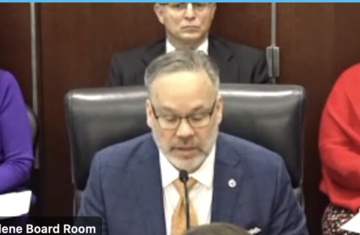
NCUA Chairman Todd Harper at board meeting.
The OTR determines the amount of funds transferred from the National Credit Union Share Insurance Fund to the NCUA operating budget to cover costs related to supervising state-chartered, federally-insured credit unions.
The rate has over the years been the source of an ongoing tug-of-war between federal and state chartered credit unions.
The Four Principles
Staff noted the methodology is based on four underlying principles in allocating the amount transferred, including:
- The first principle is 50% insurance related and reflects the time spent examining and supervising credit unions. “In this request for comment we clarified NCA's role as regulator versus an insurer,” staff stated.
- The second principle is 100% insurance related, in this case for the time and cost NCUA spends supervising or evaluating the risks posed by federally insured credit unions, state chartered credit unions or other entities it does not charter or regulate, such as third-party vendors and CUSOs. In the proposal the agency seeks to clarify its use of state supervisory authorities.
- The third principle is 0% insurance related and is related to how some of the agency’s offices provide a small amount of insurance-related activity.
- The fourth principle is 100% insurance related and is related to the NCUA 's role in administering federal share insurance and the share insurance. Comment is sought on the clarity of those allocation factors, NCUA said.
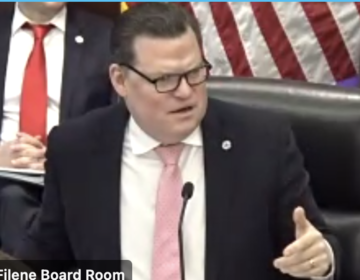
NCUA Vice Chairman Kyle Hauptman at board meeting.
Harper: The Goldilocks Dilemma
For NCUA, said NCUA Chairman Todd Harper, the overhead transfer rate methodology is a “classic Goldilocks style dilemma,” in that if the OTR is adjusted too low, federal credit unions must pay a greater portion of the NCUA budget. If it is calculated too high, the funding could fall disproportionately on state-chartered credit unions and insufficiently reflect the contribution of state supervisory agencies.
“Therefore, it's incumbent upon the NCAA to get it just right,” said Harper. “It's for those very reasons that the OTR methodology has at times become a controversial subject over the years as the NCAA has worked to find the correct balance.”
Harper explained that since 2017 the methodology has placed different risk weights on many activities to assist in calculating the final OTR each year.
“Today's request for comment would clarify the principles for calculating the OTR and the various cost allocations associated with the calculation,” said Harper. “The notice does not contemplate any substantive changes to the existing process. The notice provides interested stakeholders with graphs illustrating the principles. It provides important transparency on this mechanism for the funding the agency’s operations.”
Hauptman: Clearing up Confusion
NCUA Vice Chair Kyle Hauptman noted that a comprehensive methodology for calculating the OTR was adopted by the board in 2003 and remained in place until 2017, when after seeking comment the current OTR methodology was adopted.
“Despite greater transparency, there is still some confusion regarding the OTR methodology,” said Hauptman. “There has been much concern regarding the cost distribution of the overhead transfer rate. When considering both the operating fee and the OTR, for the 2023 budget year, federal credit unions account for 69% of the NCUA’s budget, and federally insured, state-chartered credit unions account for 31% of the NCUA budget. State-chartered credit unions are not responsible for paying the full amount of the OTR, which is where some of the confusion may lie.”
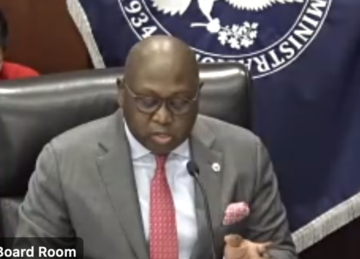
NCUA Board Member Rodney Hood at board meeting.
Hauptman stressed again that the comment period is to address what he called “industry interest regarding transparency and understanding of the allocation of insurance-related expense among charter types.”
He urged credit unions to take time to provide comment.
Hood: ‘Committed to Transparency’
NCUA Board Member Rodney Hood said he and the board are committed to improving transparency and to providing for more stakeholder involvement in its budget approval and funding process, which is the reason for the new comment period.
“I believe our current OTR methodology, which incorporates the four key principles in allocating agency operating costs, is very transparent and comprehensive, and appropriately distinguishes between the agency’s dual role as a prudential regulator and that of an insurer, which is unlike any other regulator,” Hood said. “Additionally, the current OTR methodology appropriately defines the safety and soundness related activities and other agency functions that are directly related to insurance, and accounts for the value of the insurance-related work performed by state supervisory authorities."