

ALEXANDRIA, Va.–Any premium to be charged credit unions to shore up the equity ratio of the National Credit Union Share Insurance Fund has been pushed further into the future, if one is charged at all.
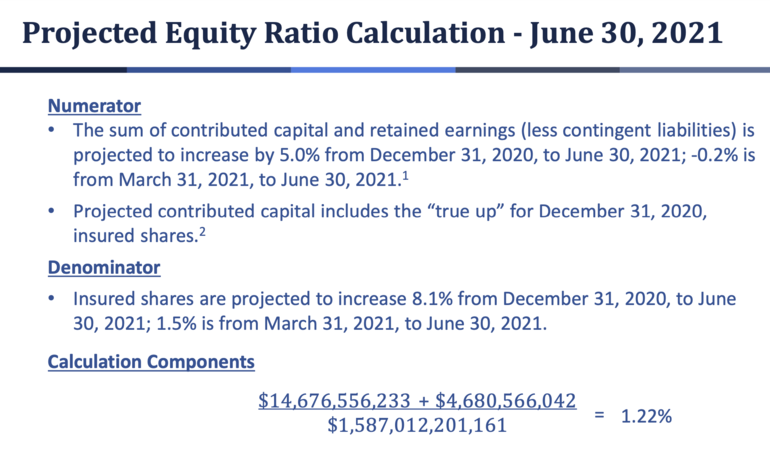
During the NCUA board meeting, the agency said it is projecting the equity ratio of NCUSIF will be 1.22% at June 30, 2021, just two basis points above the 1.20% ratio at which NCUA would be required to implement a net worth restoration plan for the fund.
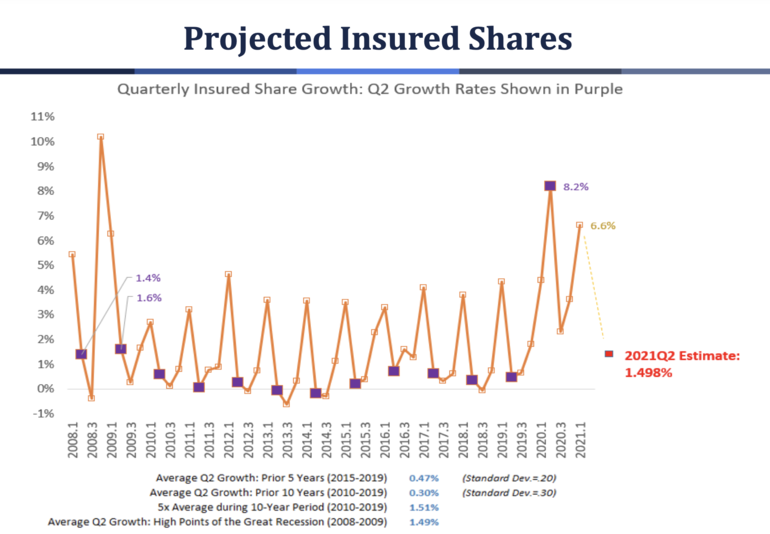
But as NCUA Chief Economist Andy Leventis noted, what might happen with deposit inflows continues to involve “great uncertainty,” and the fund ratio itself has been on the decline for several years (see chart).
Harper: ‘Choppy Wave Pattern’
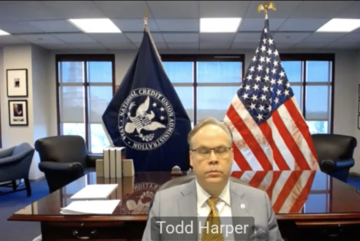
NCUA Chairman Todd Harper during hearing.
NCUA Chairman Todd Harper, who at earlier meetings has cautioned credit unions to prepare for a potential premium being assessed, noted that while credit unions have provided $850 million to the fund in the most recent semi-annual capital deposit true-up, the projected 1.22% ratio means it is not just two basis points away from the statutory minimum, it is four basis points below the equity ratio reported at the end of 2020.“I have come to think about the choppy wave pattern of the equity ratio rising and falling during the last several years as a stone skipping across the water. With each semi-annual true-up of a credit union’s 1% capital deposit, the equity ratio rises just like the stone after each bounce off the top of a wave,” said Harper. “But, no matter how far the stone travels, it continues to fall lower each time until it drops below the waterline because the forces pushing it down remain constant.”
Harper said two forces “remain constant,” low interest rates and elevated insured share growth, and it appears that absent some unknown external event those forces seem likely to eventually push the equity ratio below the 1.20 statutory minimum waterline required for establishing a restoration plan.
Four Options
Should the board establish a net worth restoration plan, Harper said there are four options: premiums at some point, a wait-and-see approach, or an approach of small and steady premiums over several years, or a large premium up front.
Seeking to avoid the kind of 69-basis-point premium NCUA charged as a result of the 2008 financial crisis, Harper said it’s the reason he has asked Congress to give the agency more flexibility to manage the fund.
“… The Share Insurance Fund must be able to weather any potential challenges resulting from the pandemic’s economic fallout. And, as we know from experience, credit union performance will likely trail any improvement in the labor markets by up to two years,” said Harper. “Accordingly, system-wide delinquency rates, which remained low through the end of 2020, could begin to rise as forbearance programs and eviction moratoriums end. As the full extent of the pandemic’s economic disruptions become more apparent in the coming months, some credit unions will likely see their performance deteriorate. It is also possible there may be credit union failures and losses to the fund.”
Hauptman: ‘Welcome News, But…’
NCUA Vice Chairman said the update is “welcome news as the equity ratio is a bit higher than we might have expected a few months ago.” But he also noted that had the newest projection been three basis points lower, the agency would be required to put together a restoration plan.
That said, Hauptman stressed three points:
- “We know that today’s situation is very different than the 2008-09 financial crisis. We get it. We know the equity ratio has fallen for very different reasons than it did in back then. Last time, it was all about defaults and delinquencies, and this time it’s about rapid share growth.”
- “We know this is likely temporary. All parties at NCUA know that the fiscal and monetary stimulus drove up share growth, and that just like a tide coming in and then receding, that money may leave credit unions as quickly as it arrived. Credit union CEOs have told me they consider it “hot money” that members may soon withdraw. After all, the American economy is the undisputed world champion at finding ways to get people to spend money.”
- “Thus, we’re aware that in the next year or so, the SIF’s equity ratio may well right itself without NCUA doing anything more. I just want to make that clear.”
A ‘Sugar High’
Repeating comments he made at the February board meeting, Hauptman called for caution and said the agency should allow credit unions to continue to focus on real member needs, “not our uneasiness about the future.”
While the economy has been on what Hauptman called a “bit of a sugar high,” he said he believes the “most prudent action is to stay on top of new developments while remaining cautious about taking money from credit union members and sending it to NCUA. An itchy trigger finger isn’t a good trait for a regulator nor for a fiduciary of the Share Insurance Fund.
Hood: ‘Exhaust All Options’
NCUA Board Member Rodney Hood pressed staff for clarifications around the NCUSIF’s investment decisions, including its move to a seven-year investment strategy from a 10-year strategy (as a result of the taxi medallion crisis). Staff told Hood the entire portfolio is modeled quarterly, including interest rate shocks, and the results are shared with the SIF Investment Committee.

NCUA Board Member Rodney Hood during meeting.
Hood, saying he was looking to exhaust all options before assessing any premium on credit unions, also asked about whether it is prohibited from selling Treasury investments.
Staff said the Treasury circular under which the agency operates doesn’t specifically state it can’t sell a Treasury in order to avoid a premium charge, but it is prohibited from engaging in anything that would result in “windfall gains or losses.” As a result, staff said, some would argue selling to take gains that might fall under that prohibition, plus any sale would require a reinvestment of the funds, most likely at a lower rate.