

ALEXANDRIA, Va.–The NCUA board has passed a rule aimed at assisting credit unions in doing loan workouts and providing greater assistance to members.
Final Rule, Party 741, Appendix B, Capitalization of Interest was passed by the board on a 3-0 vote.
Specifically, the appendix currently states that the credit union must have a loan modification policy with controls to ensure the loan workout actions are appropriately structured.
Agency staff said examiners are being instructed to not criticize CUs that are working with borrowers as part of their risk mitigation strategy intended to improve existing loans, even if the loan restructuring results in an adverse credit designation.
“The preamble does clarify the agency’s supervisory position for FICUs that may have already begun offering interest capitalization prior to the finalization of the rule,” agency staff told the board.
Agency staff further said the consumer protection guardrails include requirements that credit unions adopt policies and procedures with an ultimate goal of modifications leading to a favorable outcome for borrowers, including determining whether the borrower can repay the debt.
Harper: ‘Storm’ May Lie Ahead
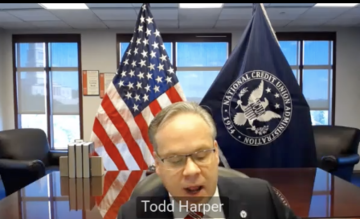
NCUA Chairman Todd Harper during board meeting.
NCUA Chairman Todd Harper called the rule “another targeted measure by the NCUA board aimed at helping credit unions and their members navigate the COVID-19 pandemic’s economic environment.”
Harper noted the final rule gives credit unions parity with banks, Fannie Mae, Freddie Mac, and the Federal Housing Administration, all of which already allow servicers to capitalize interest as part of a prudent modification program.
“For more than a year, several government stimulus programs and interventions have saved the economy from a more severe contraction,” said Harper. “But many of these initiatives are now starting to end. Only when these programs expire will we know the pandemic’s actual effects on consumers’ personal finances and credit union balance sheets.”
Harper said the expiration of unemployment benefits, mortgage forbearance programs, and eviction moratoriums will cause many households to experience financial stress in the months ahead, especially among the low-income.
“A personal finance storm could lie ahead for many, and credit unions need to have appropriate tools to support their members,” said Harper.
Harper said a prudently underwritten and appropriately managed loan modification, consistent with consumer financial protection laws and safe-and- sound lending practices, is generally in the long-term best interest of both the borrower and a credit union.
A ‘Floor, Not a Ceiling’
“That is what makes this final rule on the capitalization of interest such an important measure,” said Harper. “Specifically, the final rule would remove the prohibition on credit unions from capitalizing interest on loan modifications while maintaining the important prohibition on a credit union capitalizing credit union fees and commissions. It also establishes ability-to-repay requirements to ensure that the addition of unpaid interest to the principal balance of a mortgage loan will not hinder the borrower’s ability to make payments or become current on the loan.”
Harper said the NCUA board expects federally insured credit unions to provide capitalization of interest as only one of several components in any loan modification.
Harper added the new rule “establishes a regulatory floor, not a ceiling for consumer financial protection,” and said that in the long-term, “members will remember who supported them during their times of need.”
In response to a question from Harper over when Letters to Credit Unions will be issued and when CUs can use the new tool, NCUA staff said the Letter will be coming “as soon as possible.”
Hauptman: A ‘Surprise’ Finding
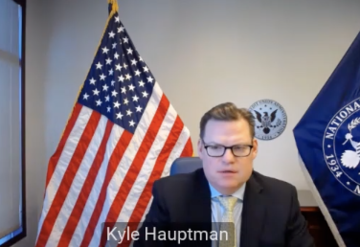
NCUA Vice Chairman Kyle Hauptman during board meeting.
NCUA Vice Chairman Kyle Hauptman noted that in setting forth requirements related to loan workout arrangements, the rule’s appendix currently states a credit union must have a loan modification policy with controls to ensure the loan workout actions are appropriately structured.
“It also states, ‘The policy must provide that in no event, may a credit union authorize additional advances to finance unpaid interest and credit union fees’,” stated Hauptman. “I was surprised to learn that credit unions are the only financial institutions that have this prohibition.”
Since joining the board in December of 2020, Hauptman noted virtually every board meeting has encouraged credit unions to work with members impacted by the pandemic and said he is pleased to see the new guidance being provided.
It’s What Credit Unions Do
“At its essence, this proposal is about supporting one of the key things that credit unions do: working with members in times of difficulty,” said Hauptman. “This amendment gives credit unions parity with banks, but it is also our acknowledgement of the importance of the difference between cooperatives and other kinds of lenders. While the CARES Act provided welcomed mortgage forbearance for borrowers who needed it, it has also resulted in an unprecedented amount of accrued interest for many loans.
“As the economy heals, and forbearance is no longer needed, many member-owners may be unable to meet the original loan terms,” Hauptman continued. “This rule change will provide credit unions a mutually beneficial option to help members-owners stay in their homes.”
What About Loan Churning?
In response to a question from Hauptman related to “loan churning,” staff noted the rule includes language that modifications more often than once a year will result in “higher scrutiny” from examiners, but that the rule is not a restriction or prohibition.
In response to a second question related to the expiration of forbearances and whether members will have to pay back skipped loan payments all at once, staff said how a CU handles such situations will need to be guided by “what kind of repayment plan is appropriate.”

NCUA Board Member Rodney Hood during board meeting.
Hood: Reducing Burden
NCUA Board Member Rodney Hood said a priority of his while on the board has been to reduce “burdensome regulations where appropriate, without losing sight of our safety and soundness mission,” adding that he regrets credit unions did not have “this tool in the toolbox” earlier in the pandemic.
Asking by Hood why the rule matters now, Myra Toeppe, director of NCUA’s Office of Examination and Insurance, said the rule isn’t just a response to the pandemic, and that moving forward it gives credit unions another tool to use to help members modify loans.
NAFCU Response
“NAFCU applauds the NCUA for approving a final rule allowing credit unions and their members to capitalize interest on loan modifications,” said NAFCU President and CEO Dan Berger. “The NAFCU team worked hard to advocate for this rule as it will provide credit unions with flexibility and their members with a safe, sound solution with strong consumer protections that will help them manage their loan payments amid the COVID-19 economic recovery. We thank the NCUA Board for listening to our feedback and instituting this rule.”