

ALEXANDRIA, Va.–The NCUA board has voted 3-0 to set the Normal Operating Level for the National Credit Union Share Insurance Fund at 1.33%, down from the current 1.38%.
The change and statements made by board members indicate credit unions should not expect an NCUSIF premium needs to be included in their 2022 budgets.
The board last considered the policy for setting the NOL in 2017. While the Share Insurance Fund continued to show solid performance throughout 2021, the equity ratio is projected to rise only to 1.28 at the end of the year.
The Federal Credit Union Act requires the Normal Operating Level to be set at no less than 1.2% and not more than 1.5%. It was set by the board at 1.38% for 2020, a level that was maintained for 2021. The NCUSIF has approximately $21 billion in assets.
Credit Union Feedback
After NCUA put out for comment its proposal on setting the NOL, Russell Moore, risk officer in the Office of Examination and Insurance, told the board the agency received 23 comment letters from leagues, associations credit unions and CUSOs, with a working group formed at NCUA in response.
Moore said the majority of responses continued favoring the use of a moderate recession for evaluating the fund’s performance and for modeling the NCUSIF performance for a period of less than five years, among other points raised. Moore said the working group disagreed with using a model of less than five years and recommended to the board that the five-year timeframe be maintained.
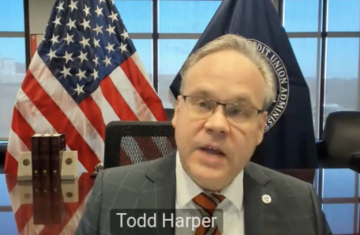
Harper noted that setting the normal operating level is a critical part of the board’s management of the Fund, and he quoted former NCUA Chairman J. Mark McWatters as stating in 2017, “The NCUA must be mindful not to hold too little equity in the Share Insurance Fund, with the corresponding risk that premiums will be necessary when credit unions can least afford them. Nor should the NCUA hold too much equity, which could lead to underutilization of resources within the credit union community. Instead, the goal should be to have a reasonably prudent level of equity consistent with contemporary risk exposures to fulfill our duty in managing the Insurance Fund.”
Harper said “much has changed since 2017, but the wisdom of his statement still holds true.”
‘There is Nothing Normal’
“Many within the credit union system undoubtedly wanted to see the normal operating level return to 1.30%, which is where it has been historically before the Temporary Corporate Credit Union Stabilization Fund was merged into the Share Insurance Fund in 2017. In normal times, that might make sense,” said Harper. “However, there is nothing normal about what we have all experienced for nearly two years because of the COVID-19 pandemic. No previous recession or financial crisis that I have seen in my lifetime has caused such fundamental shifts in the way that credit unions provide services to their members, and to the ways in which we live, work, and interact, than this global pandemic.”
Citing figures on employment and inflation, and recalling a period 15 years ago when the fund “teetered precipitously close to a danger zone, Harper said the resulting “uncertainty” requires the board to strengthen the Share Insurance Fund to “better prepare for the future.”
Harper called setting the normal operating level at 1.33% is “prudent.”
Hauptman: Heard the ‘Concerns,’ But…
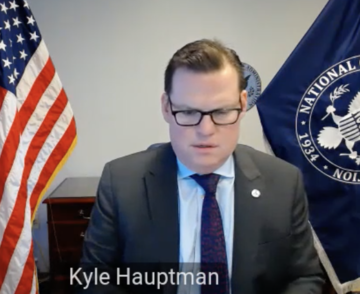
NCUA Vice Chairman Kyle Hauptman said he has heard “concerns” from within credit unions over the potential for premium as the result of the dip in the NCUSIF’s equity ratio as deposits flowed into credit unions, but that dip was “temporary” and is correcting itself.
Hauptman noted that money at credit unions normally earns a higher return than is earned by the return on Treasuries in the SIF, which means that every dollar in the SIF makes CUs and their members “poorer.”
Moreover, said Hauptman, the decrease to 1.33% from 1.38% doesn’t really matter that much as a “practical matter,” said Hauptman given the low returns.
Hauptman asked NCUA staff about statements from some long-time professionals in credit unions that based on the history of the NOL, it should be at 1.30%.
Acting Director of Risk Management David Blanchard responded by saying the NOL is not a “short-term measure” and is a measure of what the liquidity should be over a five-year period, which allows the fund to be prepared for the “unpredictable” and avoid triggering a premium.
Hood: Questions Around Methodology, Call for More Transparency
NCUA Board Member Rodney Hood noted that earlier this year he had called for setting the Normal Operating Level at 1.30%, at least temporarily, and that when he called on lowering the NOL he had done so because it “became clear to me that the current NOL was too high, because the taxi medallion crisis is behind us and any risks from the closure of the Temporary Corporate CU Stabilization Fund have generally ceased.”

Hood noted that from 1984 to 2017 the NOL was set at 1.30 and remained at that level through times of conflict and times of relative calm.
“As we approach 2022, and now that we have a few years of historical data to review the 2017 policy, it is appropriate to take a look at the facts,” said Hood. “This is an issue where I have seriously studied over the last several months, so my views have evolved. Here is my thinking: If 1.30 is not adequate, I think the burden of proof is on the NCUA to show that this figure is inadequate.”
Other Points Raised
Other points made by Hood included:
- “Credit unions are legally committed and bound to update a large majority of the NCUSIF equity contribution. Credit unions today provide the bulk of the capital contributions that are the basis of the fund's soundness. It's the cooperative insurance system prudently run by the NCUA. A premium is always an option under the law, but it can only raise funds to a Normal Operating Level of 1.30. Having a Normal Operating Level above 1.30 negates a lot of the benefit that credit unions may receive by perpetually underwriting the 1% capital commitment to the NCUSIF.”
- “The vice chairman often talks about incentives. As he puts it, you get what you incentivize,” said Hood. “ So, moving forward, I would like to see if we can better incentivize the loss reserves with actual losses incurred. And this is relevant because the more we hold in loss reserves, the lower the equity ratio.”
Hood also had staff walk through the details around the assumptions and calculations involved in setting the NOL. The agency’s chief economist responded by saying the agency uses a “moderate recession” in doing its modeling, in addition to examining other potential outcomes.
Call for Greater Transparency
Hood said that while he believes a case can be made for setting the NOL at 1.30%, “since today’s proposal reduces the NOL to 1.33, it is something I can support since it removes things from the NOL calculation that are no longer relevant–the risks posed by the closing of the temporary corporate credit union stabilization fund, for example.”
He concluded by questioning if the agency could commit to making a detailed calculation of the assumptions used to calculate an NOL public every year, so that “credit unions do not feel like this calculation is done without transparency.”