

ALEXANDRIA, Va.–The NCUA board has voted 3-0 to adopt its final rule on the CAMELS rating system, approving a plan to add an “S” for market sensitivity to its examination tool.
Technically, the change affects Parts 700, 701, 703, 704 and 713 of the CAMELS Rating System.
NCUA staff members Tom Fay, director of Capital Markets; Rob Bruneau, senior capital markets specialist in the Office of Examination and Insurance; and Marvin Shaw, senior staff attorney in the Office of General Counsel addressed the board on the proposal.
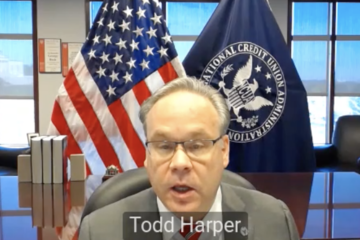
NCUA Chairman Todd Harper during board meeting.
The agency staff members said NCUA received few comment letters on the CAMELS proposal, and of those expressing concern it had to do with potential costs, especially for smaller credit unions.
Agency staff and the NCUA board members said they do not anticipate any additional costs to credit unions from the change.
NCUA itself, however, will spend up to $546,000 on internal processes in order to make the change.
In addition to the S, the new rule, which is to go into effect April 1, 2022, also updates the Liquidity component. The agency said it will host a webinar in the future to help credit unions prepare for the change, although staff indicated there is little credit unions will have to do differently as a result of the change.
Harper: ‘Good Public Policy’
“In my view, the NCUA’s adoption of the CAMELS system is good public policy and long overdue,” said Chairman Todd Harper.
“Separating the liquidity and market sensitivity components will allow the NCUA to better monitor these risks within the credit union system, better communicate specific concerns to individual credit unions, and better allocate resources.?
Harper, who noted that all of the other federal banking agencies added a market sensitivity risk component to their CAMEL systems in 1997 and that 24 state regulators also already do so, said he expects those state regulators that have not yet moved to CAMELS will be doing so.
NCUA’s Inspector General recommended the “S” be added in 2015.
“The credit union system, however, has become more complex during the last 24 years. In 1997, only 19% of a credit union’s balance sheet was in mortgage-related assets,” said Harper. “That figure has more than doubled to 45% as of the end of the second quarter of 2021, and a sizable portion of these mortgages are in fixed-rate products.”
Harper said the new CAMELS update will help to better protect the NCUSIF and taxpayers, and that separately the Liquidity and Market Sensitivity components will help CUs to better react to and prepare for future challenges.
What About CARES Act Change?
Following his statement, Harper asked agency staff about one component of the CARES Act that affected the Central Liquidity Facility by allowing all 11 corporate credit unions, as an agent, to buy CLF capital stock for a subset of their member credit unions.
Each corporate credit union determined member credit unions with assets less than $250 million as their subset and purchased capital stock on their behalf, thus making them eligible to apply for aCLF loan, Harper noted, before reminding the temporary provision will expire Dec. 31.
“Do you anticipate that this will have an impact on the CAMELS liquidity risk rating for credit unions with less than $250 million in total assets?” Harper asked.
Agency staff responded by saying barring any significant changes in a CU’s liquidity position or risk management practices, it’s unlikely a CU’s liquidity rating would be rated any differently.
Staff further said it has made clarifying changes to descriptions of the L and S components to provide greater clarity to credit unions.
‘Hopeful’ For One More Change
Harper added he remains “hopeful” the agency will eventually pursue a similar action for the management component of the CAMELS rating when examining the largest credit unions by breaking out as a separate metric credit unions’ compliance with consumer laws.
Hauptman: ‘More Transparency Added’
Board Vice Chairman Kyle Hauptman said he believes the change to the CAMELS ratings should provide credit unions and the NCUA more transparency on interest rate risk in federally insured credit unions.
“Separating interest rate risk from liquidity risk should also make the examination process more efficient,” he said. “Banking regulators have done this for years, and while we don’t have any obligation to follow what they do, the fact is that adding the S to CAMELS doesn’t appear to have caused trouble?”
Hauptman said, however, that while distinguishing between the management of funds and the sensitivity to interest rate risk is more precise and therefore a more desirable method for evaluating risk, he is “concerned that the implementation could be disruptive especially for credit unions under $50 million in assets. More than 50% of federally insured credit unions fall in this category, and as we know, they are hit hardest by even the most modest regulatory changes. Just because NCUA was already evaluating interest-rate-risk doesn’t mean credit unions don’t have extra work to do to comply with today’s rule.”
Addressing One Concern
Hauptman further noted that currently, credit unions with less than $50 million in total assets are not required by regulation to have a separate Interest Rate Risk (IRR) policy, and that NCUA’s examination of IRR will remain constant during the transition to CAMELS.
“A number of credit unions have expressed concern that a separate rating for IRR could impact their overall CAMELS rating,” said Hauptman. “I understand that the underlying framework to assign the composite CAMELS rating is not changing, and that the composite does not represent an arithmetic average of assigned component ratings.”
Hood: ‘Timing is Opportune’

NCUA Board Member Rodney Hood during board meeting.
NCUA Board Member Rodney Hood said of the new rule, “The timing is both opportune and appropriate. I certainly believe that updating NCUA’s rating systems to CAMELS will help credit unions to clearly understand the examiner’s assessment of interest rate and liquidity risk by citing separate S and a separate L component rating. This also has been a long and outstanding issue that has been identified by our Office of Inspector General for quite some time now.”
Hood said the adoption of CAMELS will not change the examination procedures for interest rate and liquidity risk assessments, and that examiners will continue considering the interrelationships between and among the seven risks categories and how they inform six rather than five CAMEL components when assigning the composite CAMELS rating.”
A Final Question
Hood asked agency staff about a recent GAO report, “NCUA: Additional Actions Needed to Strengthen Oversight,” in which the CAMEL rating system at NCUA was reviewed in detail, and how NCUA plans to address the findings.
Agency staff responded by saying the GAO report specifically recommended the agency’s executive director more fully leverage CAMEL ratings into composite ratings in enforcement decisions, and that the agency agrees that additional ways to extract more information into its supervisory program is appropriate.