

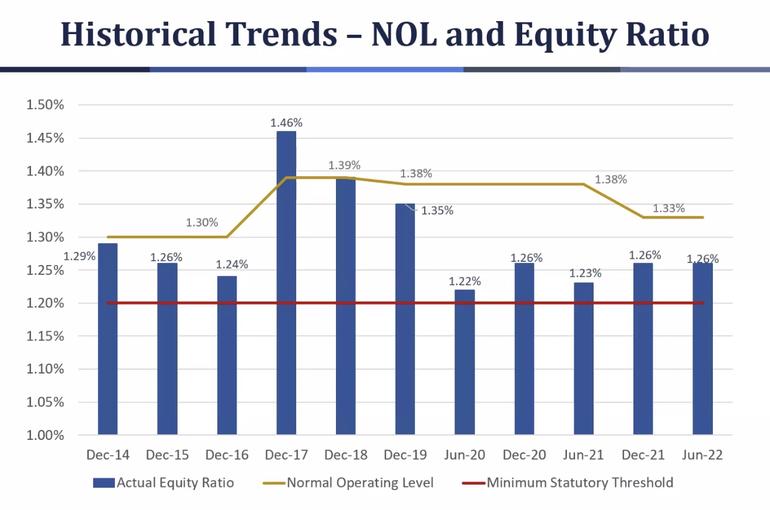
ALEXANDRIA, Va.–The Normal Operating Level (NOL) for the National Credit Union Share Insurance Fund (NCUSIF) will remain at 1.33% in 2023, the same level as 2022.
The NOL determines whether credit unions pay a premium to support the fund’s reserves, are paid a distribution when reserves exceed the NOL, or no action is taken.
According to agency staff who made a presentation to the NCUA board during its meeting Thursday--Amanda Parkhill, deputy director, David Blanchard, risk management division director in the Office of Examination and Insurance, and Andy Leventis, chief economist—the projected year-end ratio for the NCUSIF is 1.30%.
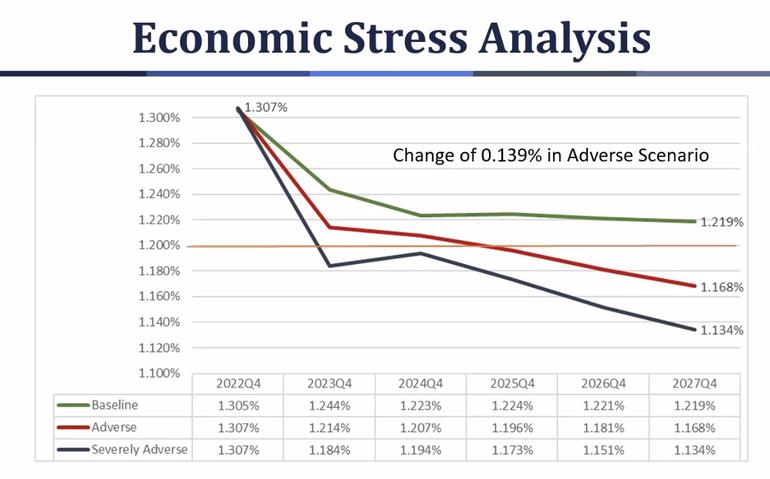
Leventis said that due to market conditions the equity ratio of the NCUSIF is expected to continue to decline, as outlined below. Staff also said the agency can expect to see the number of CAMELS code 3, 4 and 5 credit unions increase in the years ahead.
Harper: ‘Solid Footing, But Some Cracks’
Todd Harper
In his comments, NCUA Chairman Todd Harper said the $20.2 billion in assets behind the Share Insurance Fund currently shield four-in-10 Americans who use a federally insured credit union.
“The Share Insurance Fund guarantees more than just their accounts or balances on a spreadsheet. It protects the financial well-being and dreams of families, businesses, and communities who have entrusted their hard-earned savings in federally insured credit unions,” said Harper. “The Share Insurance Fund is also a critical bulwark which helps to maintain the economic and financial stability of our nation.”
Harper said that overall credit unions “remained on a solid footing during 2022. Total loans, assets, and insured shares and deposits all increased. Yet, some cracks have started to form around the system’s edges and within some credit unions. In the year ahead, we need to ensure that these small fissures do not grow into sizable fault lines.”
Harper reminded that the NCUSIF’s November report showed an increase in the number of credit unions with a composite CAMELS code rating of 3, 4, or 5 in the third quarter, while several credit unions have also recently experienced liquidity issues, including some with more than a billion dollars in assets.
‘Sound’ Decision
“Given the level of economic uncertainty in the year ahead and the growing stresses we see within the credit union system, the staff’s recommendation to maintain the normal operating level at 1.33% in 2023 is sound,” Harper said. “As detailed on slide 15 (of presentation made to board), we could have opted to round the normal operating level up to 1.34% based the December 2022 estimate of 1.339%. But, because this figure was just a half of basis point different from the actual normal operating level for December 2021, we decided to maintain the current level.”
In response to a question from Harper over the “slow and steady decline in the NCUSIF equity ratio,” Leventis said he expects the trend will continue.
“Increases in interest rates certainly have been helpful they've increased SIF investment returns, but on balance I think we're still swimming against the tide. With some back of the envelope calculations you can easily see that without pretty sharp increases in interest rates or a dramatic slowdown in share growth, the equity ratio will continue to decline over the next few years,” said Leventis. “(As for) the second question on share growth, there's a clear empirical phenomenon in which economic stress like a modern recession tends to increase share growth. There's a flight to quality…Share growth tends to drive down the equity ratio…In addition to insured share losses, elevated share growth tends to play a significant role in that five-year decline.”
Increase in CAMELS 3, 4 & 5 CUs
In response to another question from Harper, Blanchard said it is expected the number of CAMELS code CUs rated 3, 4 and 5 will also increase over the next few years.
Kyle Hauptman
Hauptman: What is ‘Worth Emphasizing’
In his remarks, NCUA Vice Chairman Kyle Hauptman noted that just a few months ago, he voted, along with the rest of the board, to lower the NOL to 1.33% from 1.38%, where it had been for several years.
said NCUA Vice Chairman Kyle Hauptman. “Now, I don’t pretend to know that 1.33% is the magic, perfect net operating level. I do know that, for the moment, moving it from 1.38% to 1.33% is a moot point because the fund isn’t close to either number. And if someday we wind up back in that range, the correct NOL level will be a high-class problem to worry out. Given the current rate environment, I do not believe any of us believes we will be getting close to that number. That said, every basis point over 1.30% represents money credit unions could put to good use.”
Hauptman added he believes it’s “worth emphasizing credit unions are doing their part,” noting losses to the fund have been low.
‘An Additional Factor’
“One additional factor in determining the adequate level of the fund’s equity is how well we manage our budget,” Hauptman said. “The cost of managing the risk in the fund directly impacts the equity ratio. The more NCUA spends on itself, the lower the equity ratio. NCUA can’t, in good conscience, spend additional millions on programming for ourselves,the 1,400 NCUA employees, while also claiming our insurance fund needs more cash. I realize today’s briefing is strictly about the Normal Operating Level calculation, but I hope you’re picking up what I’m putting down.”
Hauptman further noted that nearly two years ago he had pointed out the NOL was being affected by COVID stimulus funds flowing into credit unions, combined with the effects of low investment returns, and that he had suggested the federal spending should push Treasury yields higher, leading to higher investment returns, which has been the case.
Hood: What Do The Basis Points Cost CUs?

Rodney Hood
In his remarks, NCUA Board Member Rodney Hood recalled that in 2021 he called for setting the NOL at 1.30%, at least temporarily, as the risks from the taxi medallion crisis was behind the agency and any risk from the closure of the temporary Corporate Stabilization Fund have generally ceased.
“From 1984 until 2017, the Normal Operating Level set by the NCUA board was 1.30%,” said Hood. “It stayed at 1.30% during times of conflict, and in times of relative calm, through economic booms and busts and through societal and technological changes. It stayed that way until 2017, when I believe the agency was worried about the failure of credit unions heavily concentrated in taxi medallion loans and quite rightfully so.
“I'll note when the NOL increase was done in 2017, the board at the time indicated the increase, and I quote from the remarks at the board meeting, ‘...was intended to be temporary’,” Hood continued. “ I now want to pose what I realize is a hypothetical question: For every basis point increase in the NOL, how much does that have the potential to take away from credit unions and ultimately their member‑owners in the form of a potential dividend based on this current point in time, assuming hypothetically that we are, in fact, required to pay a dividend?”
In response, staff said if insured deposits remain static, every basis point represents about $170 million in retained earnings.
Questions & Answers
In response to other questions posed by Hood, staff said:
- The NCUSIF has a $183.2 million in loss reserve balance
- The taxi medallion CU-related losses totaled more than $800 million to the NCUSIF
- Five years ago the baseline forecast for losses to the NCUSIF were in the range of $50-$80 million. The average loss was $51 million, with the defunct taxi medallion lender Melrose Credit Union representing a unicorn-type of loss
- NCUA has assessed premiums in its history three times--1991, 2009 and 2019—excluding the premiums assessed for the corporate CU stabilization fund
- The agency is projecting additional share growth for 2023