

ALEXANDRIA, Va.–The number of credit unions that have seen their CAMELS codes slip in Q3, primarily to CAMELS code 3—and that includes CUs of more than a billion dollars in assets--was apparent in an update provided to the NCUA board on the state of the National Credit Union Share Insurance Fund.
NCUA Chairman Todd Harper cautioned during the November board meeting that there are some “flashing warning lights” that credit unions need to be watching, and he stressed CUs must “remain diligent" in managing risk.
During the board’s meeting, NCUA CFO Eugene Schied provided the overview on the NCUSIF as of Sept. 30, as outlined in the charts below. The slide in CAMELS codes ratings was apparent, with increases in CAMELS code 4 and 5 credit unions. In nearly all cases, the poorer CAMELS ratings reflected liquidity and other pressures facing many credit unions as interest rates have risen, affecting both shares and loans.
The one highlight of Schied’s report: the NCUSIF is currently earning about $770,000 every 24 hours on its overnight investments.
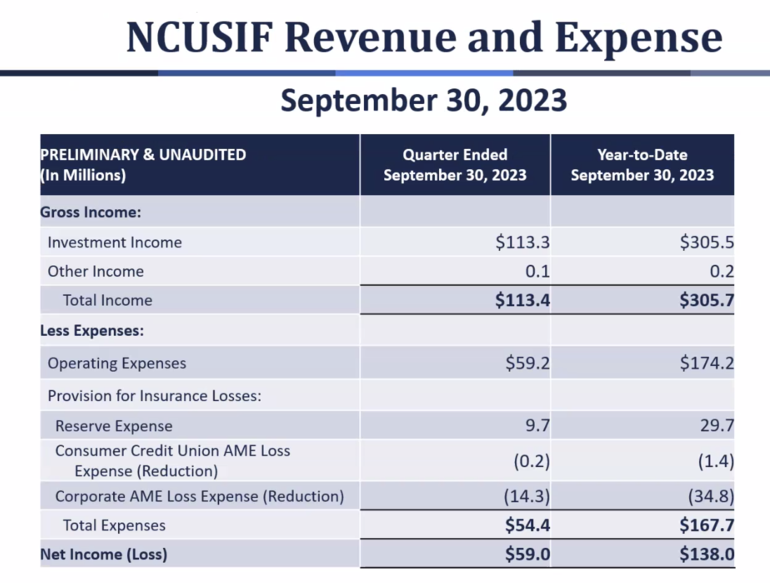
Overall, Schied said the NSUSIF saw $59 million in net income during Q3 on total income of $113.4 million from the entire portfolio, which was mainly the result of investment income and treasury securities investment income, which increased 12% when compared to the prior quarter and 54% when compared to the third quarter of 2022.
The asset management estate also performed above expectations, he said.
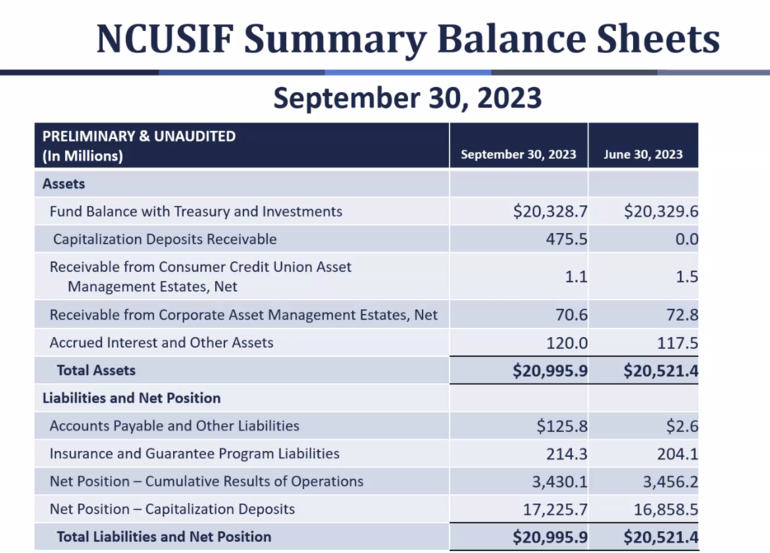
Worth noting on the summary balance sheet, said Schied, is the NCUSIF recognized the capitalized deposits receivable of $475 billion.
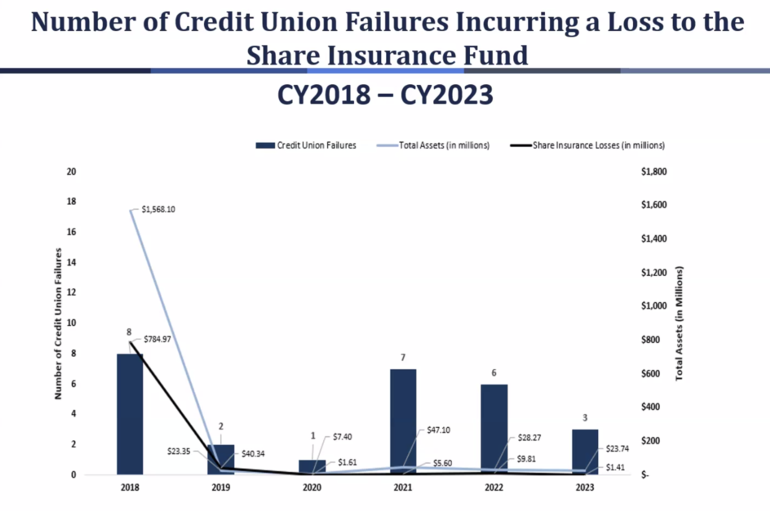
There have been three credit union failures through Q3 at a cost to NCUSIF of $1.4 million. Fraud was not a contributing factor in any of the failures, Schied said.
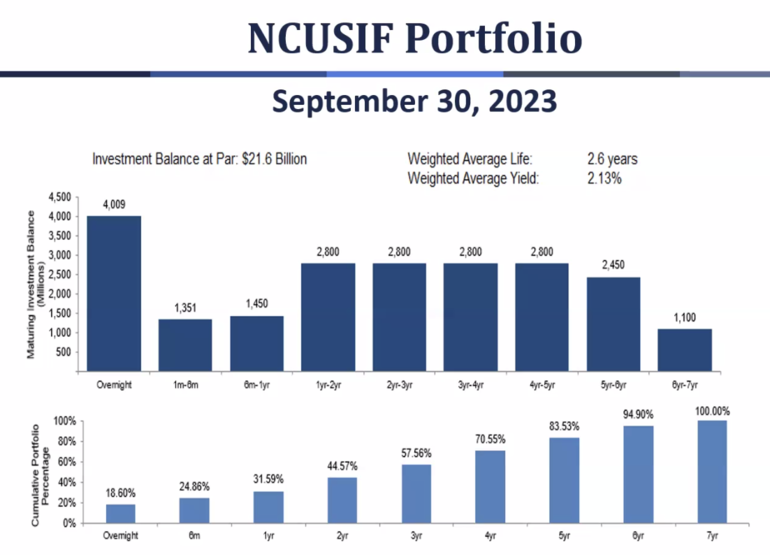
Schied said NCUA has met its target of $4 billion (it’s at $5.2 billion) for investments in overnights to meet the liquidity needs of credit unions, and has returned to its laddering strategy for investments. As noted above, that portfolio is earning $770,000 every day for the NCUSIF.
The equity ratio of the NCUSIF as of June 30 was 1.27%, a decrease of three basis points from year-end 2022.
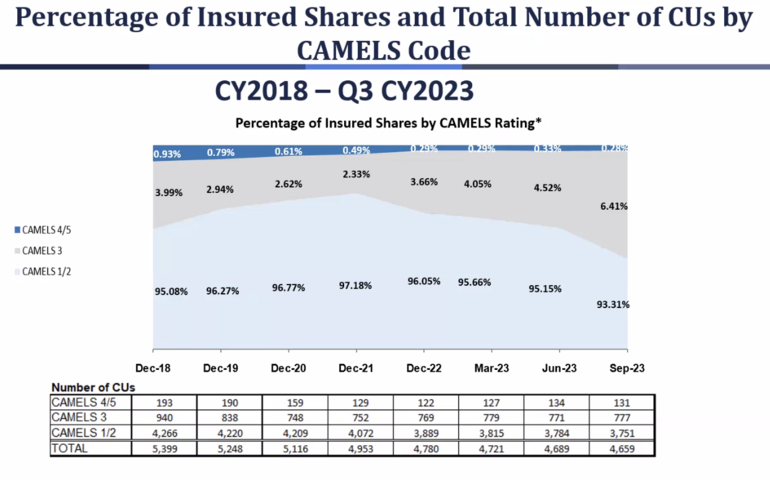
Schied flagged that the percentage of insured shares in CAMEL code 3, which have increased, while percentage of shares in CAMEL code 1, 4 and 5 CUs, decreased.
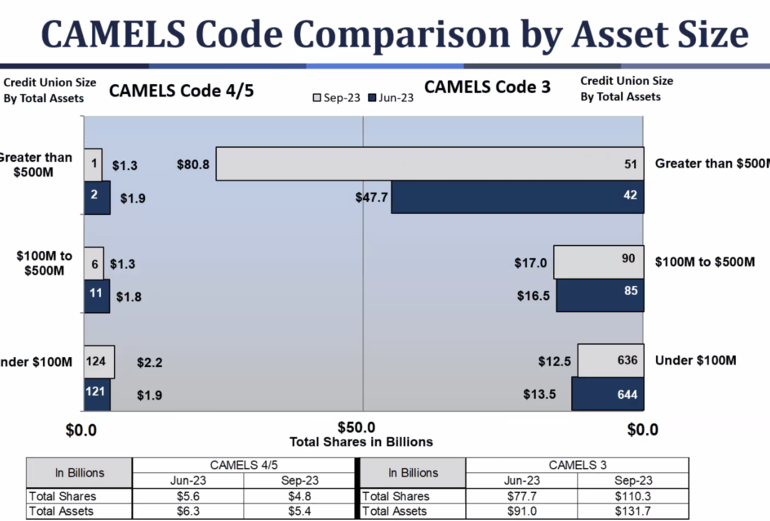
There are 121 CUs that are CAMEL Code 4 and 5, most of which are below $100 million in assets, Schied reported.
There are 777 CUs CAMELS Code 3 credit unions.
Harper: ‘Flashing Cautionary Lights’
“The Share Insurance Fund’s performance in the third quarter of 2023 mirrors the industry’s financial performance over the last year,” said NCUA Chairman Todd Harper. “Like the credit union system, the Share Insurance Fund is performing generally well overall. But, there are some flashing cautionary lights that we should all heed and act upon.”
Among those flashing lights, according to Harper:

NCUA Chairman Todd Harper During board meeting.
- Growing liquidity, interest rate, and credit risks. “In today’s report, we see that stress firsthand, especially in large, complex credit unions with $500 million or more in assets,” Harper said. “In fact, as shown on slide nine, the number of large, complex credit unions with a composite CAMELS code 3 rating increased by nine credit unions to a total of 51 credit unions in the third quarter of 2023.”
- Assets in the CAMELS code 3 group for credit unions of all sizes increased to $131.7 billion, 45% higher than Q2. “This sudden rise may be startling for some, but it should have been expected,” said Harper. “After all, the continued high levels of interest rate risk have increased credit union liquidity risks, contributed to asset quality deterioration and capital erosion, and placed pressure on earnings.
- Billion-Dollar CAMELS 3s. “What is most concerning for me, however, is the rapid rise in total assets for composite CAMELS code 3 billion-dollar-plus credit unions,” Harper stated. “ If not addressed quickly by credit union management, these problems could escalate into composite CAMELS code 4 and 5 ratings and even failures. And, it’s the billion-dollar-plus credit unions that pose the greatest risks to the Share Insurance Fund.”
Need for Resources
Harper said the rising risks within the credit union system also demonstrate why the NCUA board must ensure the agency’s 2024 budget has sufficient resources to examine, supervise, and mitigate these growing risks.
“Some may not like the size of the increase proposed in the staff draft budget, but it is our job to protect credit union members and the system,” said Harper, hours before the agency’s public budget briefing is to be held.
In response to a question from Harper over the 275-basis point increase in the percentage of insured shares held by composite CAMELS code 3 credit unions since the end of 2022, and whether the agency has ever seen such growth in prior business cycles, Schied said one would have to go back to the Great Recession of 15 years ago to see such a trend line.
‘Can’t Stress This Enough’
Returning to a point he made several times, Harper added, “I cannot emphasize this enough — credit union executives, supervisors, and boards of directors must remain diligent in managing the potential risks on their balance sheets and when monitoring economic conditions and the interest rate environment. Today’s economic environment requires active — not passive — management by all.”
Hauptman: There are Stresses, But…

Like Harper, Hauptman pointed to strains on credit unions due to higher inflation and interest rates, as well as liquidity pressures. He noted, for example, delinquency rates for loans rose slightly to 63 basis points and, like Harper, he pointed to the rising number of CAMELS code 3, 4, and 5 credit unions, especially among credit unions with more than $500 million in assets.
“However, I want to stress that credit unions have demonstrated stability and resilience in the face of economic challenges,” said Hauptman. “As of June 30, the system’s net worth ratio was 10.6%, and there was continued year-over-year growth in assets and lending. While total interest expenses have grown substantially over the year, the industry’s return on average assets remains solid at 79 basis points.”
Overall, Hauptman pointed out the SIF had no significant realized losses, a small increase in unrealized losses due to one credit union failure, and a small reserve expense increase due to the increase in CAMELS 3, 4, and 5 credit unions.
Hauptman did pose several questions to Schied, including:
Q: What have been the most significant factors contributing to the increase in CAMELS 3, 4, and 5 credit unions?
Schied: I think the main factors are…interest rate and liquidity risk. Other risk factors include risk management, audits, accounting, information security, credit risk and recordkeeping. I think all have been contributing factors to that to one degree or another depending on the particular credit union
Q: The news cycle has been reporting on significant pressure on commercial real estate lending. How much material exposure does the credit union system have to this type of lending?
Schied: “Credit union exposure is relatively low. Call report data as of the end of September show federally insured credit unions hold about $140 billion in commercial real estate loans, which is about 8.9% of total loans in the system, so it’s relatively small. Most of the credit unions that do hold commercial real estate loans are not highly concentrated in the product and to put that concentration into some perspective, only 7% of the federally insured credit unions have commercial real estate concentrations over 100% of the net worth.”
Hauptman stressed that most of the CRE under stress is commercial office buildings in downtown areas.

NCUA Board Member Rodney Hood during board meeting.
Hood: Another Reminder on Risk Assessment
In addition, NCUA Board Member Rodney Hood also posed a number of questions for Schied, including:
Q: Are we still on track for the same projected earnings and equity ratio for year-end 2023 as you previously shared in the last quarterly share insurance fund update?
Schied: “I believe that we remain on track for the same projected earnings and equity ratio for year end 2023. The equity ratio projection is 1.27%. We're about halfway through the fourth quarter and I would say earnings are trending maybe slightly higher than was projected, and insured share growth may be slightly lower. But I don't think those are going to have a significant impact on the outcome.”
Hood also urged all CUs to be very attentive to fundamental risk assessment processes, as those have been the key reasons three credit unions have failed this year, and are the primary contributors to degraded CAMELS codes.