

ALEXANDRIA, Va.–Members of the NCUA board expressed “very real concerns” around what the year-end expiration of expanded authorities for the Central Liquidity Facility (CLF) could possibly mean, especially as more credit unions are feeling liquidity pressures.
The expiration of that expanded borrowing capacity will mean a near $10-billion reduction in reserve liquidity, according to the agency’s chairman, Todd Harper. The expiration of the expanded powers that were granted by the CARES Act during the pandemic will be a particular risk for credit unions below $250 million in assets, the board said, with one board member noting the “current interest rate risk environment makes a liquidity event a real possibility.”
On Dec. 31, when NCUA redeems the agent memberships in the CLF, agency staff said there will be 3,641 credit unions that currently have access to the CLF that will no longer be able to request liquidity through those agents.
The CLF is an NCUA-operated, mixed-ownership U.S. government corporation designed to improve general financial stability of credit unions and be a backup source of liquidity for CUs.
The update on the state of the CLF was provided by Anthony Cappetta, president of the Central Liquidity Fund. In his remarks, Cappetta outlined the requirements for credit unions, as seen in the slide, below.
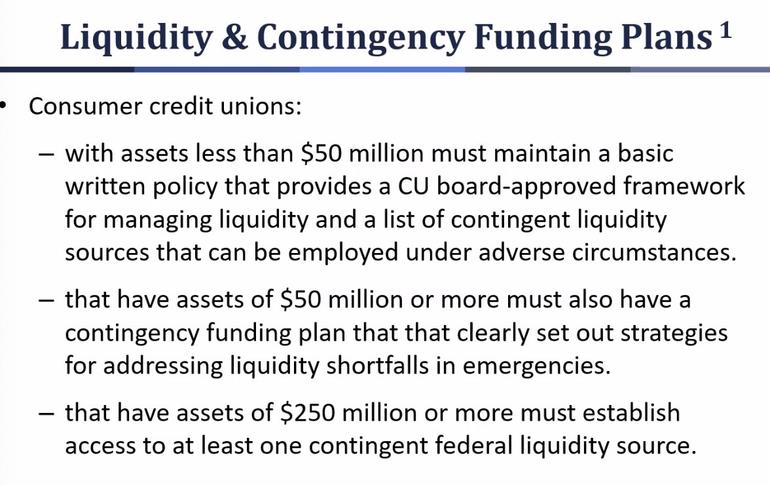
While rarely used, Cappetta said the CLF has proven to be a dependable source of liquidity to credit unions in emergencies.
In response to a question from Harper over what he has heard related to the state of credit union liquidity, Cappetta responded, “Anecdotally, I, too, am hearing of credit unions throughout the system of all asset sizes are facing liquidity challenges and are turning to borrowings that are rapidly increasing cost of funds.”
He added that call report data supports the anecdotal evidence.
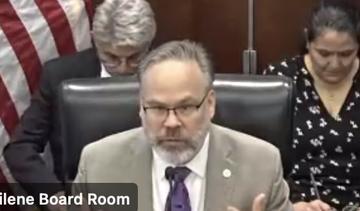
Todd Harper
Harper: A ‘Backstop’ Will Soon Disappear
In his comments following the presentation to the board, Chairman Harper, who credited Board Member Rodney Hood for being a strong advocate for the creation of a separate CLF office with a dedicated, full-time president, and Vice Chairman Kyle Hauptman for supporting the improvements, said that with more than $29 billion in borrowing capacity, $1.2 billion in total assets, and nearly 4,000 regular and agent members, the CLF is a “vital source of emergency liquidity within the credit union system. However, the pending expiration of the temporary CLF enhancements authorized by Congress at the start of the COVID-19 pandemic remains a very real concern,” according to Harper.
Harper said the agency is aware of several credit unions that have experienced liquidity issues in recent months, including some with more than $1 billion in assets.
(CUToday.info has launched a series on liquidity as a result.)
“And, with ongoing inflationary pressures and likely continued interest rate increases, there is the potential for strong headwinds slowing the economy and increasing stress on households and financial institutions,” said Harper. “Those headwinds could soon result in even more credit unions encountering liquidity issues. So, the CLF must stay alert and ready to support the credit union system and the Share Insurance Fund.”
For the CLF to work best, Harper said what is needed is a “flexible agent member option.”
“By permitting corporate credit unions to become agent members for groups of credit unions, rather than requiring them to join for their entire membership, the CLF becomes a more affordable and attractive option for corporate credit unions to participate in,” Harper said. “Without that agent membership, credit unions with less than $250 million in assets will be much less likely to have access to a federal liquidity backstop when they need it.”
Lack of Legislation
He also expressed concern that there is no legislation to extend the temporary CLF enhancement provisions, which will mean a $9.7-billion reduction in reserve liquidity for the credit union system at the end of 2022.
“We know through the painful lessons of the financial crisis more than a decade ago how quickly liquidity can dry up during periods of economic and financial stress,” Harper said. “While we are grateful to Congress for allowing the CLF enhancements of the last few years, there is a real need to keep in place the ability of corporate credit unions to serve as a CLF agent for a subset of their members. That authority will allow us to provide emergency liquidity quickly when needed.”
Hauptman: ‘Liquidity Event a Real Possibility’
Calling the CLF the “only practical source of emergency liquidity for the over 3,600 credit unions under $250 million in assets,” NCUA Vice Chairman Kyle Hauptman noted it’s been 40 years since the country has seen inflation at the levels they are today.
“Interest rate risk and liquidity are a growing challenge,” said Hauptman. “Although the credit union movement has a variety of tools to manage these challenges including the derivative rule and updated supervisory guidance on interest rate risk, credit unions under $250 million are especially vulnerable.
“They are limited in their ability to manage their interest rate risk using derivatives – even in their simplest form as allowed by NCUA. More to the point, these credit union

Kyle Hauptman
s are so limited in resources that a direct relationship with the CLF is impractical,” continued Hauptman.
Like Harper, Hauptman noted how the CARES Act has solved that problem by authorizing a corporate credit union to join the CLF on behalf of a subset of its members, an authorization he lamented will expire on Dec. 31.
“The current interest rate risk environment makes a liquidity event a real possibility,” said Hauptman. “Without agent sponsorship, my fellow board members and I are deeply concerned about the consequences for the credit union movement.”
Hood: ‘Not a Question of If…’
Board Member Rodney Hood, who echoed Harper’s comments about some credit unions feeling liquidity pressures, had numerous questions for the agency staff related to the CLF. In response to one question regarding the current state of liquidity in CUs, Cappetta said no credit unions have reached out related to difficulties their balance sheets might be feeling.
In response to a separate question from Hood, Cappetta said loan growth has exceeded share growth, boosting the loan-to-share ratio to nearly 75%.
“The Central Liquidity Facility is a source of liquidity that is needed,” said Hood. “It is not a question of if there will be another financial crisis, but when there will be another financial crisis. Anthony, what is the best way for credit unions to use the CLF before it is too late?”
Like Harper and Hauptman, Hood called for the temporary CLF enhancements that were provided as part of the CARES Act to be made permanent.
“Prior to U.S. Central’s involuntary liquidation, most natural person credit unions effectively had access to the CLF without the expense of a CLF subscription through U.S. Central,” said Hood. “Since U.S. Central no longer exists, extending the agent membership change in the statue is critical. At Chairman Harper’s request, I have reached out to leaders on Capitol Hill to encourage them to extend this provision.”
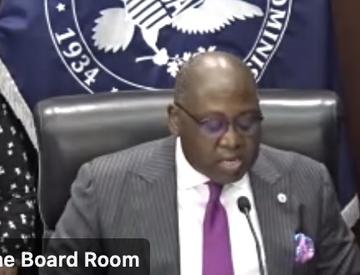
Rodney Hood
Hood said one of the reasons the aboard agreed to establish the CLF as a separate office was to revamp the system.
“We need to sit down with the corporates and credit unions to create a cooperative facility that reflects the realities of today under existing powers,” said Hood.
About CUs & the CLF
In response to a question from Hood, Cappetta said when it comes to the CLF:
- There are 20 credit unions under $50 million in assets
- There are 109 CUs in the $50-$250 million asset category
- There are 221 CUs with assets of more than $250 million
In addition, according to Cappetta, among the CLF members with over $250 million in total assets, 143 have an account with FRB, while there are 262 CLF members that are FHLB members with lines of credit totaling $52.5 billion.