

ALEXANDRIA, Va.–By a 2-1 vote, the NCUA board has approved publishing a request for information (RFI) around climate change.
The RFI will include 38 questions related to the effects of a changing climate on credit union operations and related risks. Agency staff said an internal working group around climate change has spent 18 months working on the initiative.
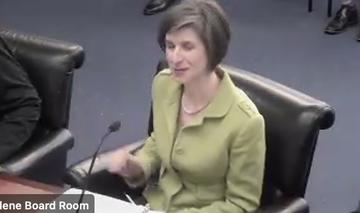
Rachel Cononi
NCUA Vice Chairman Kyle Hauptman, following a detailed explanation, cast the dissenting vote on the proposal. Board Member Rodney Hood, a Republican appointee like Hauptman, said he would vote in favor because he had earlier given his word he would do so, but also made clear he expects one of his priorities to be taken up by the board later this year.
Rachel Cononi, deputy director of NCUA’s Office of the Chief Economist, told the board climate-related risks can be grouped into two broad categories: physical risk and transition risk. Physical risk refers to harm to people and property caused by discreet climate-related events, both short and long term, while transition risk refers to stress on institutions or sectors caused by measures taken to move towards a less carbon-intensive economy, such as responding to public policy changes and adopting new technologies.
How Risks Are Manifested
“Climate-related physical and transition risks tend to manifest as traditional financial risks, including credit risk, liquidity risk, market risk, and operational risk,” said Cononi.
For members and their credit unions, she said that can be related weather events like flooding or wildfires that may affect household income and the ability to stay current on households’ financial obligations, the property damage associated with such events, or the collateral value of motor vehicles that may also be affected as consumer preferences shift away from gasoline-powered vehicles to electric.
The risk can also involve entire fields of membership that are tied to a specific industry, such as oil refining or agriculture.
She further noted, as NCUA has said in earlier reports, that financially vulnerable households and communities are the least able to absorb the costs associated with climate-related disasters.
Potential Positives
On the flip side, Cononi said climate change may also present new opportunities for credit unions, such as in generating demand for renewable loan products and services such as loans for solar power generation, biodiesel development, residential or commercial energy efficiency upgrades, and solar panel installation.
“Our aim in publishing this request for information is to improve NCUA’s understanding of climate-related financial risks, how credit unions view those risks and how the agency can best support the industry and mitigate those risks,” Cononi said. “In addition we're hoping to gather information on the products and services credit unions may be offering to leverage the opportunities presented by transitions to clean energy.”
Cononi, like the NCUA board members who followed her presentation, stressed the RFI does not “speak to the permissibility or impermissibility of any specific activity, does not imply any intention to modify existing requirements applicable to federally insured credit unions and does not grant federally insured credit unions any new authorities or limit any existing authorities.
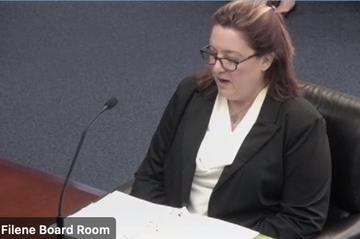
Lisa Roberson
What Will be in the RFI
Lisa Roberson, deputy director, of NCUA’s Office of Consumer Financial Protection, who like Cononi is a member of the internal working group, said other federal agencies have already published similar RFIs.
Roberson said the 38 questions in the NCUA RFI will seek input on:
- Current and prospective climate-related financial risks to federally insured credit unions, related entities and the NCUSIF
- The extent to which NCUA should develop guidance, regulations, reporting requirements and supervisory approaches to federally insured credit unions’ management of climate-related financial risks
She said the questions are categorized around:
- Climate-related financial physical risks that are or may in the future affect the industry, and measures that can be taken to minimize those risks
- Climate-related transition risks that are or may in the future affect the industry and measures that can be taken to minimize those risks
- Potential adjustments to operations, governance, and business strategies to account for climate-related financial risks
- Risk management, including methods and metrics for identifying and measuring climate-related financial risks and associated challenges
- Climate-related opportunities, including the support needed to expand products and services and any barriers that credit unions may face
- Suggestions for NCUA
- Data and measurements
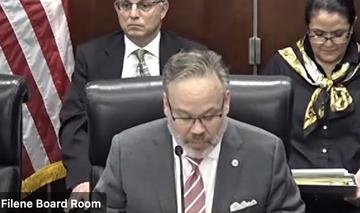
Todd Harper
Harper: Seeking a ‘Better Understanding’
Noting the RFI is being proposed just ahead of this weekend’s Earth Day, NCUA Chairman Todd Harper said the agency has a “duty” to ensure credit unions remain resilient against all risks, including climate risks. He noted, for instances, that NOAA data show the U.S. experienced 20 separate billion-dollar weather and climate-related disasters just in 2021, with one such event occurring every 18 days on average.
He also noted that NCUA recently released data showing 25% of credit unions are located in communities with a high or very high risk of experiencing adverse outcomes from natural hazards, and that those CUs account for 34% of the systems wide assets.
“NCUA is interested in better understanding stakeholders’ views and experiences on climate-related financial risk. Commenters are encouraged to discuss any relevant issues they believe the NCUA board should consider about the financial risks associated with climate,’ Harper said. “(The information) we receive may allow us to discern what tools credit unions would like to have to assist them in effectively monitoring managing and mitigating climate-related risk.”
Harper added the information will not be used during exams, and that if there ever were a subsequent change in agency policy related to climate risk, that change would have to be agreed upon by the entire board.
=
Hauptman: A Board Member on an Island
Noting he grew up in two places, both of which are islands in the Atlantic Ocean, where his father worked at a park along one national seashore, NCUA Vice Chairman Hauptman said one obstacle to the work in protecting the shoreline was federal policies.
“I also know that today’s vote is technically just about NCUA publishing a Request for Information (RFI). RFIs are a good faith effort to gather information and may or not even result in any concrete actions. In fact, other agencies have put out similar RFIs that haven’t resulted in any actions,” said Hauptman. “So, I get it; this RFI may not result in any action at all, much less anything harmful. I can even think of some narrowly targeted positive results, such as credit unions educating us on new, profitable business lines we may not be familiar with, such as loans for electric vehicle charging stations. I know if I was an examiner, I’d be more comfortable if I understood new terminology and new financial products, and I’d also be more comfortable knowing that other examiners are dealing with similar things at other credit unions. I’m here to state that this RFI just might wind up being beneficial for all parties.
“Essentially, I think there’s some ways this can go well but also quite a few ways this effort can unintentionally wind-up doing harm to both the Share Insurance Fund and credit union members,” continued Hauptman.
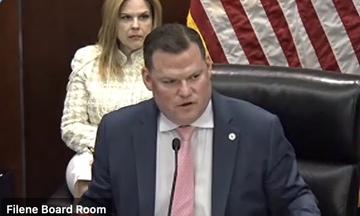
NCUA's Kyle Hauptman during board meeting.
Reasons for ‘No’ Vote
But Hauptman said he was voting no for several reasons, including:
- Those closest to these natural disasters and changing markets are best positioned to understand and manage the risks. “We in the D.C. area don’t need to tell folks in Puerto Rico about hurricanes. We’ve already had situations where a credit union is deciding on a loan to a member affected by natural disaster, and the credit union employees themselves lost their homes in the disaster, and the office they are meeting in was also rendered uninhabitable by a hurricane. I feel that those people in that room have a better understanding than those of us here in the D.C. area.”
- The history of unintended consequences of government interference in private markets. “The easy example here is the National Flood Insurance Program (NFIP). It’s a useful comparison because the NFIP is the one government program which solely exists to manage the risks associated with severe weather events,” said Hauptman. “NFIP has become a political football, with bipartisan agreement that it fails at both of its core missions. Created in the late 1960s, NFIP was created with the good intentions of providing flood insurance at appropriate prices that protect the taxpayer, and to reduce unnecessary flood damage. Well, NFIP has lost over $50 billion dollars, and any insurance commissioner in the country would have shut it down. And per reducing damage from floods, it’s been widely criticized by environmental groups like the Sierra Club for subsidizing continual unsafe building in flood-prone areas, thereby increasing loss of life and property damage. Such is the history of well-intentioned government involvement in managing weather-related risks.”
- Potential harm to credit union members. “The only reason to put in the effort to produce the RFI is because there’s some chance that someday, NCUA may take some action,” said Hauptman. “That future action by NCUA could manifest itself in rulemakings, guidance, examiner training, data collections, or other documents that signal NCUA’s priorities and approach. Those documents include our Strategic Plan, our Supervisory Priorities, our pre-exam questionnaires, and the call reports that credit unions submit. All of these communicate NCUA priorities and can influence behavior. Thus, any change in any of those communications have the potential to nudge credit unions towards – or away from – certain behaviors that may not be in their members’ best interests.”
- FOM Expansion. “Let’s say a local oil refinery expands, and the local credit union has to the opportunity to expand membership and lending activity that is indirectly related to the oil and gas business. I foresee a scenario where NCUA’s words might give that credit union pause about increased exposure, even indirectly, to the fossil fuel industry. That NCUA-caused reticence could result in harm to those potential new members and to the credit union’s finances,” Hauptman stated. “Again, this is a hypothetical, I’m just elucidating my apprehension about what might happen in the future.”
- Auto Loans. “For example, today’s RFI mentions risks related to the ‘shift from gasoline-powered vehicles to electric and hybrid vehicles’,” said Hauptman. “I worry we might ask credit unions for data on the share of their lending for electric and hybrids. Someone out there might feel this is a nudge, indicating a shift towards those vehicles is the ‘better answer,’ the answer that gets examiners nodding their heads. Meanwhile, credit unions live and breathe the auto-lending market. This could result in tweaks to loan pricing to make some vehicles more desirable than others. That sort of ‘nudge’ would interfere with the credit union’s ability to price risk in the markets they know best, and perhaps give a credit union member a less favorable deal than they otherwise would’ve gotten. “
‘Already Dealt With’
Finally, said Hauptman, all of the issues he outlined are already dealt with via existing workstreams, and NCUA involvement could “dull the market signals that make those workstreams function well. Credit unions are currently watching land prices in flood-prone areas. There are constantly shifting insurance markets for homes and vehicles. NCUA already has sensible concentration limits and other regulations. And of course, there are a lot of entities writing checks before NCUA’s deposit insurance kicks in. There is the potential here to view climate as a separate workstream or area of regulatory focus that could interfere with existing processes.”
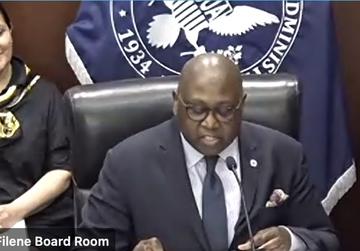
Rodney Hood
Hood: A ‘Go-Slow Approach’
NCUA Board Member Rodney Hood said that while it is his view credit unions know best how to mitigate the risk in their communities, “it is worth noting this RFI doesn’t change any NCUA policy or supervision for climate change,” and that “changing policy will require a future board action. However, nothing that I will say today should constrain me or, frankly, lock me into a position, one way or another, for future action regarding climate change. I'm indeed open to studying this issue more and would like to see the best public policy prevail.
“I continue to be a strong supporter of the key tenets of stakeholder capitalism – including diversity, equity, and inclusion initiatives and ESG goals – and I continue to make the case for these practices, because I believe they’re the right thing to do, and I believe they’re good for business and society,” Hood continued. “But in my position as a financial services industry regulator, I prefer the go slow approach, and I’ve sought to encourage these practices without being heavy-handed about it…
“One could even argue that ESG regulation is not urgent at this stage for the system of federally-insured credit unions we oversee,” continued Hood. “We’re talking here about smaller, non-profit, membership-driven financial institutions with a strong community orientation. As such, their ESG impact simply doesn’t compare to publicly traded firms with national or international scale.”