

ALEXANDRIA, Va.–The NCUA board has put out for 60-day comment its 2022-26 draft strategic plan, with one board member suggesting the “rapid pace of consolidation poses a risk to the long-term viability,” while all three board members debated over whether NCUA should be regulating around the issue of climate change.
The proposal passed on a 3-0 vote.
Agency staff told the board the objective of the strategic plan is to support three goals:
- Ensure a safe, sound, and viable system of cooperative credit that protects consumers.
- Improve the financial well-being of individuals and communities through access to affordable and equitable financial products and services.
- Maximize organizational performance to enable mission success.
‘An Essential Process’
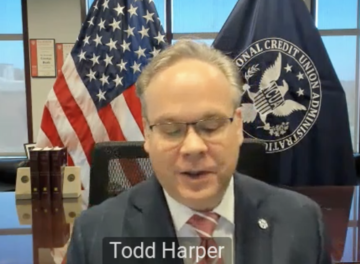
“For any organization, strategic planning is an essential process for outlining where the organization is going, how it will get there, and what investments are needed to achieve organizational goals,” said NCUA Board Chairman Todd Harper. “For an insurer, prudential regulator, and consumer financial protection supervisor like the NCUA, a strategic plan is also a vital part of good governance.”
Harper noted the rapid change in financial services and the increasing role of technology in delivering those services.
“Many credit unions are also growing in both size and complexity,” Harper said. “Our work must adapt to each of these new realities.”
Harper called on NCUA to continue to help provide access to safe affordable financial services, to provide financial education, and to close the racial wealth gap.
Harper further called for addressing risks from climate change, stressing the agency is not mandating any changes at this point, saying any response is a business decision for companies of all types and sizes to make, including credit unions.
“For that reason, the agency will not micromanage auto lending, mortgage lending, or member business lending for climate financial risk. This includes lending to family farms and others in the agricultural sector, as well as businesses tied to the fossil fuel industry,” said Harper. “As a regulator and insurer, the NCUA will continue to work to ensure that the institutions it oversees remain resilient against all material risks, including climate financial risk. As such, the NCUA is studying the risks to collateral, held for security on a loan, exposed to climate-related natural disasters in order to understand the risks associated with an increase in those extreme weather events on the credit union system. In its oversight, the NCUA would evaluate whether credit unions are addressing those risks. By managing the risks on their balance sheets, credit unions will remain viable and support broader U.S. economic growth.”
Hauptman: ‘Sometimes, It Means Getting out of the Way’
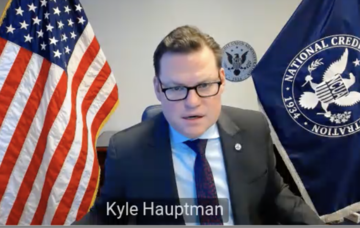
NCUA Vice Chairman Kyle Hauptman said NCUA recognizes that credit unions must be allowed to evolve technologically to remain viable.
“The agency needs to understand this evolution and provide the guidance allowing credit unions to move forward confidently,” said Hauptman. “Responsible oversight must be balanced with policies that allow for innovation. Sometimes that means getting out of the way, so credit unions don’t slowly go the way of Blockbuster Video.
“The agency understands that the rapid pace of consolidation poses a risk to the long-term viability of the credit union movement,” Hauptman continued. “In particular, the plan addresses the vulnerability of new and smaller credit unions through several objectives. Among other things, these objectives include streamlining the chartering process, support for small credit unions, and credit unions designated as minority depository institutions.
Hauptman, who urged credit unions to comment on the plan, added, “With regards to the plan’s language around climate change and extreme weather, obviously we don’t need to inform people in Miami that they have damaging hurricanes, nor those in agriculture that droughts are harmful. It may be most effective to approach this issue in that spirit.”
Hood: Chairman Needs More ‘Leeway’
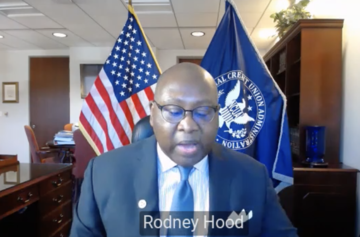
NCUA Board Member Rodney Hood, a former chairman of the agency, said that after considering the issue for months, it is his view the chairman should be given “more leeway to set the vision he would like to take the agency.”
“The strategic plan is an aspirational document. While I certainly believe that climate change is an issue, I do not believe it is an issue for the NCUA as a safety and soundness financial regulator at this time,” said Hood. “As of now, my view is that credit unions know best how to manage this risk, not the NCUA. However, in the spirit of bipartisanship, I deferred to the Chairman on the climate change language in the strategic plan. And I did so knowing that this strategic plan, as an aspirational document, does not change any NCUA policy or supervision for climate change.”
Hood repeated that as a legal matter, the board’s support for the strategic plan does not change NCUA policy and should not be interpreted by anyone to implement a future policy change.