

ALEXANDRIA, Va.—Comparing the five failed corporates to a gambler “busted at the blackjack table,” the NCUA board Thursday outlined what credit unions can expect in future distributions as the agency winds down its Corporate System Resolution Program.
The board and agency staff emphasized that while economic factors may play a role in future distributions, currently the market is good for the sale of the remaining assets.
With NCUA recently announcing a $569-million distribution to credit unions from the Resolution Program, Keith Morton, regional director for the Southern Regional office, told the board, “We're in the final resolution phase. In short, we hope to wrap up the Corporate Resolution Program, make distributions and close” the program next year. “This timeline is dependent on market conditions which enable our ability to orderly liquidate securities and monetize assets and resolve the remaining legal cases.”
NCUA Senior Capital Markets Specialist Brian Heitman told the board the market for the assets has not weakened due to current economic events.
“If we hear from market participants that the market has weakened due to current events or for any other reason, we may temporarily postpone sales of the remaining assets,” Heitman said, noting NCUA this week sold legacy assets for more than $200 million. “The market does appear to suggest a strong bid for the legacy assets despite current events.”
$2.2 Billion Returned
Board Chairman Todd Harper reminded NCUA has recovered and returned nearly $2.2 billion to member capital account holders.
“Nevertheless, some continue to question our actions. Skeptics of the Corporate System Resolution claim the NCUA overestimated the losses,” Harper stated. “Others assert that the corporates were merely experiencing a liquidity crisis but were otherwise financially sound. Such sentiments seriously minimize the true nature of the crisis the agency faced between 2008 and 2010. The five corporate credit unions that failed were insolvent. That is a fact. Like a gambler busted at the blackjack table, they were out of money. The game was over. Promising the dealer that you will have cash once you win the next few hands does not work in a casino, and it does not work for financial institutions.”
The funds are being paid out as NCUA winds down its Corporate System Resolution program and will go to credit unions that held capital in the former U.S. Central Credit Union, Members United Corporate FCU, and Southwest Corporate FCU.
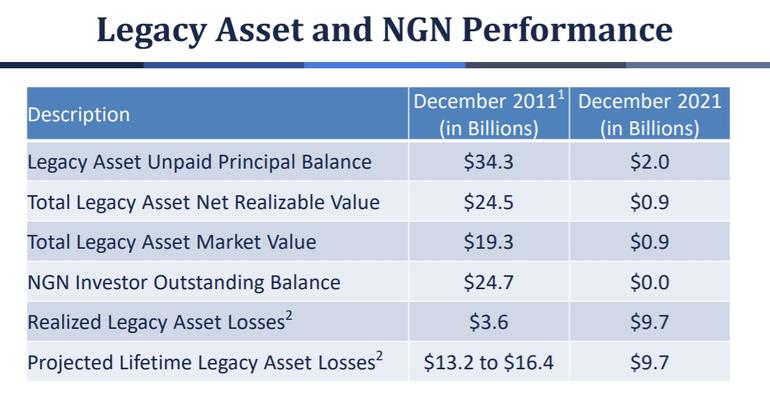
“What came next was the need to resolve these failed institutions in a responsible manner and in a way that did not endanger the entire credit union system, which was under enormous stress during the 2008 financial crisis and its resulting recession,” reminded Harper. “That is why we structured the Corporate System Resolution to allow the credit union system to bear the costs of these failures over time. Those costs, based on the best information available during that chaotic period, were estimated to be between $13.2 and $16.4 billion. That was nearly twice the total assets that were in the Share Insurance Fund at the end of 2008.”
Legal Recoveries
Harper noted what the agency has paid in legal fees for legal settlements continues to be challenged.
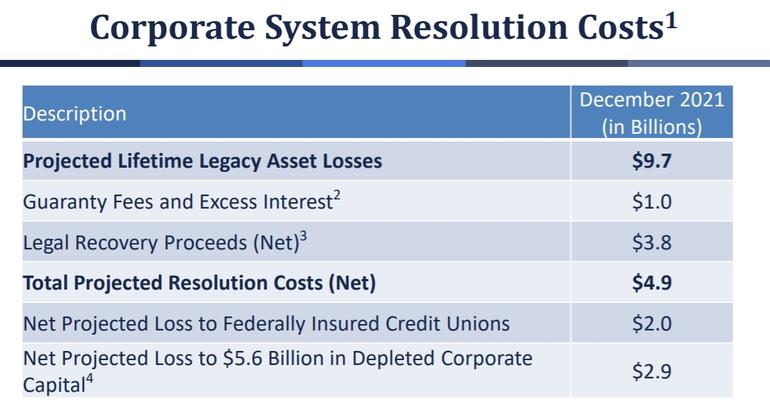
NCUA staff pointed out the contingency fees paid for the legal recoveries to date is approximately $1.2 billion, and legal recoveries have provided net proceeds of $3.8 billion.
Board Member Rodney Hood addressed how small credit unions have lost much more than dollars invested in the five failed corporates.
“We should also acknowledge publicly that this really hurt the smallest of credit unions. Prior to the corporate failures, smaller credit unions could put all of their investments in one corporate,” Hood said. “They cannot do that today as the corporate system has entirely evolved—as today it primarily handles cash management and short-term investment and liquidity services, with longer-term investments being directed off balance sheets. It has become more difficult for smaller credit unions to compete based on this outcome.”
Vice Chairman Kyle Hauptman closed by saying the wind down of the Resolution Program and final distributions should be viewed as good news.
“As regulators we are often in the position of playing the Grinch. I have to say, being Santa is more appealing,” Hauptman said.