

ALEXANDRIA, Va.–The NCUA board has gotten an update on the federal credit union loan interest rate ceiling, including that it does have the ability to institute a variable rate and that lowering it to 15% would likely cost millions of dollars in lost income across hundreds of credit unions.
As CUToday.info reported, at its January board meeting the board approved an 18-month extension through September of 2024 of the 18% interest rate ceiling that is currently in place. But during that same meeting there was also discussion over whether the board had the authority to make the rate floating rather than fixed.
In response, NCUA’s Office of General Counsel said its position is a floating interest rate ceiling is legally permissible under the Federal Credit Union Act.
As CUToday.info has also reported, there have also been various calls from credit unions and trade associations to either lower the rate to 15% or raise it to 21%.
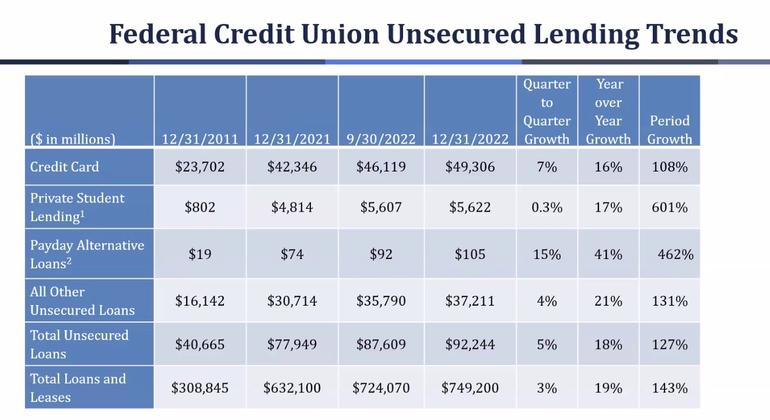
During a presentation by NCUA’s Office of Examination and Insurance, data was shared around unsecured lending trends, as seen in the slide below.
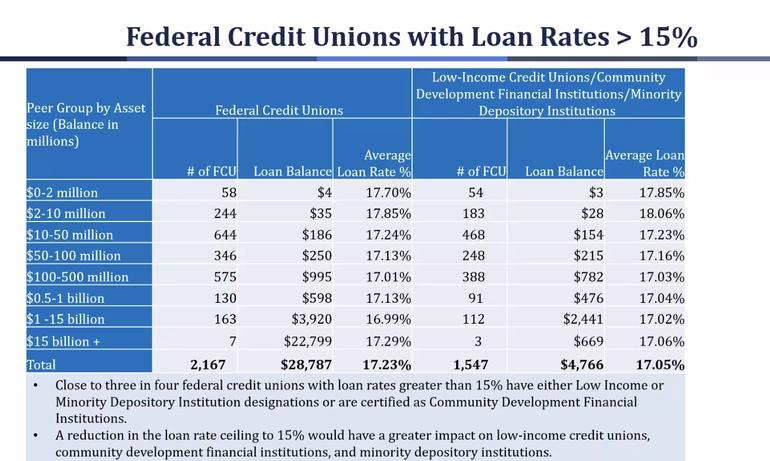
Staff further provided data around FCUs with loans priced above 15%, as seen in the chart below.
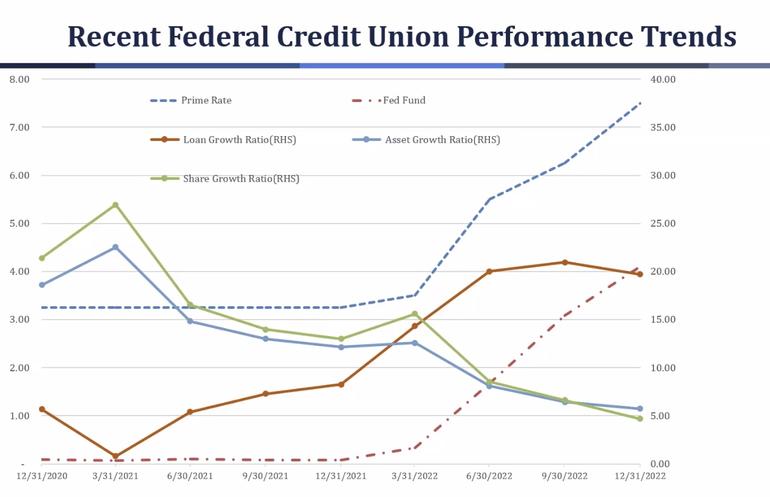
E&I staff told the board cost of funds was relatively stable during 2022, and that ROAA and net interest margins have remained stable, as well.
However, staff told the board that reverting the federal CU loan rate ceiling to 15% would have a safety and soundness effect on individual federal credit unions, and addressed that impact on three different kinds of CUs.
According to agency staff:
- Of CUs with a concentration of loans above 15% interest rates that comprise more than 10% of assets, 33 FCUs have a concentration of unsecured loans with average rates of 17.29%
- Of federal credit unions rated CAMELS 3, 4 or 5, 37 would see a $2 million cumulative loss in interest income. Agency staff said the income loss would create not just a liquidity challenge for this group, but other CUs would also feel the squeeze
- There are 299 FCUs with net losses, with a concentration of $200 million in unsecured loans with average rates of 17.3%
- There are 247 CUs rated CAMELS 1 or 2 with cash and short-term liquidity ratios of less than 6%. If the loan interest rate were to revert to 15%, these CUs would see a $72.6 million loss of income that would lower liquidity ratios to less than 4%
Agency staff also shared the CU performance chart, below.
Harper: Potential Safety & Soundness Threat
Noting the rising-rate environment in which credit unions are operating, NCUA Chairman Todd Harper said NCUA staff analysis has concluded that lowering interest rates below 18% would threaten the safety and soundness of several individual credit unions.
Moreover, he said, to change the interest rate ceiling for federal credit unions would require consultation with Congress, other federal banking agencies and the Treasury Department, plus NCUA would need to meet a legal standard requiring it to determine that the prevailing interest rate levels threaten the safety and soundness of individual credit unions.
Harper asked agency staff for their views on how the increase in the ceiling to 21% or a floating ceiling—as requested by some—might affect credit unions.
Staff responded by saying that in addition to the financial effects, credit unions might also need time to update their systems and policies, and the agency would need time to ensure it also had systems in place, such as a tool for examiners to track what the maximum rate is at various points in time so that they can properly examine loan portfolios.
That could affect products such as PALs loans, agency staff added.
Hauptman: 'Another Method Would be Superior, But…’
NCUA Vice Chairman Kyle Hauptman noted the FCU Act contains only one number around interest rates: 15%.
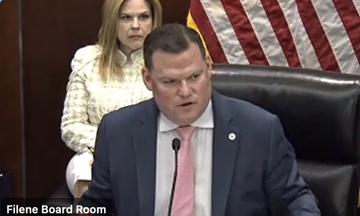
NCUA's Kyle Hauptman during board meeting.
“Although there were more than a few stakeholders asking the board to raise the ceiling above 18%, we did not have the evidence in January that met the criteria set by Congress,” Hauptman said. “And after further analysis by staff, we still do not have the data to support raising the ceiling above 18%.
“The concept of a floating interest rate ceiling makes economic sense to me, and the analysis was worth the effort,” Hauptman continued. “At this time, I do not believe there is a way we can do a floating rate ceiling that would satisfy stakeholders. It’s one of those situations where a majority of people would agree that another method might be superior, but that same majority will not be able to agree on exactly what that method is. I know this from my conversations in the last few months.”
Lesson from Japan
Hauptman added he believes credit union members need to benefit when rates drop, such as in 2020 when the overnight Fed rate was 0%, the 10-year Treasury bond yielded 0.1%, and 30-year mortgages could be had for under 2.50%.
“If that scenario persisted for years, as it has in Japan, any floating rate used by NCUA would have to, logically, yield a maximum interest rate at or below the 15% decided on by Congress,” said Hauptman. “And I know that is not what is expected by everyone who was asking me to find a way to raise our interest-rate ceiling. “
Hood: Concerns Remain, Especially for Smaller CUs
In his comments, NCUA Board Member Hood referenced the January board meeting discussion around the interest rate issue, and the vote to extend the 18% ceiling until September 2024.
“However, in our January meeting we asked the General Counsel to opine if a variable rate is legal. At that time, Chairman Harper said that ‘If a floating interest rate is legal, we will need to move expeditiously with next steps’,” said Hood. “In today’s briefing, we learned that a variable rate is indeed a reasonable legal interpretation of the Act. After we discussed this matter at our January meeting, we received additional documents from the National Archives that showed that our general counsel opined in the 1980s that a variable rate was a reasonable legal interpretation but at the time the staff recommended the ‘board not use the floating or indexed interest ceiling rate…,’ I presume from the operational considerations of implementing a floating ceiling in the 1980s.
Could Be ‘Complicated’ for Some CUs
“While we can all agree data processing has improved significantly since the 1980s, which would make a variable rate easier to implement, I remained concerned that a variable rate could be complicated for smaller credit unions to implement and may cause operational problems with the Truth in Lending Act, among other consumer protection laws,” Hood continued. “As I called for in January, I still believe that a 21% interest rate ceiling is appropriate and strikes the right balance to consider the statutory goals of thrift promotion and credit availability while being responsive to economic conditions to avoid safety and soundness considerations.”