

ALEXANDRIA, Va.–Noting that 90% of the 100 largest credit unions have state charters, the NCUA board has put out for comment a proposal on chartering and field of membership for federal charters that includes nine different changes the agency said is aimed at enhancing access and removing duplicative paperwork.
The comment period will run for 90 days.
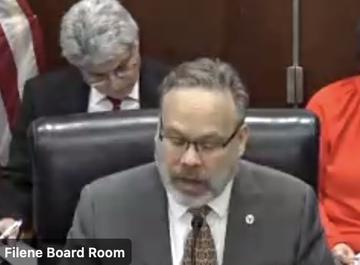
Todd Harper
Many of the changes are coming out of NCUA’s Advancing Communities through Credit, Education, Stability and Support (ACCESS) initiative and are aimed at making it easier to expand services into underserved areas. Among the proposals is a change related to “secondary members” following the death of a member, and a technical clarification around officials involved with de novo CUs.
The presentation to the board was made byRita Woods, division director, Consumer Access, in the Office of Credit Union Resources and Expansion; along with Rob Leonard, Compliance Officer and Counsel Ian Marenna.
Harper: ‘Significantly Behind the State Charter’
NCUA Chairman Todd Harper, who noted the proposed rule is the product of NCUA’s ACCESS Initiative, which began under then-Chairman Rodney Hood, said the “credit union system is at its best when the dual chartering system is strong and vibrant. Yet, with respect to field-of-membership options, the federal charter lags significantly behind the state charter. According to an analysis by NCUA’s Office of Credit Union Resources and Expansion, 91 of the 100 largest potential fields of membership in the system are state charters.”
While it is ultimately up to Congress on whether to amend the field of membership rules in the Federal Credit Union Act, Harper said the NCUA board can and should take “appropriate and tailored action to simplify, streamline, and strengthen” federal chartering options.
“Together, these nine proposed changes won’t close the wide gap between the field-of- membership options for federal and state charters, but they will make some meaningful changes to enhance consumer access to financial services,” Harper said, adding the proposal would also make technical corrections and clarify the process for the NCUA’s reviews of chartering and field-of- membership changes.
Harper observed that one of the nine changes in the proposed rule would eliminate the business and marketing plan requirements for certain federally insured, state-chartered credit unions that seek to convert to a federal charter while serving the exact same community field of membership.
No Need to Jump Through Hoops
“If a credit union is already serving the community and won’t be changing the boundaries of that community, we shouldn’t have to make that credit union jump through an unnecessary paperwork hoop,” he said.
He cited another change in the proposed rule that would expand the community-based chartering options to recognize the changes in work habits accelerated by the pandemic.
“As such, more of those individuals who telework or work remotely would become eligible for membership for companies headquartered within the community,” Harper said.
In response to a question related to how the CDFI Fund is changing its certification and recertification requirements and whether those changes would affect the economic distress criteria NCUA uses, staff said it should not have an effect.
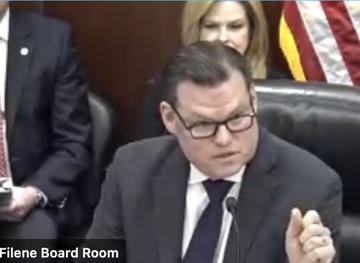
Kyle Hauptman
Hauptman: Clarification & Simplicity
NCUA Vice Chairman Kyle S. Hauptman said that when Congress adopted the Credit Union Membership Access Act of 1998 (CUMAA) amending the Federal Credit Union Act, it reiterated its support for credit unions, emphasizing their “specific mission of meeting the credit and savings needs of consumers, especially persons of modest means.”
“The Credit Union Membership Access Act of 1998 includes the express provision for the NCUA board to establish regulations to encourage the chartering of community and multiple common bond FCUs – including provisions for encouraging formation of FCUs to provide financial services to underserved communities and people of modest means. And doing so in a safe and sound manner,” Hauptman said.
He reminded that specifically Congress directed NCUA to consider multiple responsibilities, including encouraging access to financial services for people of modest means, encouraging competition among providers of financial services, and protecting taxpayers by enhancing the safety and soundness of the credit union system and protecting the NCUSIF.
He added the board’s goals in revising and modernizing the chartering and FOM manual include:
- Increasing access for underserved communities
- Providing objective criteria to potential applicants
- Providing regulatory relief while balancing safety-and-soundness concerns
- Enhancing efficiency.
‘Clear is Better’
“Clear regulation is better regulation. Understanding field of membership is not easy, so when we amend the rules, it is done to improve precision and simplicity,” said Hauptman. “This NPR seeks to clarify existing chartering and FOM rules for multiple common bond FCUs and for community FCUs.”
Pointing to the FCU Act and the authority of multiple common bond FCUs to serve members residing in
“underserved areas,” Hauptman explained how many terms are defined and said the notice of proposed rulemaking is designed to do several things, including:
- Apply the CDFI Fund’s economic distress criteria as required by the FCU Act
- Clarify that the NCUA defers to the CDFI Fund and eliminate census block groups as a geographic unit for composing underserved areas
- Clarify flexibility for multiple common bond FCUs serving underserved area based on rural districts
- Streamline the existing required statement of unmet needs that accompanies a request to serve an underserved area.
A Simpler Approach
“The proposed rule simplifies application requirements for community based FCUs by providing a standard form for business and marketing plans,” said Hauptman. “In addition, the proposed rule would eliminate the business plan requirement for certain federally insured state-chartered credit unions that seek to convert to a federal charter already serving the same community FOM. This only applies to already-operating credit unions for whom NCUA already examines for insurance purposes. In such cases, the written business plan requirement is unnecessary work for both the credit union and NCUA. If the credit union’s business model didn’t work, we’d already know and so would their state regulator. Moreover, the proposed rule recognizes the growth of telecommuting for companies headquartered in a geographic community.”
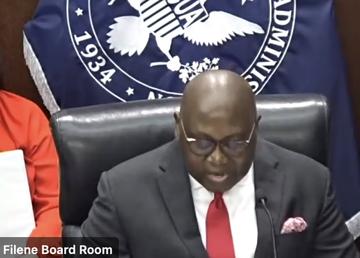
Rodney Hood
Hauptman also praised anything that clarified field of membership for groups seeking a de novo charter.
Two Questions
In response to a question, NCUA staff said the use of more general references to CDFI’s requirements for investment areas should not change the level of difficulty in pursuing an underserved area.
In response to a question related to a separate proposed rule, staff responded by saying the proposed new affinity of persons paid from companies headquartered within the community will give existing community charters an opportunity to serve potential members who are more apt to work remotely.
“In addition, the rule affecting members of the immediate family or household of decedents can help credit unions maintain relationships with people who may not have realized they were eligible for membership when their family or household member was still living,” said Woods.
Hood: A ‘Step in the Right Direction’
NCUA Board Member Rodney Hood called the proposed rule a “step in the right direction.”
“For example, I am glad it makes it easier for family members of deceased family members to join a credit union,” he said. “I also am glad that the NCUA board is recognizing in today’s proposed rule that hybrid work is impacting the traditional definition of affinity groups for community charters, namely people who live, worship, attend school, or work in the community or rural district. Today’s proposed rule attempts to capture remote work employees as affinity groups for community charters. This is a positive development. But we have much more to build upon in this rule and from previous field of membership rulemakings.”
Hood called serving the underserved a “hallmark” of his time on the NCUA board, and said more must be done to increase credit union access in rural, minority, disabled, and tribal communities, among other communities, where currently all that may exist is a pernicious and predatory payday lender.
Time to Go Mobile
“Personally, I believe the best way to do this is to allow mobile phones to serve as service facilities,” Hood said. “For us to continue to use an antiquated definition of service facility is not responsible in my view. When the Federal Credit Union Act was signed into law in 1934, I venture to say that no one living at the time could have imagined ATMs. Yet, with the advent of ATMs, our regulations evolved to consider how ATMs represent a service facility. In 2023, the reality is that mobile banking is how many members are served by credit unions. And as I previously mentioned from this board table, more and more credit union members are making their phones the primary place they access financial services…If we have learned anything since the COVID-19 pandemic, we should recognize that members are using mobile and internet banking at a higher rate than branches. In my view, the regulator must respond to changes in technology just like credit unions are having to do.”
Water & Land Masses
In response to a question from Hood over how the agency address areas in which large bodies of water fall between land masses, a question Hood said he consistently hears from CUs in Alaska and Hawaii, staff recommended credit unions in those areas provide input in response to the proposal.
NAFCU Response
Following the NCUA proposal, NAFCU President and CEO Dan Berger said, "NAFCU thanks the NCUA board for being receptive to important field of membership reforms that allow the credit union industry to better serve their communities. This proposal to, among other things, improve field of membership application processes by eliminating unnecessary and duplicative paperwork requirements will improve credit unions’ ability to add underserved areas. Additionally, the proposed changes to address the survivorship issue is a compassionate move to ensure no credit union member’s family has unnecessary burdens to manage when a loved one passes away. Credit unions are there for every important milestone in a member’s life, and we appreciate the NCUA board’s effort to protect those longstanding relationships. NAFCU looks forward to gathering feedback and providing comments to the agency on the details of these and other changes.”