

ALEXANDRIA, Va.–With one person suggesting the move runs counter to the mission outlined in the FCU Act, and the other saying it instead supports the idea of member-ownership, two NCUA board members spent the first 20 minutes of the agency’s board meeting outlining strongly opposing views on what NCUA’s collection of data related to overdraft/NSF income is going to mean—or whether it’s even necessary.
For the first time, with their Q2 2024 call reports credit unions of a billion dollars-plus in assets will need to break out separately the income earned from overdrafts/NSFs.
The data collection is largely opposed by credit unions and America’s Credit Unions, which fear “reputational risk” and some bad press once the numbers are released.
As CUToday.info has been reporting, some state-chartered credit unions in California have been heavily scrutinized both in that state and in Congress following the collection and release by the state regulator of data related to OD/NSF income.
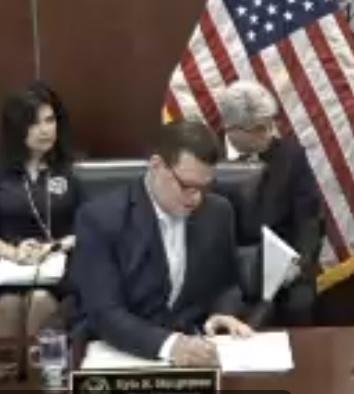
NCUA Vice Chairman Kyle Hauptman during board meeting.
‘Why Are You Doing This to Us?’
During the rare Wednesday board meeting, which was led by Vice Chairman Kyle Hauptman due to the absence of Chairman Todd Harper—who is out following back surgery—Hauptman expressed his opposition to the collection of the data, while Board Member Tonya Otsuka expressed support.
Both board members acknowledged the collection of the data is an issue they have been hearing regularly about, with Hauptman saying he is often asked, “Why are you doing this to us? Do you realize how harmful it is to members?”
The latter is a reference to the harm that would be caused if credit union dropped or significantly altered their programs.
“No one likes paying those fees,” said Hauptman. “I have paid them myself. But anytime you wake up and owe $X that day but have less than $X available, there are only a series of bad options. We are pressuring credit unions to limit what is often the least-bad option for members under financial stress.”
Hauptman, who said some analyses indicate that up to one-third of all late fees and overdrafts could be eliminated with faster payments that get people their money quicker, said he was offering his comments on the collection of the OD/NSF data because it had not been previously discussed during a board meeting.
Hauptman said it is his wish “NCUA was not doing this – especially on such short notice, and that he does realize how harmful it is to consumers.
‘Don’t Serve the Underserved’
“I found out about this burdensome requirement in January,” Hauptman said. “In lieu of repeal, I have suggested several ways to make it less damaging to both credit unions and to the Share Insurance Fund. For example, the same data could be collected in a manner where it’s available to NCUA examiners and we only publish aggregate data. We could also listen to those pleading for adequate time to prepare, and not publish the data until next year, especially since it’s been harder than expected to figure out what numbers are to be used for each category. All my ideas were rejected. Credit unions will now face reputational risk for data that neither the NCUA nor the credit union knows to be correct.”
The decision to collect the data, suggested Hauptman, has made NCUA just another federal agency “mathematically incentivizing institutions to avoid serving low-income people. This policy is very clear: don’t serve the underserved.”
‘Working Against the FCU Act’
Hauptman further stated NCUA is now “working against the Federal Credit Union Act,” which he noted states credit unions are “to create credit…for those of modest means.”
“Well, it’s not the rich that are going to worry about overdraft protection being removed. It’s not those with secure, high-paying jobs that will suffer from a further reduction in offers for ‘free checking accounts’,” said Hauptman. “And make no mistake, the NCUA’s requirement is designed to pressure those fees downward, since one of the main reasons credit unions want more time to comply is to lower these fees and to try to raise revenue in other ways and re-evaluate their business models.”
‘Seen This Movie Before’
Saying “we have seen this movie before,” Hauptman said 2010’sDodd-Frank Act reduced access to free checking and made it mathematically less profitable to serve low-income people. “The outcome was as painful as it was predictable,” he said.
“Doesn’t it seem odd for someone to support the regulations that make it infeasible to serve low-income people, and then talk about ‘financial inclusion’ and lament the millions of Americans who are unbanked?” Hauptman asked. “Can we guarantee the SIF is better off because of this? Nope. And yet we are adding regulatory burden.”
2 Beneficiaries of ‘Misguided Interference’
Hauptman said there will be two beneficiaries of “this misguided interference”: Those who benefit politically, and members of the media, who get to “write click-bait articles that are often devoid of financial or business literacy.”
“It goes without saying that none of the people supportive of these policies will be there with their own money to you offer a better deal when you’re a few bucks short and desperately want to avoid a $500 late fee,” Hauptman said. “That’s what will eventually happen. Overdraft protection, in particular, will become less common. Overdraft is when a credit union pays part of your bills for you when your account doesn’t have enough. Anyone at a banking institution will tell you the most distraught customers are not those whose bills were paid via overdraft, much as they may not like the $30 fee. Nope, the distraught customers are those customers upset that a bill wasn’t paid due to insufficient funds, forcing them to pay much higher costs.
‘We Can’t Pretend’
“We can’t pretend that government artificially forcing down the price of something won’t have major negative effects,”” Hauptman continued. “We also can’t pretend that it makes sense for the NCUA to make interest rate risk our top Supervisory Priority the same year we’re pushing credit unions away from non-interest income. Because no regulation or law passed by government repeals the laws of economics.”
Otsuka: NCUA Has a ‘Mandate’
NCUA Board Member Tonya Otsuka, who did not join the board until January, said her view is the agency has a “responsibility” to ensure there is a “safe and sound system of cooperative credit” available.
“We also have a mandate to ensure that credit unions are following all applicable laws,” said Otsuka. “I agree that the purpose of credit unions are to serve those of modest means. I would like to see more credit unions serve more low-income people, more underserved people, more people of modest means. The actions NCAA has taken over the years with respect to overdraft fee income is consistent with those responsibilities.
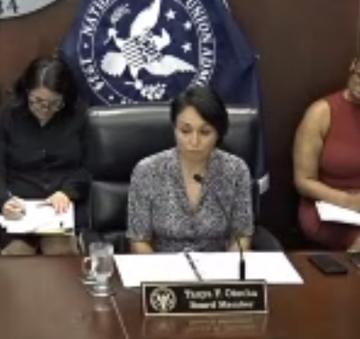
NCUA Board Member Tonya Otsuka during board meeting.
“It's important for NCUA to understand the data both at the institution level and system wide,” Otsuka continued. “We need to make sure that it is transparent for credit union members and the public. Overdraft practices and fees should already be disclosed to members and in be in compliance with applicable laws. An overreliance on overdrafts and NSF's adversely affects both members and their credit unions. Institutions that rely more on fee income can have greater concentration risk and that is a significant concern.”
Concerns Over Excesses
Otsuka said she, too, has heard from “so many consumers, including credit union members” about overdraft practices and fees, and said she agreed with Hauptman that for many people who are struggling, overdraft protection provides a much-needed service.
“But I've also heard from a lot of consumers about excessive overdrafts, of overdrafting over and over and over again, pushing their account even further into the red,” said Otsuka. “Our agency has a responsibility to make sure that those practices are not happening.”
With respect to the reporting of the data on fee income, Otsuka said she believes it’s important “not to prejudge” or “assume a narrative” before “assessing the data in aggregate.”
A ‘Right to Know’
“I think that the public does have a right to know, members have a right to know, what that fee income looks like,” Otsuka said. “The agency needs to know from a system wide safety and soundness perspective…I've heard a lot of concerns about what this means and whether there is going to be risk for institutions or not about the perception of their they're overdraft programs. A lot of that information is already disclosed and, again, members should know. Member-owners have a right to know.”
Otsuka added there are many credit unions that do not charge overdraft fees and are still able to serve low-income members. She further acknowledged the changes may affect how credit unions price their offerings moving forward.
“I want to emphasize that I think we should see what the lay of the land looks like and I look forward to reviewing it to get a better sense of what it looks like from a safety and soundness perspective and from a consumer protection standpoint,” Otsuka said.