

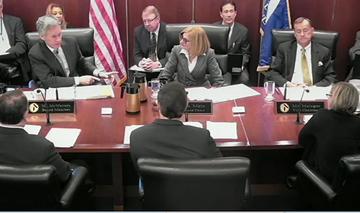
L-R: Mark McWatters, Debbie Matz, Rick Metsger
ALEXANDRIA, Va.—By a 3-0 vote, the NCUA board Thursday approved publishing the Overhead Transfer Rate (OTR) methodology in the Federal Register.
Doing so allows credit union stakeholders to comment on the OTR, and the agency has opened a 90-day comment period. While the vote was unanimous, NCUA Board Member Mark McWatters said he still sees a great deal of subjectivity in what proponents of the current OTR methodology have said is purely a mathematical formula.
The NCUA board also voted 3-0 in favor of publishing its operating fee and methodology and strategic plan in the Federal Register for comment. It is the first time the agency has done so.
The OTR has long been a bone of contention between state and federal charters—and between NASCUS and NCUA—as it reflects the amount of agency “overhead” related to deposit insurance exam costs from state chartered CUs that is “transferred” from the National Credit Union Share Insurance Fund each year to NCUA’s operating budget.
‘About Time’
For years NASCUS has pushed for the methodology to put out for comment. Following Thursday’s vote, NASCUS President and CEO Lucy Ito said, “It’s about time.”
“This is an unprecedented opportunity,” she said. “For years, state regulators and credit unions have sought the chance to weigh in on the overhead transfer rate to address the inequities of the current system. The NASCUS legal analysis released last summer, in fact, found that that the OTR is a rule and should be subject to notice and comment. We’re gratified that NCUA has voluntarily considered the view expressed in our analysis and taken this step. Although we are still poring over the agency’s 112-page document and considering the details of the comment call, we urge as many state regulators and state credit unions as possible to file their own comments about the OTR and address a system in imbalance.”
In her comments during the meeting, Chairman Debbie Matz called setting the OTR a “difficult and thankless job,” saying “all we can do is ensure the methodology accurately reflects the value of the work done by federal and state examiners.”
As she has previously, Matz emphasized that the OTR is not based on arbitrary numbers “picked at random” and that it is based on a mathematical formula established in 2003 under former Chairman Dennis Dollar. Matz noted again that a PricewaterhouseCoopers review of the OTR concluded there is “no basis that it favors or disadvantages” any one type of charter.
She noted that while the OTR will now be published in the Federal Register, it has been available on NCUA’s website since 2011.
Matz added that all comments received during the 90-day comment period will also be available on the NCUA website, even though it is not a new rule that is being proposed.
NCUA’s Director of Examination and Insurance, Larry Fazio, said the goal is to have a response to feedback on the proposal finished by the conclusion of 2016.
An Accounting Construct
In response to a question from Board Member McWatters, Fazio said that setting “the OTR is really a cost-accounting construct. It’s really about allocating the costs of operating the agency.”
But in follow-up, McWatters, who is both an attorney and a CPA, disagreed, saying, “There has been talk about the OTR being an accounting construct that I never really understood. I understand the cost accounting, but it applies after the rules are determined. If you tell me something is Title I and tell me something else is Title II, then (an accountant) can come in and crank through formulas and drop different dollar amounts in the buckets…But we have to back up ultimately to a legal determination of what falls in Title I and what falls into Title II, and that may be set by statute but it may also be set by the NCUA board. When the NCUA board makes a subjective determination to put a regulation in one bucket versus the other, it affects the OTR. The OTR to me is substantially subjective. The part that matters, I will let those who I respect and admire tremendously, to make that determination. To me, the key here is looking at pages 72 (of the OTR methodology) and going forward. That is the mapping. Mapping sets forth what falls in the Title I or the Title II bucket. Comments on that would be very much appreciated.”
In follow-up comments, Matz reminded that the OTR is not simply an issue that impacts state charters, and that FCUs fund a majority of the Overhead Transfer.
“In addition, federal credit unions pay the entire operating fee,” Matz said. “So in total, federal credit unions account for more than 65% of NCUA’s operating budget. Since federal credit unions fund nearly two-thirds of our budget, it’s only fair to put the operating fee methodology out for comment at the same time as the OTR methodology.”
Matz assured that NCUA will take the same next steps with the operating fee methodology as with the OTR methodology.
Matz said she is very interested in comments regarding the exemption threshold.
“Since 2012, federal credit unions with assets under $1 million have been exempt from paying any operating fees,” said Matz. “So I would be interested in hearing whether stakeholders feel this exemption is still appropriate, or whether more small credit unions should be exempt from paying any operating fees.”
NCUA Strategic Plan
Also being put out for comment after the NCUA board voted in favor is NCUA’s draft Strategic Plan for 2017-2021. It will also be published in the Federal Register.
“As we look forward to 2017, I want to reassure stakeholders that NCUA is not locked into an annual exam cycle every year,” said Matz, touching on what has been a divisive issue on the NCUA board and among some credit unions that want to return to 18-month exams for those that meet the requirements. “We may consider moving back to an 18-month exam cycle for credit unions that need to be reviewed less often and we are exploring the possibility.”
In response to a question from Matz, Peggy Sherry, NCUA’s deputy CFO, said, “The 2016-2017 APP contains a measure that reflects the current exam cycle process. It reads, ‘Examine all federal credit unions by December 31, annually.’ If a potential future change in exam cycle were to occur, NCUA will build the APP indicators and targets to appropriately reflect the new exam cycle and regularly measure our performance against the desired outcomes.”
Office Of Minority & Women Inclusion
The board voted 3-0 to complete a restructuring of its Office of Minority and Women Inclusion (OMWI). As part of the restructuring the OMWI will also serve as Director of Equal Employment Opportunity. The OMWI director will no longer report directly to the executive director, but will now report directly to the NCUA chairman.