

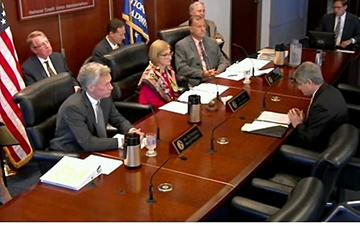
L-R: Mark McWatters, Debbie Matz, Rick Metsger
ALEXANDRIA, Va.—NCUA in May told CUs that adjustments were coming to its business lending rules to streamline the process for CUs and remove some limits, and Thursday the agency delivered on its promise.
At NCUA’s open board meeting today, Chairman Debbie Matz outlined an MBL proposed rule that she said “completely rewrites” current MBL rules. The proposal was approved by a 3-0 vote.
A number of the adjustments announced today were foreshadowed by Matz in a previous CUToday.info report, when she explained the agency would make MBL adjustments that don’t require congressional action.
Key changes under the proposed rule, which will be out for a 60-day comment period:
- Each credit union has the freedom to "prudently" write its own business loan policy without prescriptive regulatory limits.
- CUs can make the decision to waive a member from a personal guarantee, eliminating the current waiver process.
- LTV limits are removed.
- All “unnecessary” limits on construction and development loans are lifted.
- The rule clarifies that participation interests in loans to non-members do not count against the statutory member business lending cap.
- The 15% of net worth limit on loans to one borrower now increases to 25% if the additional 10% is supported by readily marketable collateral.
Right Time For Change
Matz said the rule is “the right approach at the right time.”
The chairman noted that CU business lending acumen has markedly improved since Congress placed new limits on MBLs before 2000, with NCUA at that time following with prescriptive rules to ensure sound MBL programs.
Matz explained that for years the “prescriptive approach” worked for CUs just starting with business lending and obtaining MBL experience. But today, the large majority of CU MBL lenders have sound, well-established programs and risk management policies.
“Now is an appropriate time to transition away from prescriptive regulatory limits toward general principles that will give CUs greater flexibility to serve their business members,” Matz said
Addressing how the proposed rule gives CUs the freedom to prudently write their own business lending policy without prescriptive regulatory limits, Matz said that under the proposal, credit unions with small commercial loan portfolios would not even have to write a policy.
“Based on current volume, nearly 700 credit unions would be exempt from the policy requirement,” said Matz. “For instance, credit unions that may make an occasional commercial loan for a truck or a pizza oven could serve those small businesses without additional paperwork.”
Giving CUs More Control
Vice Chair Rick Metsger emphasized how the changes are another example of how NCUA continues to give CUs greater control over their own business.
“Most importantly, this proposed set of revisions continues the devolution of decision-making from the NCUA to the boards and management of credit unions,” said Metsger.
Matz addressed how she heard through conversations with CU leaders across the country about the operational challenges they face with NCUA’s current MBL rule.
“This proposal completely rewrites the current rule to address those challenges and remove unnecessary burdens,” she said. “Of course, we recognize that commercial loans still pose unique risks and require specialized oversight, so when this rule becomes final, we plan to update guidance for credit unions and supervise effectively for sound commercial lending practices.”
Matz said that will require retraining examiners, which will take time and resources to implement. NCUA said training would being once a final rule is approved and then would likely take until some point in 2017 to complete.
“This modernized and flexible rule, implemented by well-trained examiners, would allow credit unions to safely and soundly serve more small business owners,” she said.
State Chartered CUs
Matz pointed out that while the proposed rule would apply to most state-chartered CUs making business loans, seven states have their own MBL guidelines.
“We recognize that some state chartered credit unions might like this new rule, while some state regulators might prefer their own rule,” said Matz. “So we’re seeking comments on whether the seven existing state rules should be grandfathered, and whether any state should continue to have the opportunity to apply for NCUA approval of a state commercial lending rule in the future.”
Board Member Mark McWatters said the proposal represents “true” regulatory relief.
“But that is in the eyes of the beholder—those credit unions that make business loans,” said McWatters. “So please read this rule in detail, think about how it will or won’t work with your business plan, and give us your comments.”
Matz's complete statement on the MBL rule can be found here. Metsger's complete statement can be found here.
Among other issues the board addressed:
By a vote of 3-0, the board approved a final interagency rule regarding loans in areas with special flood hazards.
The rule final rule, established by NCUA, the OCC, Federal Reserve Board, FDIC, and Farm Credit Administration, implements provisions in the Homeowner Flood Insurance Affordability Act of 2014 and the Biggert-Waters amendment. The proposal establishes mandatory requirements on the escrow of flood insurance payments for loans made on or after January 1, 2016, and includes exceptions to the requirement for credit unions with assets of less than $1 billion. Also, the plan would create an exception for home equity lines of credit.
Matz said the final rule strikes a balance between consumer protections and compliance expectations, pointing out that more than 96% of credit unions will be exempt from the flood insurance escrow requirements.
“However, while less than 4% of credit unions will have to comply with the flood insurance escrow requirements, those credit unions represent more than 48 million consumers,” said Matz. “Based on first-quarter Call Reports, those consumers represent about half of all credit union members.”
The board also outlined the final interagency policy statement establishing a joint diversity assessment standards for CUs. The joint policy covers institutions regulated by NCUA, the Federal Reserve Board, the CFPB, FDIC, OCC, and the SEC.
Understanding that some CUs, especially in rural areas, may have hiring limitations, Matz said the new policy statement is flexible. “Credit unions may choose to set their own definition of ‘diversity,’” explained Matz, adding that CUs located in areas where minority populations are sparse may choose to adopt an alternate definition.
Matz said that means CUs could include people with disabilities, veterans or anyone who self-identifies as lesbian, gay, or bisexual, for example.
“These standards are not one-size-fits-all,” said Matz. “To make this voluntary process as easy as possible, we’ve developed a sample self-assessment checklist as guidance for credit unions,” which Matz said NCUA will send this week in a Letter to Credit Unions.
The board approved, 3-0, maintaining the federal credit union loan interest rate ceiling at 18% for most federal credit union loans and 28% for payday alternative loans.
The board unanimously approved to again participate Economic Growth and Regulatory Paperwork Reduction Act (EGRPPA), and put out for a 90-day comment period rules the agency is reviewing under EGRPPA.
Matz said the agency is looking forward to CU comments on its latest rule review process, which includes 10 existing rules.
The new review is the third under EGRPRA for the agency. Under EGRPRA, federal financial institution regulators, with the exception of the NCUA, are required to review their rules at least once every 10 years. NCUA voluntarily participates in the process.
Matz pointed out that important changes to NCUA rules have come from previous EGRPPA rounds, based on comments from CUs. For example:
- Raising raise the asset threshold for regulatory flexibility from $50 million to $100 million
- The new consumer complaint process
- The Field of Membership Working Group
- Member business lending
The board also unanimously approved a final interpretive ruling and policy statement (IRPS) on the minority depository institution preservation program—under which NCUA’s IRPS would establish a Minority Depository Institution (MDI) program.