

ALEXANDRIA, Va.–The NCUA board is strongly encouraging credit unions--as well as those outside the industry--to provide thoughts, suggestions and concerns around digital assets and other developing technologies as it looks to provide guidance and set rules.
The board approved a request for information on digital assets during its meeting. To emphasize the degree to which the agency is seeking comment, NCUA Vice Chairman Kyle Hauptman noted during his remarks that the RFI includes a “catch-all” statement that essentially says, “Regardless of what’s in this document, send us anything you think NCUA can do to help.”
Hauptman was joined by his fellow board members in noting NCUA is seeking the input and expertise of anyone who has something to offer, including tech entrepreneurs and others.
Agency staff said the RFI seeks input around a number of themes related to digital assets, including opportunities and risks, the permanent nature of transactions and how it affects consumer records, and fraud, such as money laundering.
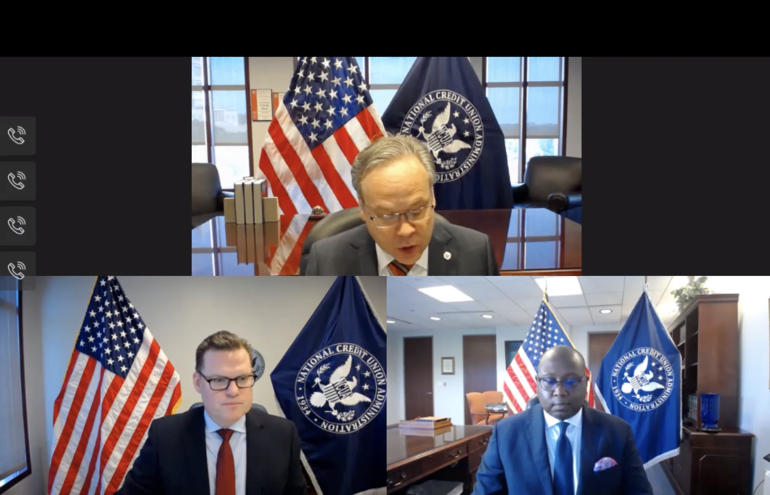
Hauptman, given the privilege of speaking first at the board meeting by Chairman Todd Harper due to his interest in developing technologies, noted that during his Senate nomination he mentioned blockchain and the fact 88 million stimulus payments took weeks (or longer) to reach people due to paper checks being sent to addresses that were often years old.
Hauptman said it’s time to act now, comparing the current state of digital asset technology development to the era of dial-up AOL, adding that early “regularity guidance” from NCUA will help credit unions in a changing marketplace and help prevent CUs from going the way of Blockbuster.
“We want people to make products designed for credit unions,” said Hauptman. “And today’s request for information dovetails nicely with NCUA’s focus around inclusion.”
Opportunities & Guardrails
During his comments, Harper, who credited former NCUA Chairman J. Mark McWatters for his early work urging the agency to focus on the developing technologies, said NCUA and credit unions must recognize digital assets are not solely for Silicon Valley and high finance. He further noted cryptocurrencies have exploded to more than 6,000 forms worldwide, and that distributed ledger technology is expanding and lowering costs, often with no depository institutions acting as an intermediary.
Harper said the risks are also apparent, especially around BSA, AML, consumer financial protection, equity and fairness.
“This request is the next logical step for federally insured credit unions to leverage these innovations,” said Harper. “Any policy related to cryptocurrencies, digital and other assets cannot solely come from NCUA. Any top-down approach could inadvertently miss the mark or stifle innovation and prevent credit unions from embracing this technology or competing against non-bank actors increasingly gaining market share in areas where banks and credit unions have traditionally operated.”
Harper also urged a better understanding of the guardrails that will need to be put in place to guard safety and soundness.
Hood: What Visit With One FI Revealed
In his comments, NCUA Board Member Rodney Hood shared a story about visiting with a financial institution in Charlottesville, Va., that earlier this year started providing Bitcoin access at their branch locations and ATMs.
“That is not exactly something you expect to hear from a small financial institution,” said Hood. “But their customers had expressed interest in crypto-currency, and so they decided to experiment with Bitcoin to gauge the response. As he put it, they wanted to prove that smaller institutions could be just as innovative as the big national players.”
Hood said he wanted to clarify that he does not believe CUs should “rush into” Bitcoin, but he said he is encouraging all credit unions to look carefully at technological tools – whether it’s crypto-currencies, or digital payment platforms, or blockchain applications, financial data aggregation –and “think very hard about how they may, or may not, fit into your business models.”
“An undeniable challenge that credit unions face — and all financial services providers for that matter — is how to continue growing and prospering in a crowded marketplace,” Hood said. “And one way to compete effectively, as this small institution in Virginia recognized, is by looking very closely at these fintech solutions and determining how they can be of value to your members.”
Hood said too often regulators are behind the curve on technological change and he is determined not to allow NCUA to get “caught flat-footed” by the changes taking place.
“As an agency, we are working to do more to focus on the regulatory and supervisory needs related to fintech,” the agency’s former chairman said. “We recognize these technologies are going to play a growing role in financial services in the years to come, so we want to be prepared to ensure they’re effectively integrated with the needs of credit unions and credit unions’ member-owners.”