

ALEXANDRIA, Va.—The NCUA board Thursday voted 2-0 to approve a final rule on capital planning and stress testing that provides regulatory relief for federally insured CUs with assets of $10 billion or greater.
The rule allows covered credit unions to conduct their own stress testing and incorporate those results into their capital plan submissions. The current process requires the NCUA to conduct a stress test even if a credit union conducts one of its own.
Under the final rule, credit unions with assets of less than $20 billion will continue to develop annual capital plans, but those plans will no longer be submitted to the NCUA each year. Credit unions with assets greater than $20 billion will continue to submit plans that must be approved by the agency. Also, NCUA will no longer be required to conduct supervisory stress tests. Credit unions subject to the rule will conduct stress testing themselves.
Credit unions with assets of less than $15 billion will no longer be subject to stress-testing requirements. CUs with assets greater than $15 billion will be required to conduct stress testing, though credit unions with assets greater than $20 billion will be subject to a 5% minimum stress test capital ratio, NCUA said.
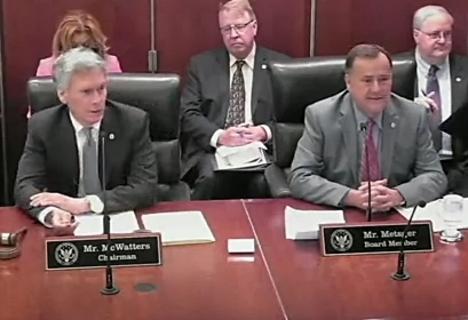
Board Chairman Mark McWatters explained that the rule was constructed not with the FDIC’s stress testing rules in mind, since credit union stress testing performs a much different function than stress testing for banks.
“Credit unions themselves are not systemically critical to the economy,” said McWatters. “I can’t think of a single credit union or group of credit unions that could bring down the U.S. economy if they failed. But I can assure you there are certain banks that could bring down the U.S. economy. So we are not building these rules to obviate risk to the U.S. economy, we are building them to protect the Share Insurance Fund.
McWatters emphasized that in granting credit unions a measure of regulatory relief, of primary concern moving forward is protecting the needs of CU members.
“We are not just protecting the NCUSIF, we are protecting the credit union community and all of its account holders,” said McWatters. “These middle class people, those striving to be middle class and the underserved, we have that burden on us that perhaps the large banks don’t. Our issue is a consumer protection issue.”
McWatters emphasized that is a large responsibility.
“If a credit union fails, now some people in the community who need an affordable mortgage or car loan are out of luck,” he said.
Given that NCUA is placing the job of stress testing in the hands of credit unions, McWatters Thursday asked Scott Hunt, director of the Office of National Examinations and Supervision, how prepared the agency is to move forward under the new rule and protect the Share Insurance Fund and credit union members.
“We want to provide regulatory relief where it’s prudent to do so, and, yes, we are giving credit unions more responsibility,” said Hunt.
Hunt explained that NCUA, in the four years since the agency instituted its capital planning and stress testing rule on the heels of the financial crisis, has developed the expertise and added systems to effectively oversee credit unions under the new rule, and to run and supervise stress tests.”
Board Member Rick Metsger emphasized that in the final rule, NCUA is providing regulatory relief by “phasing-in both the capital planning and stress testing requirements as credit unions grow in size. We are adjusting the thresholds to account for inflation, changes in the credit union system, and the growth of the Share Insurance Fund.”
He also noted that NCUA is prepared to step in and conduct stress testing for any credit union if warning signs arise.
“Under this rule, NCUA retains the right to move a credit union to a higher tier if facts and circumstances warrant it, and to conduct a stress test itself rather than allowing the credit union to do it,” Metsger said. “In addition, NCUA will continue to define capital planning requirements and stress testing scenarios and how stress tests must be conducted.”
Advertising Final Rule
In other business, the board voted 2-0 to approve a final rule that revises outdated provisions and allows credit unions greater flexibility in their advertising requirements.
The advertising rule had required federally insured credit unions to use one of three versions of the NCUA’s official statement in all advertising. The approved rule adds a fourth version, allowing a credit union to state “insured by NCUA.”
“To provide additional regulatory relief, the board is expanding a current exemption from the advertising statement requirement regarding radio and television advertisements and eliminating the requirement to include the official advertising statement on statements of condition required to be published by law,” NCUA said.