

ALEXANDRIA, Va.–The NCUA board voted 3-0 to update its rules around Public Unit and Nonmember Shares, a change expected to primarily benefit smaller and low-income credit unions.
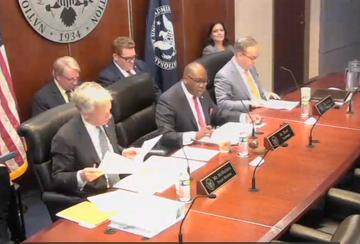
L-R: Mark McWatters, Rodney Hood, Todd Harper
The final rule, Part 701, is identical to the rule that had previously been proposed and retains the $3-million alternative limit. The board said it expects the final rule will provide federally insured credit unions with greater balance between external funding options and borrowings.
Under the rules, credit unions will continue to be limited to non-member deposits from public units, such as a municipalities, the higher of a 50% aggregate amount of public unit and nonmember shares as a percentage of the net amount of paid-in and unimpaired capital and surplus less public unit and nonmember shares, or $3 million. The new rule now applies to all non-member shares, regardless of the source, even if the public unit is a member.
The final rule does not provide any exemption to the limit of public unit and nonmember shares a credit union my accept.
Plan Required
Any federally insured credit union would be required to develop a plan regarding the intended use of any borrowings, public unit, or nonmember shares that, taken together, exceed 70% of the FICU’s paid-in and unimpaired capital and surplus.
NCUA staff said the new rules will supersede and do away with waivers, and that CUs will need to come into compliance.
The new rule would allow credit unions to increase funding capacity from the two sources from the existing 56% to 65%, but a credit union would require a net a net worth ratio of approximately 16% to fully take advantage. It’s typically smaller CUs that have the higher net worth ratios.
Growth in Non-Member Deposits
Agency staff told the board that third parties will continue to act as a marketplace between issuers and investors, but that a majority of credit union funds will remain direct deposits. “Overall diversity, cost, source insurability and operational burden are key factors in the decision making around how credit unions fund their business,” staff told the board.
The total for public unit non-member shares in credit unions is $16 billion, or just 1% of assets. Member shares and equity continue to represent 94% of total funding. Borrowings and other sources make up the remainder of the funding.
Staff said there will continue to be a “practical limit” on the level credit unions can obtain.
Hood Says Concerns Were Heard
NCUA Chairman Rodney Hood said the agency listened to credit union concerns in forming the final rule, including the alternative $3-million limit. He said the result is credit unions will be able to think about funding sources in a “more holistic manner,” while at the same time paperwork has been reduced.
In response to a question from Hood on how NCUA examiners might change their reviews of funding sources, staff said the changes will be “subtle at best.”
In response to a question from NCUA Board Member Todd Harper, agency staff said it is not expected the change will lead to CUs turning to higher-cost brokered deposits, saying in many cases public unit funds and non-member funds do not come via brokers. Moreover, those funds often come from sources that aren’t seeking high returns but instead to achieve a social objective, and as such are lower in cost.
‘Sensible’ Decisions
NCUA Director of the Office of Examination and Insurance Larry Fazio told the board that regardless of the source of funds, NCUA needs to continue to ask the same questions around whether “sensible” decisions are being made by the CU.
Why have CUs seen a four-fold increase in non-member deposits to $16 billion? asked Harper.
Fazio said the increase reflects the increasing number of low-income designated CUs, meaning more CUs have access to nonmember deposits.
“The other trend is while we’ve seen strong share growth, we’ve seen even stronger loan growth, and if over a five-year period loan growth outpaces share growth, CUs are outgrowing their ability to fund the loans,” said Fazio.
CUNA's Reaction
CUNA thanked NCUA for the decision.
“We thank NCUA for retaining the $3-million alternative cap in its final public unit and nonmember shares rule. As stated in our comment letter to the agency, we believe that removing the alternative limit could have harmed several credit unions that currently use the $3-million alternative cap, mostly small institutions, so this is a welcome change for them," said Elizabeth Eurgubian, deputy chief advocacy officer and senior counsel.
NASCUS Response
In response, NASCUS CEO Lucy Ito said, “State regulators are prepared to work closely with NCUA to supervise the increased non-member shares public unit deposits in a safe and sound manner. We commend NCUA’s efforts to provide federally insured credit unions with greater flexibility to manage funding. Raising the limit for public unit and non-member deposits enhances credit union liquidity options and allows credit unions accepting these deposits to preserve other lines of credit. We are particularly pleased that NCUA heeded our call to retain the regulatory limit on public unit and non-member shares of $3 million in addition to the newly approved 50 percent limit of paid-in and unimpaired capital and surplus.”