

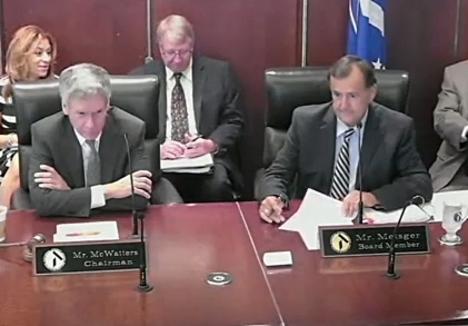
L-R: Mark McWatters, Rick Metsger
ARLINGTON, Va.—Credit unions in 2018 could see $600-$800 million in Corporate Stabilization refunds from monies paid to prop up the corporate system, according to a proposal the NCUA board approved Thursday.
By a 2-0 vote, the NCUA board approved a proposed plan to close the Temporary Corporate Credit Union Stabilization Fund Oct. 1, 2017—four years ahead of schedule—and reset the normal operating level of the National Credit Union Share Insurance Fund from 1.3% to 1.39%. The rule is out for a 60-day comment period.
The distributions, which the agency emphasized are projected, could begin sometime during the second quarter of next year, the agency said.
“The proposal to close the Stabilization Fund in 2017 is prudent, based on a number of factors,” said Board Chairman Mark McWatters, reading from a letter he plans to send to the Senate Banking Committee. “Unlike in 2009, the current exposure presented to the Share Insurance Fund by the Legacy Assets and the NGNs are dramatically lower than the $13.3 billion in Share Insurance Fund assets (as of April 30, 2017). Due primarily to nearly $4 billion in net legal recoveries, the Stabilization Fund has a positive net position of approximately $1.9 billion as of May 2017. The NCUA board believes that the remaining obligations of the Corporate System Resolution Program can now be prudently borne by the Share Insurance Fund without inordinate risk, provided additional equity is maintained in the Share Insurance Fund. Additionally, there remain no outstanding borrowings with the Treasury Department. The Stabilization Fund has, accordingly, served its purpose of retaining the resolution costs of the five failed corporate credit unions within the credit union system, at no cost to taxpayers.”
Not Simple Process
McWatters acknowledged that determining when it could close the TCCUSF and rebate payments has not been a simple process. He also said that those who would suggest that NCUA hold onto the NGN notes longer to possibly receive a greater return are mistaking what the agency is charged to do.
“The NCUA is not a hedge fund,” said McWatters. “We fell into this role by default. This is not our skill set. (To hold onto Legacy Assets) longer puts us in the position of acting like a hedge fund manager. That is not something I am comfortable with the agency doing, and something I am not comfortable going to Congress with.”
Board Member Rick Metsger thanked the work of those within NCUA who managed through the tough years of the Corporate crisis and made the difficult decisions on which road to travel. He credited many, including former Chairman Debbie Matz and Board Member Michael Fryzel.
Metsger emphasized that the tough decisions made during the corporate crisis have possibly prevented assessments that might be on the backs of natural person CUs “even until today . . . (Those who devised the TCCUSF plan) have spun straw into gold,” he said.
During the meeting, which provided lengthy detail on the processes and thinking behind closing the stabilization fund—including announcing a dedicated web page on the proposal—NCUA noted that payouts to CUs could not be made this year since the Federal Credit Union Act only allows for a distribution of stabilization fund assets to one entity, that being the NCUSIF, from which payouts to CUs will be made next year.
Factors Affect Outcome
NCUA explained that several factors make the proposed closure of the Stabilization Fund this year possible, as well as next year’s proposed payouts:
- There are no longer any outstanding borrowings to be repaid to the U.S. Treasury, as the agency made the last payment to the Treasury Department in October 2016
- The balance of the Legacy Assets that secure the NCUA Guaranteed Notes Program and the NGN investor balance are both lower than the $13.2 billion Share Insurance Fund
- Due to nearly $4 billion in net legal recoveries, the Stabilization Fund has a net positive position of $1.9 billion as of May 2017
The board emphasized that in transferring the TCCUSF’s assets to the NCUSIF, that the Share Insurance Fund now takes on the remaining NGN note risk. The payout to CUs, which the agency projected could someday reach $1.4 billion to $1.7 billion, is based in part on the difference between the NCUSIF equity ratio and the normal operating level of the fund. NCUA said it looked closely at what the economy could bring over the next five years, including the effects of a moderate and severe recession on CUs and therefore the insurance fund, before choosing to set the operating level at 1.39%—which also helps to avoid a possible Share Insurance Fund premium in 2017, the agency said. NCUA Chief Economist Ralph Monaco said the agency made its final decision based on a moderate recession and its lingering effects.
Metsger emphasized to credit unions that they need to provide the agency with their comments, and do so expediently.
“Don’t wait until the final few days of the comment period,” said Metsger, noting that will not give the agency enough time to adequately address feedback and develop a final rule in a timely manner. He said if credit unions wait until the final few days to comment, that distributions set for the second quarter of 2018 could be delayed. “We believe we can do this, but we need your (timely) help.”
Trades Respond
CUNA said it is reviewing the details of NCUA’s plan for closing the corporate stabilization fund and the mechanisms for providing credit unions rebates in 2018.
“While we have some initial concerns about an increased operating level, CUNA, leagues and credit unions appreciate Chairman McWatters' efforts on this front and we’ll work closely with the agency on this matter,” said CUNA President/CEO Jim Nussle.
NAFCU noted that many factors are involved in a potential merger of the stabilization fund into the National Credit Union Share Insurance Fund, and that public comments are crucial to developing a solution that is in the best interests of all credit unions.
"However, the proposed substantial increase in the normal operating level is unacceptable, and NAFCU will strongly urge the agency to avoid such a dramatic move," said NAFCU President and CEO Dan Berger. "NAFCU will be giving the NCUA our members' feedback on the proposal. For our part, NAFCU recommends the agency's decision take into account two facts: 1) under the Federal Credit Union Act, the NCUA is not required to assess a premium in 2017, and 2) we believe the NCUA has the authority to return assets to credit unions directly. The money credit unions pay to the NCUA comes from its members, and it should be returned to the fullest extent possible."
Equity Distributions Proposal
Also, by a 2-0 vote, the agency approved a proposal to address how Share Insurance Fund Equity Distributions will be made.
The proposal outlined three methods for determining payouts to credit unions: insured share balances at the close of 2017, the average of insured shares over the last four call report periods, or a system based on what credit unions actually paid into the TCCUSF, which the agency acknowledged would the most difficult option.
NCUA said the proposed rule that amends the existing share insurance requirements rule would also give federally insured credit unions greater transparency on how an individual credit union’s share of an equity distribution from the Share Insurance Fund would be calculated. The rule also would prohibit a federally insured credit union that terminates share insurance coverage from receiving a distribution for the calendar year in which that termination occurred.