

ALEXANDRIA, Va.–The NCUA board has voted 2-1 to approve final new rules for Final Rule, Part 701, Payday Alternative Loans II (PALs II). The new rules create an additional PAL option and do not replace the current PALs I loans.
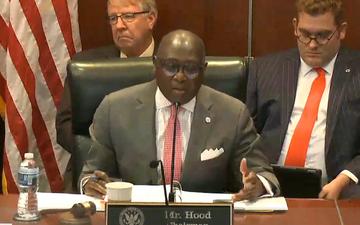
Rodney Hood
Board Member Todd Harper voted against the proposal, saying among other things the program runs the risk of pushing members into payday lender-like triple-digit APRs on loans.
PAL II loans are now permitted up to be made by credit unions in amounts up to $2,000, with no minimum loan amount and a maximum term of 12 months. That’s a change from the PALs I loans that arerestricted to amounts between $200 and $1,000 and a six-month term.
PAL II loans would not have the 30-day membership requirement, an issue for which both CU trade groups had advocated. The new rule includes a few changes from what had originally been proposed.
The original PALs program was created in 2010. NCUA Chairman Rodney Hood said credit unions are on pace to make more than 225,000 PALs loans this year with an average size of $400. The majority of those loans are being made by credit unions of less than $50 million in assets. According to Hood, an analysis of PALs loans suggests 30-day PALs loans have saved consumers more than $200 million since inception through the end of 2018.
The agency said it received 54 comment letters on the proposal, the majority of which supported the PALS II framework, although a number of suggestions were made and in some cases acted upon, NCUA staff said. Some are also calling for a PALs III option, but staff said no such program is currently under consideration.
Among the points made by three members of NCUA staff in comments to the agency’s board:
Length of Membership
The purpose of doing away with the 30-day membership requirement is to allow any FCU borrower who needs funds immediately access to those funds. Staff noted there is nothing in the rule that prohibits an FCU from establishing a minimum membership term if they choose to.
Minimum/Maximum Loan Amounts
PALs II eliminates the $200 minimum loan amount required in PALs I. Agency staff said some commenters expressed concerns that removing the minimum means in cases where a credit union charges an application fee, the cost of the loan for a borrower could mimic the costs of payday lenders (for which the PALs loans are designed to be an alternative).
Staff said allowing the higher amount of $2,000 would give a federal credit union the opportunity to meet demand, and give some borrowers opportunity to consolidate multiple payday loans into one, creating a pathway to mainstream financial services. Agency staff said some comment letter writers had requested even higher amounts, but the $2,000 strikes a “nice balance.”
Limits on Number of Loans
There is a current limit of no more than three loans during a rolling six-month period under PALs I, a limit that is retained under PALs II, even though some also wanted to see that changed.
Overdraft Fees
In making its recommendation, NCUA staff said they acknowledged whether to charge an overdraft fee is a decision for each CU to make in accordance with its own risk tolerance. But staff said many people who take out PALs loans are in “vulnerable positions” and that an overdraft fee would likely “weaken them further.” Staff recommended against any overdraft fee or NSF fee on PALs II loan.
Chairman’s Statement
Following the staff presentations, Hood said PALs are not designed to be the only means by which federal credit unions can help members who need financial help.
“For this option to work it must strike the appropriate balance of flexibility and consumer protection,” said Hood. “Federal credit unions should consider how this loan will help benefit a member’s financial well-being.”
Harper’s Statement
Prior to saying he would vote against the PALS II proposal, Harper said he supports the concept behind the program but that he also “cares deeply about consumer financial protection,” and that he is opposed to what he called “overly broad” loan amounts under PALs II.
Harper said loans made under PALs II could effectively have triple-digit APRs, and argued loan amounts from $1,000 to $2,000 are outside the limits of what payday lenders make. He noted Delaware, for instance caps such loans at $1,000, including the fee.
“To me, a PAL in the range of $1,000 to $2,000 looks like a consumer loan that most credit unions are already making under the 18% APR cap,” he said, citing a number of other lenders he said already have loans that are similar and which charge less than 14% APR.
Harper said the data show the median income of a payday loan borrower is between $25,000 and $30,000.
“We know over time payday loan borrowers’ loans increase in frequency as they try to keep up with interest and fees,” Harper said. “In my opinion a $2,000 loan at 36% interest will drive borrowers deeper into that cycle.”
McWatters’ View
NCUA Board Member J. Mark McWatters said his research into why PALs was created a decade ago was partially as a beta test to “sort of understand the market.”
“What I’m told is what we learned is there really are people with payday credit that need a $50 loan; people with payday lender credit risk who need a $1,500 loan,” said McWatters.
McWatters cited one comment letter filed by the Pew Trusts—which he said “stands by itself as a champion of consumer rights and is hardly a pro-payday organization–in which Pew said NCUA should really consider raising the maximum loan cap to $4,000, as there are many people in the category who need the larger amount.
“What I’m most concerned with, if you’re the person who needs the $50 or the $1,500, this is not theoretical to you,” said McWatters. “You are going to get it because you have to have it. We can’t be too ivory tower about this. Maybe you go to the payday lender and maybe you go to another credit union product. Credit unions are small-dollar lenders. They may not call it small-dollar loans, but it’s overdraft protection, its credit cards. I don’t like the idea of driving people into overdraft.
“Small-dollar lending is cash management for people who don’t have cash. I have met with credit unions that said we underwrite our small-dollar loans and 18% is enough. If you’re borrowers have enough to repay at 18%, we don’t need your PALs I and PALs II. I have gone to other credit unions that have said, ‘We can’t make it happen. We need PALs I, we need the higher APR, the higher fee.’ And others have said ‘even PALs II isn’t enough and we need a risk-adjusted rate of return that is even higher.’ And then we have other groups that don’t touch small-dollar lending.”
What to Do Now?
“Those CUs essentially push people into overdraft and credit cards. The question is what do we do now?” continued McWatters. “PALs II doesn’t answer everything and it doesn’t really solve the problem. The first thing we need to do is figure out what the problem is, and maybe have a meeting or a discussion or a debate among members of the credit union community as to the best-approach for this small-dollar lending.”
CUNA's Perspective
“For American consumers who encounter unexpected expenses, meeting immediate financial needs can be difficult," said Ryan Donovan, CUNA chief advocacy officer. "Credit unions offer safe and affordable short-term loans to their members and we thank the NCUA board for creating an additional payday alternative loan option.”
NASCUS Perspective
"Similar to the Federal credit union bylaws rule, the payday alternative loans II rule only applies to federal credit unions. Federally insured state-chartered credit unions should look to state law and state regulation for their ability to make these types of loans," said NASCUS President Lucy Ito.