

ALEXANDRIA, Va.—The NCUA board Thursday voted 2-0 to approve a final rule that further expands the agency’s field of membership rule, bringing back the narrative approach as an option to establish a well-defined local community—an approach allowed by NCUA prior to 2010.
The agency also approved, 2-0, a final rule on voluntary mergers that provides greater transparency in merger compensation to top executives of the acquired CU, and provides members with more time to make a decision on the combination.
The final FOM rule gives CUs the option to submit a narrative approach application, which the NCUA used prior to 2010, to serve a field of membership exceeding 2.5 million people. Under this new rule, credit unions can submit a narrative to explain the existence of a well-defined local community rather than limiting them to a statistical community. For the applicants who request a community that exceeds a population of 2.5 million people, the NCUA will hold a public hearing to address their narrative. And for communities that are subdivided into metropolitan divisions, applicants will be permitted to designate a portion of this area as its community and disregard division boundaries.
Banker Suit
Thursday’s approved final FOM rule arrives as the agency faces a lawsuit from the banking industry over its existing FOM rule. As CUToday.info reported, Judge Dabney Friedrich in the U.S. District Court for the District of Columbia, in March upheld two challenged portions of NCUA’s field of membership rule and struck down two provisions in a lawsuit filed against the agency by the American Bankers Association in late 2016. The provisions declared to exceed the NCUA's statutory authority include those that automatically qualify a combined statistical area (CSA) with fewer than 2.5 million people to be a local community and the increase to one-million people in the population limit for rural districts. The agency has appealed Friedrich’s ruling.
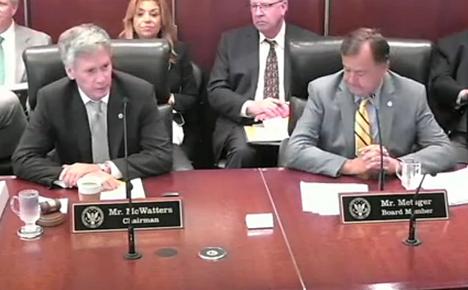
Board Member Rick Metsger noted that the narrative approach aligns with Friedrich’s opinions on what is allowable for CUs when they expand their FOM. He also stated that the new rule gives credit unions more options.
“The narrative approach will simply be an option that a credit union can use if the borders of existing political jurisdictions do not represent their natural market,” said Metsger. “This can be the case with political boundaries that were often created more than two centuries ago and no longer reflect today’s world . . . Today’s final rule will give individual credit unions greater flexibility to establish their own well-defined local communities rather than having someone else impose their definition on them.”
Metsger emphasized that he is aware the final rule will not please everyone.
“Banks may think it goes too far, and credit unions may think it doesn’t go far enough. But it is a logical next step, which is consistent with both the Federal Credit Union Act and judicial interpretations of that Act,” he said.
Metsger said the use of statistically based “presumptive communities,” an approach permitted under the last FOM rule expansion, is both more objective and less burdensome than the narrative approach.
“It provides very meaningful regulatory relief to credit unions and their members and prospective members. The narrative approach is more difficult, more cumbersome, and more expensive,” he said. “The narrative approach is occasionally more flexible than the use of statistically based presumptive communities, but it requires far more work by both the credit union and the agency. That is why we assume most credit unions that seek a community charter will still apply to serve a presumptive community such as a town, city, county, core-based statistical area, or a rural district.”
Greater Transparency In Voluntary Mergers
NCUA approved final rule on voluntary mergers, issued largely to provide greater transparency to members and the public on the deal that is being struck and the compensation provided to top executives of the acquired CU.
While NCUA did not directly address the matter in its meeting Thursday, as CUToday.info has extensively reported, sources have indicated that undisclosed compensation has gone to and goes to the management and volunteers of credit unions in some mergers. Sources have stated that these pay packages are typically not disclosed to members when they are voting on the merger; instead, members are often told the merger is about “improved products and services.”
When the NCUA board first proposed the voluntary merger rule that was finalized Thursday, staff reported that in “75% to 80%” of mergers they had found “significant merger-related compensation” being paid to people at the credit union that was being acquired, nearly all of which was kept from members when voting on the merger.
Key Changes
Key changes in the new rule are that members must be given notice of the merger and provided with information at least 45 days in dance of the vote, as opposed to the current seven-day minimum notice. Merger-related compensation paid to the top five executives of the acquired CU that exceeds $10,000 or 15% (whichever is greater) of current compensation must be disclosed. NCUA, too, will host a moderated web page for member-to-member merger communication. The new rule also clarifies the contents and format of the members’ notice to provide better information, NCUA said.
“I look at this simply as a disclosure rule similar to what the SEC requires,” said NCUA Chairman Mark McWatters. “The SEC does not pass judgement on whether the merger is good or bad, but requires disclosure so the people voting have all the material and time to make informed decisions.”
But McWatters noted that some credit unions may have a “great story to tell” in how an executive worked hard for many years, excelled, and was underpaid.
“Some of these people should receive some sort of bonus or other compensation. I know that happens all the time,” he said. “But the best answer is to disclose the story, not make it secret or pretend it does not exist.”
McWatters noted that some credit unions will argue that the new rule is simply more compliance burden.
“I don’t think this will have a chilling effect on mergers. If it does, perhaps there was something wrong with the merger in the first place,” he said.
NAFCU Has 'Concerns'

NAFCU President and CEO Dan Berger shared the trade association’s concerns.
"Despite some positive changes from the proposal, we are still concerned about the potential impact of the agency's final voluntary mergers rule. While we support increased transparency and disclosure, the rule could create unnecessary and troublesome roadblocks for responsible credit union mergers," Berger said.
Metsger said the more accurate term for the new rule should be the “merger transparency rule.”
“Credit unions belong to their members and if a credit union is being merged into another credit union the members of the merging CU must approve that merger and must have enough information to make an informed decision. After all, it is their money,” Metsger said.
While the new rule does not require the merging CU to disclose the change in benefits provided to all employees on a non-discriminatory basis, the regulation does require disclosure if only certain high-level (top five) executives receive merger-related benefits such as a split-dollar life insurance policy, a car allowance or better than the standard health insurance. However, disclosure is only required if that benefit exceeds $10,000 or 15% of current compensation, Metsger noted.
“We are also alleviating credit unions of the burden of managing member-to-member comments on the proposed merger,” said Metsger. “Under the final rule all the merging credit union needs to do is include information in the merger documents about a moderated webpage NCUA will create for member-to-member communication on the merger.”
Other Business
- A briefing was held on the board’s unanimous approval, by notation vote on May 30, 2018, a change to the member business lending rule (Part 723) that conforms with changes to the Federal Credit Union Act made by the Economic Growth, Regulatory Relief, and Consumer Protection Act of 2018, signed into law by President Donald J. Trump on May 24. That legislation revised the definition of a member business loan to exclude all loans secured by liens on one-to-four unit family dwellings, regardless of the occupancy status of the borrower. The Federal Credit Union Act and the NCUA’s member business lending rule previously defined member business loans, for the purpose of the aggregate limit on those loans, to include loans secured by liens on one-to-four unit family dwellings that were not the borrower’s principal residence.
- An update was provided on NCUA’s Enterprise Solution Modernization Program. The agency noted that the project has taken additional work outside its original scope and is moving ahead with several initiatives to streamline the agency’s processes, technology and infrastructure.