

ALEXANDRIA, Va.–The NCUA board has voted 3-0 to approve a number of new bylaws amendments for federal credit unions.
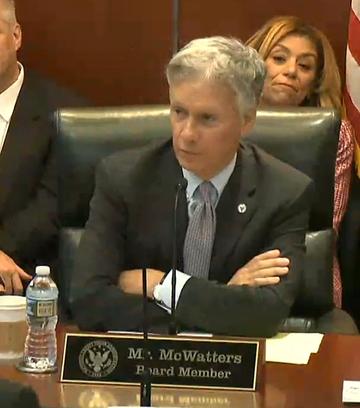
Mark McWatters
The changes include making it easier to expel abusive members or those who have committed illegal acts; making it easier to publicize board nominations; encouraging credit unions to form boards that better represent their fields of membership; allowing for remote meeting participation using technology, and making it easier to bring in potential new board members.
Many of the approved changes had the strong support from the CU trade associations, especially NAFCU, and agency staff said new rules reflect an “extensive collaborative effort with credit union industry stakeholders.”
NCUA reported it received 35 comment letters during the comment period, and while many called for greater flexibility in creating bylaws, NCUA said the board “continues to believe that having a uniform set of bylaws drafted by the NCUA is consistent with the FCU Act and is necessary to protect fundamental member rights, to avoid confusion among FCUs, and to prevent the adoption of illegal bylaw provisions.”
The Changes
- The new rules change the instructions for bylaw amendments to reflect that NCUA’s Office of Credit Union Resources and Expansion (CURE) is now the primary office handling bylaw amendments and that it consults with the agency’s Office of General Counsel when necessary. Under the new rule, there is an explicit 90-calendar-day deadline for CURE to reach a decision on a bylaw amendment. If CURE fails to render a decision, even after granting an extension of time, an FCU has the option to appeal to the NCUA board.
- The new rule includes an expanded definition of the measures an FCU may take to address/expel abusive and disruptive members, and redefines the definition of a “member in good standing.”
Prior to the vote, NCUA Board Member J. Mark McWatters observed, “Right now, you can’t expel a member without jumping through some very tough ropes. That rule is clearly out of date. It is from a time when credit unions met around a table and if you didn't like what so-and-so said, it was easy to get rid of them because everybody around the table could basically vote them out. But that's no longer the case. So if they are causing trouble, and I've heard these things reported to me--I've heard of members coming into the lobby and assaulting people, call the police or call the cops. Don't tolerate that. And you might be subjecting yourself to legal liability.”
- The new rule adds language around how an FCU may establish varying par values for different classes of membership.
- To encourage greater attendance at annual and special meetings, the rule reaffirms that notices must be placed in conspicuous places, and encourages live webcasts of annual and special meetings. NCUA said it opposes replacing in-person meetings with virtual meetings, but said all FCUs have the authority to conduct hybrid meetings if they have the operational capacity to do so.
- In terms of elections, NCUA has amended its rules adding a requirement that a “nominating committee widely publicize the call for nominations to all members and interview just those applicants who meet certain objective qualifications. NCUA affirmed an FCU may use many forms of electronic voting, but rejected requests that FCUs be allowed to allow electronic voting only, saying it could disenfranchise some members.
- The new rule calls for FCU bylaws to be revised to provide specific guidance to FCUs interested in establishing director emeritus and associate director positions. The goal is to better plan for vacancies in board positions and retirements among current directors.
Chairman’s View
“This final rule is the culmination of a long process that reflects many years of meaningful dialogue between NCUA staff and credit unions,” said NCUA Chairman Rodney Hood, who said he believes the changes around directors and elections will be especially helpful to smaller CUs.
CUNA's View
CUNA said it thanks NCUA for "acknowledging the need for flexibility with regard to federal credit union bylaws. It is our goal to ensure that regulations are tailored to changing market practices and address basic corporate governance in a prompt manner, stated CUNA Chief Advocacy Officer Ryan Donovan.
NASCUS View
“While the final rule only applies to federal chartered credit unions, we urge state-chartered credit unions to review their state bylaw requirements for federally insured state charted credit unions," said NASCUS CEO Lucy Ito.