L-R: Mark McWatters, Rick Metsger
ALEXANDRIA, Va.–The NCUA board has voted 2-0 in favor of closing the Temporary Corporate Credit Union Stabilization Fund (TCCUSF) and merging it into the National Credit Union Share Insurance Fund (NCUSIF), paving the way for credit unions to begin receiving rebates in 2018.
The two board members made several references during the board meeting to what they called a “historic” moment for credit unions and the agency in closing the TCCUSF, which not long ago was thought to be a money pit for credit unions that might even require an additional assessment. NCUA Board Member Rick Metsger even said the meeting meant CUs could “declare victory on the corporate credit union crisis.”
But the board also voted in favor of increasing the Normal Operating Level (NOL) of the insurance fund to 1.39%, something that was strongly opposed by most stakeholders prior to the vote. In remarks after staff presentations, both NCUA board members made strong statements for why the increase is necessary, and further had some pointed words for some of the positions taken by the trade associations regarding that decision with Metsger calling some of the statements made “absurd.”
Both NCUA Chairman J. Mark McWatters and Metsger referenced a statement that NCUA was engaged in a “cash grab,” with McWatters calling those words a sign of “immaturity” and “ludicrous.”
The decision to close the TCCUSF, created during the financial crisis a decade ago when five corporate credit unions failed and were conserved by the agency, comes as the Stabilization Fund is showing a $2-billion surplus. The fund was negative as recently as two years ago, but has moved into the black primarily due to legal recoveries from the big banks and other firms that sold failed investments to the corporate CUs.
Served Purpose
Indeed, without the legal recoveries, NCUA Director of Examination and Insurance Larry Fazio said the Treasury borrowings would still be outstanding and the net position of the TCCUSF would be negative. That would mean no surplus in the fund, no distributions, and possibly even the need for a small assessment, Fazio said.
Both McWatters and Fazio said the TCCUSF had “served its purpose.”
In a lengthy statement that ran more than 30 minutes prior to the vote, McWatters stressed that Congress did not authorize the TCCUSF to make any payouts, and required its assets and liabilities to be transferred to the insurance fund. The insurance fund is empowered to make such payouts, which are expected to be between $600 and $800 million in 2018.
Additional distributions between 2019 and 2021 are also possible, with NCUA providing a wide range of potentially available funds due to unpredictable economic factors. The total return is currently projected to be between $1.4 and $1.7 billion. In addition, when the legacy assets are fully disposed of, former capital holders in some, but not all, of the closed corporate credit unions are estimated to receive between $1.1 and $1.9 billion because, after legal recoveries, some of the depleted capital has been restored, noted Metsger.
In his statement, McWatters provided detail on the methodology used in deciding to increase the NOL, as well as factors used in making other decisions.
NCUA said the closure of the TCCUSF in 2017 will have no effect on the claims against the asset management estates of depleted member capital investors
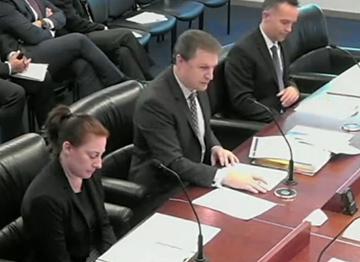
Larry Fazio (center)
In addition, the agency said the decision to close does not in and of itself affect the total amount available for distribution from the Share Insurance Fund.
Dispel 'Myth'
During remarks prior to the vote, Metsger said he wanted to “dispel the myth that we are somehow hoarding credit unions’ money, or as one trade association disingenuously said, ‘engaging in a cash grab.’ That’s just untrue. They know, or should know, that the special assessments and corporate capital were all used years ago to resolve the corporate crisis and to keep natural-person credit unions and their members safe. Even with those funds, we still had to borrow billions of dollars from the U.S. Treasury to keep the system afloat.”
Metsger added, “We also have to remember that, even if we wanted to, there isn’t a lot of cash to grab. Much of what we have is not cash, it is receivables or it is funds on hand needed to make upcoming NGN guaranty payments. When the rescue plan was created, it was never anticipated that credit unions would ever get any of their special assessments back.”
Metsger said the suggestion that credit unions are owed a “full refund is a myth.” The special assessments were never an “investment in the traditional sense,” he said.
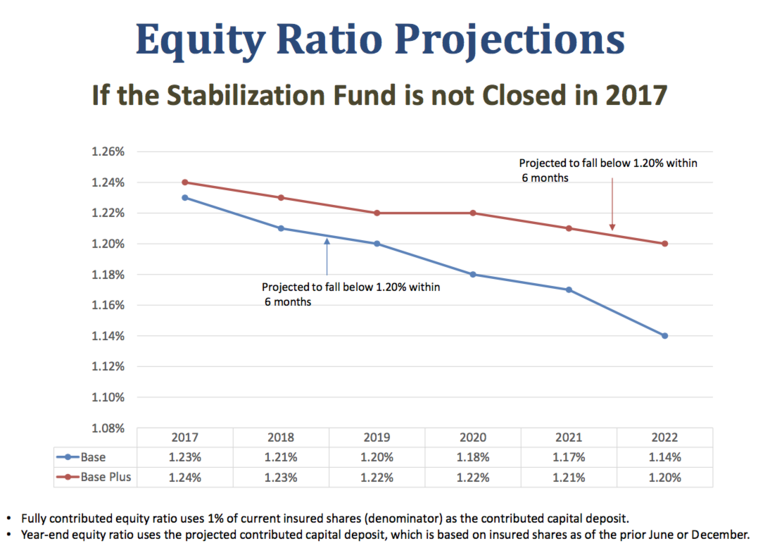
Regarding the decision to raise the NOL to 1.39%, McWatters on several occasions said the move is necessitated by the fact the insurance fund is “ill-equipped” to handle even a moderate recession without seeing a drop in its equity ratio that would require a premium be charged.
McWatters explained NCUA is seeking to manage the NCUSIF’s equity ratio in much the same way credit unions manage their own capital levels, stating, “Credit unions do not manage their levels of capital and liquidity so close to bare minimums that even a small loss means the difference between being safe and sound or being in trouble. This is prudent financial management, and just like credit unions NCUA must act prudently.”
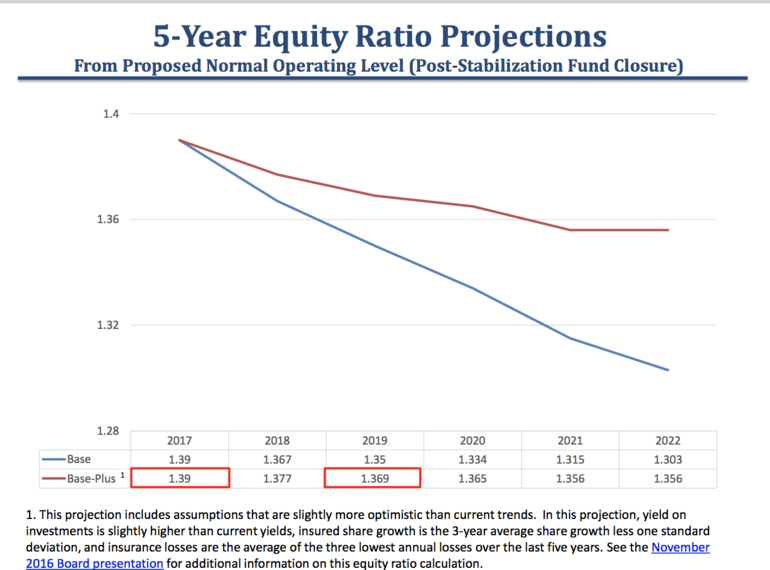
McWatters said the idea for merging the TCCUSF into the NCUSIF came about following discussions he had with NCUA’s Larry Fazio after he saw the downward trend in the NCUSIF equity ratio (due primarily to increased deposits at credit unions), which would have likely required a premium be charged.
He said the idea of merging the funds negated the need for that premium—although it does require an increase in the NOL–and made the distribution possible to credit unions in 2018, rather than 2021 or later.

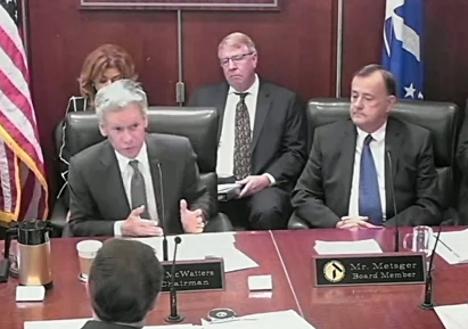
L-R: Mark McWatters, Rick Metsger
McWatters said it is “incumbent” on the NCUA board to set the NOL so the insurance fund has “sufficient resources to handle reasonable risk” and that it would be “negligent” if the broader, long-term impact were not considered. He added the methodology used in setting the NOL for the fund predates the economic crisis and the risks to the NCUSIF, and required an updating.
The Share Insurance Fund is required to be able to withstand a recession without the equity ratio falling below the 1.20% statutory minimum over a five-year period.
McWatters noted that some have argued the NCUSIF was able to survive the Great Recession at 1.20%. “That simply was not the case,” he said. “The share insurance fund required 23 basis points in premiums. Without them it would have fallen to 1.07%. One-hundred-twelve natural-person credit unions failed at cost of $1 billion plus to the fund.”
Loss Models
NCUA said it modeled losses over five years in adverse (moderate recession) and severely adverse (severe global recession) economic scenarios from the Federal Reserve Board. It also retained Black Rock to “shock” the values of underlying assets under various scenarios.
The agency noted all the statutory criteria necessary to close the Stabilization Fund have been met, with Treasury borrowings having been repaid as of October 2016, and the fund showed a positive net position as of June 2017 of $2.0 billion.
According to NCUA’s CFO, Rendell Jones, the unpaid principal balance of the legacy assets held by the TCCUSF are now $11.2 billion. The NCUA-Guaranteed Notes investor outstanding principal balance is $6.2 billion. The Share Insurance Fund assets total $13.2 billion
NCUA said it has projected the performance of the Share Insurance Fund based on three primary drivers: insurance losses, insured share growth, and yield on investments. It has also sought to quantify the potential decline in value of the Share Insurance Fund’s claims on the asset management estates.
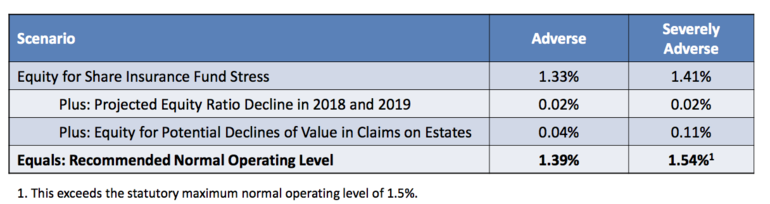
According to NCUA, to withstand a moderate recession without the equity ratio falling below 1.20%, the equity ratio needs to account for the following:
- A 13-basis-point decline in the equity ratio due to the impact on the three primary drivers of the Share Insurance Fund’s performance
- A four-basis-point decline in the value of the Share Insurance Fund’s claim on the asset management estates
- A two-basis-point decline in the equity ratio expected to occur prior to when the remaining NGNs begin to mature in 2020 and remaining exposure to the Legacy Assets can begin to be reduced. “This helps ensure the four basis points of additional equity to account for the potential decline in value of the claims on the asset management estates is maintained in the Share Insurance Fund until Legacy Assets can be sold,” the agency said.
Those figures, 13 basis points plus four basis points plus two basis points, are the basis for the 19-basis-point increase over the statutory 1.20% NCUSIF floor, and is nine basis points over the current 1.30%.
What can credit unions now expect? According to NCUA:
- The actual amount of distribution will be determined in March 2018, after year-end insured shares are reported.
- The estimated distribution is $600 million to $800 million. But actual results may vary due to extraordinary losses and/or failures in credit unions; unusual or abnormally high insured share growth; economic conditions that involve greater volatility in one or more market indicators as compared to the stress scenarios models; and/or extraordinary losses on the Legacy Assets resulting in higher than anticipated guaranty payments from NCUA.
NCUA said it will issue additional information regarding amount and accounting for any distribution in second quarter 2018.