L-R: Mark McWatters, Rick Metsger
ALEXANDRIA, Va.–The NCUA board announced Thursday that thanks to a “technical change,” it reduced its proposed budget for 2018 by $80,000. The board, in a 2-0 vote, approved the agency’s final 2018 and 2019 budgets.
The NCUA board also unanimously approved a new Overhead Transfer Rate (OTR) methodology the agency claims has been simplified.
The overall 2018 budget will be $321 million, an increase of 0.9% from 2017. The overall 2019 budget will be $331.4 million, a 3.2% increase. The 2018 operating budget will be $298.1 million, a 2.1% increase from 2017. The 2019 operating budget will be $302.7 million, a 1.5% increase from 2018.
“This is the fifth NCUA budget I have voted on since I joined the board in 2013,” said Board Member Rick Metsger. “And in each of those five years the board has acted to make the agency budget more transparent and efficient, and reduced the rate of growth. No stone has been left unturned to find ways to economize, and I have consistently made cuts to the proposed budget from my own office every year I have been on the board in order to lead by example.”
Metsger termed the new budget the “most transparent” budget in NCUA history and the most transparent of any of the federal financial services regulators.
“Quite likely the most transparent of any federal agency,” he said. “We have released more than 100 pages of information on the budget, including line items for every office and extensive detail on our capital budget and contracted services. Frankly, I am not aware of any public or private entity in the financial services sector that that releases this level of detail on its budget.”
Metsger noted that this is the fifth consecutive year in which the rate of budget growth has declined—from 6.7% in the 2014 budget, to 2.1% in 2018 and 1.5% in 2019.
“It is less than one-sixth the 13% rate of growth in the 2010 budget at the peak of Great Recession. On an inflation-adjusted basis, the change in the proposed budget is actually negative,” said Metsger. “At our Budget Briefing, one industry representative acknowledged that NCUA’s proposed budget, I quote, ‘Compares favorably to both increases in head line inflation and to increases in credit union operating expenses.’”
Metsger said that much of the reduction comes from three agency initiatives over the last several years.
“The Exam Flexibility Initiative and Space Utilization review that I instituted during my term as chairman, and the reorganization initiative begun under the leadership of Chairman McWatters. These initiatives will enable us to make better use of our human resource and our physical assets, which make up the vast majority of our budget,” he said. “Along with the work being done by our business innovation group, this will position the agency to meet the future needs of credit unions and their members.”
Under the new budget, over a two-year period, NCUA headcount will decline by 95 positions from the 2015 staffing level, two of five regional offices will close, and the ratio of supervisory examiners to staff will increase by 25%--from 1.8% to 10%. And leased office space will decline by 80%, Metsger noted.
New OTR Methodology
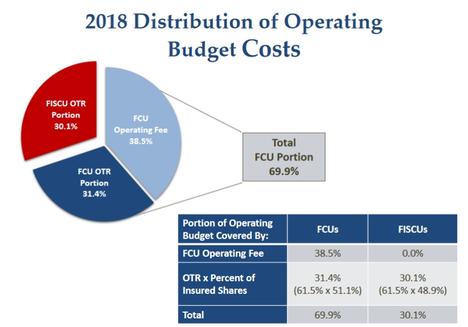
In approving the new OTR methodology, NCUA emphasized that the methodology for calculating the overhead transfer rate is simpler and more transparent, and will result in lower administrative costs. The agency set the 2018 overhead transfer rate at 61.5%, compared to 67.7% in 2017.
Larry Fazio, director of Examination and Insurance, said the new methodology is “principles based and reduces the number of steps in the calculation from eight to three, largely due to the omission of the four steps in supervisory authority calculation. The proposed new calculation reduces the number of categories in steps one and two from 15 to five, and eight to six respectively. It reduces the number of data points necessary by 80%.”
NCUA explained that the new methodology rests on four principles:
- Time spent examining and supervising federal credit unions is allocated as 50% insurance-related
- All time and costs spent supervising or evaluating risks posed by federally insured, state-chartered credit unions or other entities the NCUA does not charter or regulate is allocated as 100% insurance-related
- Time and costs related to the NCUA’s administration of federal share insurance and the Share Insurance Fund are allocated as 100% insurance-related
- Time and costs related to the NCUA’s role as charterer and enforcer of consumer protection and other non-insurance-based laws are allocated as 0%
Board Chairman Mark McWatters recognized the extensive debate the industry has had over the OTR.
“A lot of people have said that the OTR has been difficult to understand . . . But the OTR (today) is transparent, fair and reasonable. We are dealing a little more with art than science, and reasonable minds may differ, but this is a very reasonable and fair-minded rule,” the chairman said.
McWatters, noting that there has been “OTR creep” in the last few years, asked Fazio if the new calculation methodology makes the OTR rate more predictable.
“I agree that you would expect it to operate in a more narrow range than perhaps it has in recent times,” said Fazio. “The things that would affect it is if NCUA did make a big programmatic shift of the distribution. If for some reason, programmatically, there was some big shift in the time we spent between state chartered credit unions and federal credit unions (conducting exams)—obviously state charters would see a higher allocation percentage. That would drive the rate up and the inverse would be true. I think that would be the primary source of any future volatility. But we do not tend to see this picture in the exam program. For the rest of the calculation, I would not expect to see major shifts in terms of the results of the OTR.”
Metsger said that in looking back over his time on the NCUA board and even decades before that, debate over the issue of equity and fairness of the OTR has been “an annual affair.”
“And it is a very difficult thing to try and find that sweet spot, despite the fact that it has been tried many times before. What is fair. What is equitable? The OTR truly has been all over the rainbow. No one knows how to find it. But I think, in this simple and elegant approach, that in the years to come that won’t prove to be the case,” he said.
NASCUS President and CEO Lucy Ito applauded NCUA's efforts on the OTR.“A decades' old debate between NCUA and the state credit union system has been resolved, at long last," said Ito. "Over the past 20 years, NASCUS has advocated that NCUA allocate its safety and soundness examination costs for federal credit unions fairly between the insurance fund and federal credit union operating fees and to open the OTR to periodic public notice and comment. Today, NCUA agreed to both requests. NASCUS and the state system applaud and thank Chairman McWatters, Board Member Metsger, and NCUA staff for their open dialogue with the state system and for demonstrating their commitment to transparency, clarity, and fairness.”
In other business Thursday:
- The board unanimously approved a final rule making amendments to agency regulations governing corporate credit unions that revises provisions regarding retained earnings and Tier 1 capital. NCUA said the final rule will better align capital components with a corporate credit union’s financial statements and will clarify the minimum retained earnings requirement for corporate credit unions. “The final rule will not alter existing standards for prompt corrective action, and the agency does not propose to change regulations on authorized investments, concentration risk limits, maturity limits or other limitations on corporate investment activities,” NCUA said.
- Chief Financial Officer Rendell Jones reported that that 2018 operating fee will increase 15.7% for natural-person federal credit unions, and the corporate federal credit union operating fee scale will remain unchanged.
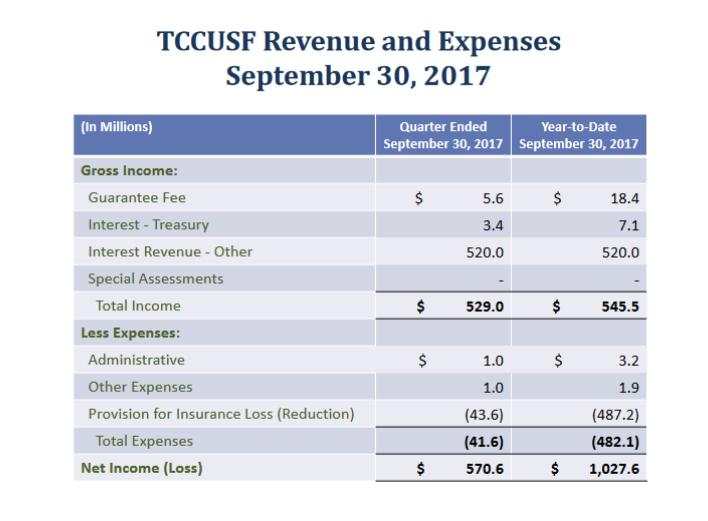
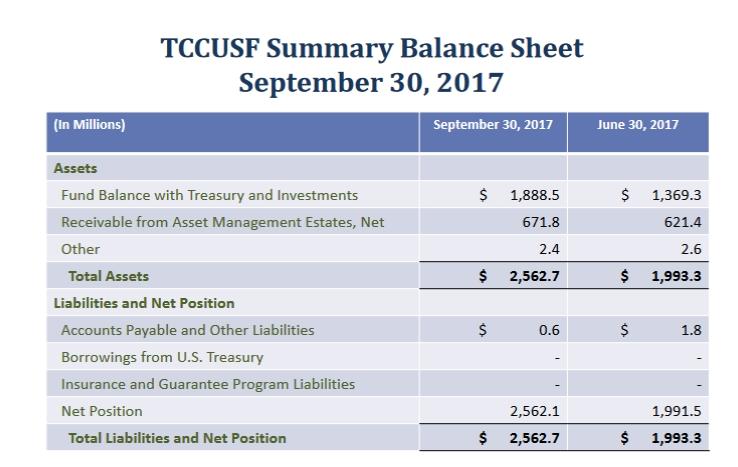
- NCUA shared that at the end of the third quarter, the Temporary Corporate Credit Union Stabilization Fund's (TCCUSF) net income was $570.6 million, increasing the Fund’s net position to $2.6 billion. NCUA closed the TCCUSF Oct. 1, and the Stabilization Fund’s remaining funds, property, and other assets were distributed to the National Credit Union Share Insurance Fund.
Alluding to all of the issues surrounding the TCCUSF since it was created as a means to prop up the corporate CU system, Metsger joked, “The stabilization fund has never been more stable than it is today, may it rest in peace.”