L-R: Mark McWatters, Rick Metsger
ALEXANDRIA, Va.—The NCUA board Thursday reviewed the performance of the Share Insurance Fund and Temporary Corporate Credit Union Stabilization Fund, and in doing so addressed the possibility of closing the TCCUSF this year, merging it into the NCUSIF.
Also, at the same time some analysts have raised concerns over potential risks from CUs that make taxi medallion loans, NCUA shared that it has markedly bumped up its liquidity position with the NCUSIF.
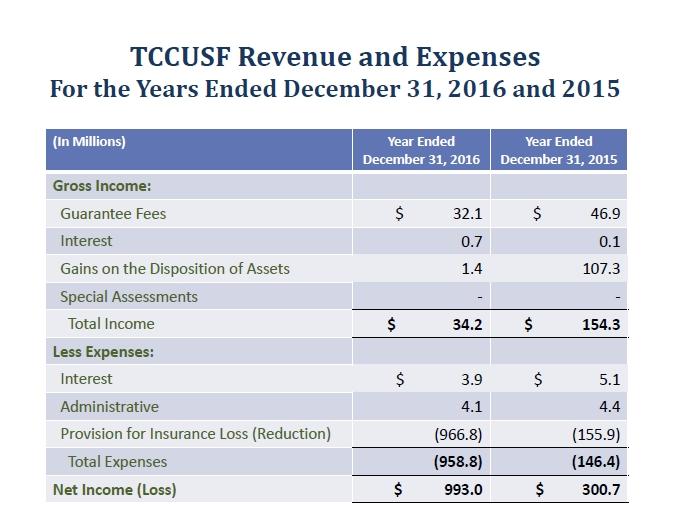
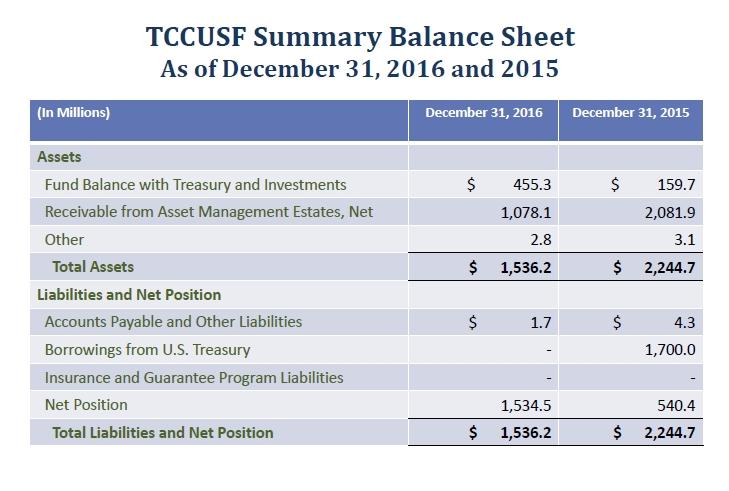
Board Chairman Mark McWatters spoke with Owen Cole, director of the Division of Capital and Credit Markets, about closing the TCCUSF early, possibly in 2017. The fund’s net position increased to $1.5 billion, from $500 million, by the close of 2016.
“At my GAC speech this year I talked about closing the stabilization fund early,” said McWatters. “I had a caveat in that speech that said this is subject to legal due diligence and financial due diligence—principally Black Rock—and probably most importantly accounting due diligence. Can you give me an update,” McWatters asked CFO Rendell Jones.
“I am working with my staff along with some consultants doing the research around issues involving presentation and disclosure of our statement. How the statement would look, how things would be valued, presented and disclosed. So we are still involved in that research,” replied Jones.
McWatters agreed that the work is “tuff stuff.”
“This is a head scratcher and a lot of work is involved,” McWatters said. “But I have not heard anything so far on the accounting side that says this can’t happen, is that true?”
Jones concurred.
“What if we were to fast forward to 2021, and the last NGN note was paid off and the stabilization fund was just sitting there and we wanted to close it and merge it because it was basically dead. What kind of accounting work would be required at that time? Work substantially similar to what we trying to do now?”
After Jones replied that the work would be similar, McWatters said, “Since we have to close the fund in 2021, hopefully there will be a way to do that in 2017.”
NCUSIF Liquidity
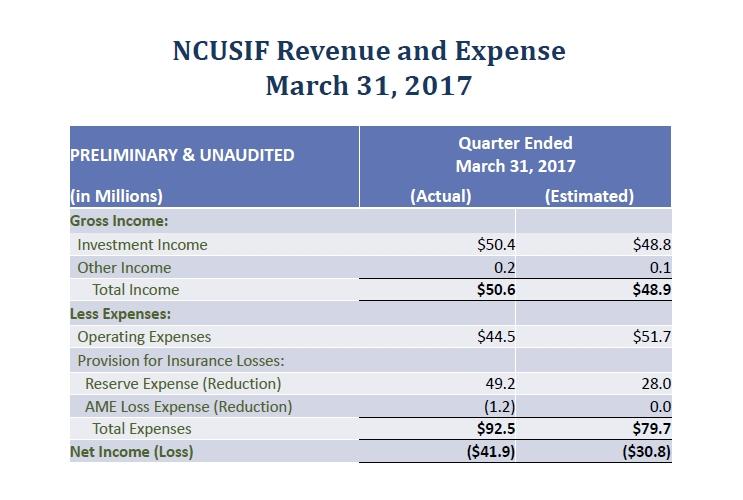
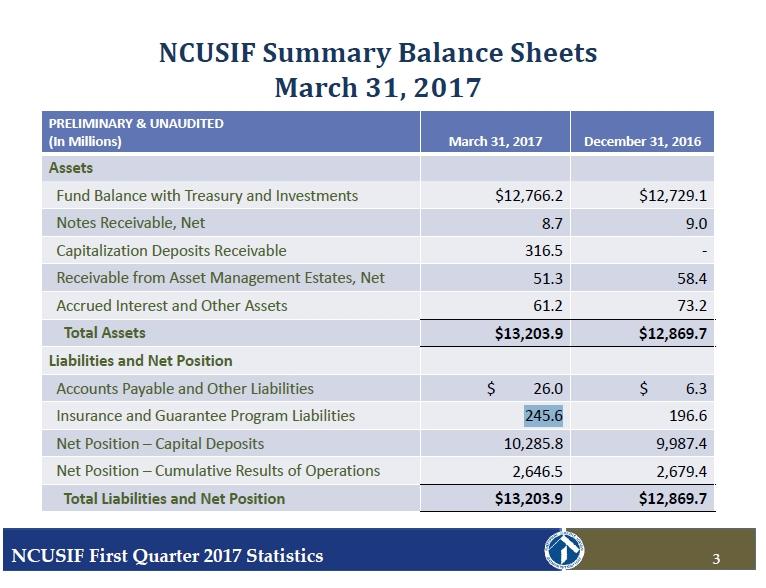
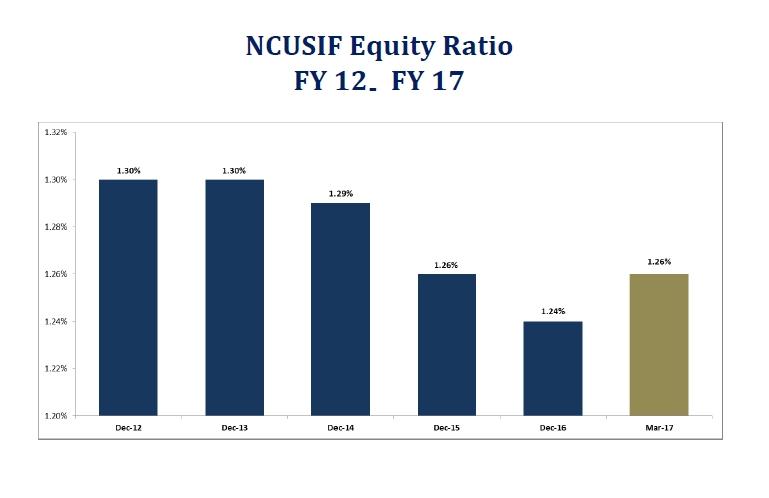
The NCUSIF showed a net income loss of $41.9 million for the first quarter of 2016—primarily due to an increase in the provision for insurance losses. The Share Insurance Fund’s net position was $12.9 billion at the end of the first quarter, and the equity ratio was 1.26%.
The data also shows that fund liquidity has increased. Cash and overnight investment balances were raised to almost $1 billion at the end of January 2017, with that number increasing to nearly $1.4 billion by the end of March.
Both Board Member Rick Metsger and Cole emphasized that the jump in NCUSIF’s liquidity position is not meant to cover the possibility of greater than expected credit union losses. Instead, both said the move was made to guard against having to sell fund assets at prices that would not be beneficial to the NCUSIF.
“We do have a significant jump in our liquidity,” said Metsger. “When we talk about planned and emerging expectations for liquidity, that would also involve the acquisition of assets that have limited instant marketability, to redeem for actual cash. That would be one of the reasons for the liquidity.”

L-R: Owen Cole, Rendell Jones
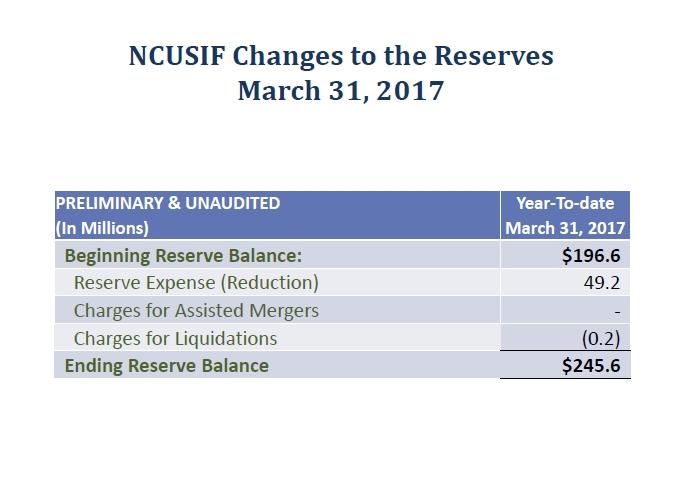
Metsger noted that the NCUSIF’s general reserves are $245 million, and is the “umbrella” the agency has to cover any type of expected losses.
“The rest of it is to make sure we have liquidity so we are not in a position of selling assets or not being in position to provide upfront temporary liquidity to a credit union,” he said.
Cole said the agency likes to look at liquidity as something that gives the NCUSIF the flexibly and buys time to deal with emerging issues.
“And it comes at a cost,” Cole said. “So we want to hold the right amount, and we want to have a cushion on top of what we need. But we recognize that if we hold too much, that will ultimately come at the expense to the return of the fund. Bolstering liquidity gives us strength and flexibility to deal with near-term challenges.”
Other Business
Overall, assets in CAMEL codes 3, 4 and 5 credit unions have decreased 68.9% since peaking at $205.6 billion in September 2010.
Year over year:
- The number of CAMEL codes 4 and 5 credit unions declined 9.6% from the first quarter of 2016 to 197 from 218.
- Assets in CAMEL codes 4 and 5 credit unions increased 21.8% from the first quarter of 2016 to $9.5 billion from $7.8 billion.
- The number of CAMEL code 3 credit unions declined 9.1% from the first quarter of 2016 to 1,102 from 1,212.
- Assets in CAMEL code 3 credit unions declined 36.6% from the first quarter of 2016 to $54.5 billion from $86.0 billion.
Two federally insured credit unions failed during the first quarter of 2017, compared to five in the first quarter of 2016. Total year-to-date losses associated with credit union failures are $3.7 million, compared to $4.7 million in the first quarter of 2016. Fraud was not a contributing factor in either failure in the first quarter, NCUA said.
The board also, by a vote of 2-0, approved proposed changes to Illinois member business loan rule.