

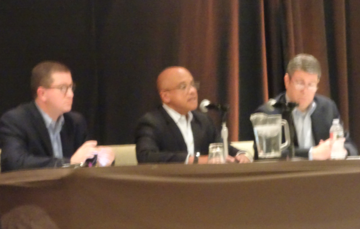
SAN DIEGO–What is the future for the corporate credit union system?
Three people at the NASCUS Summit here offered their takes on that question. Addressing the meeting were Francois Henriquez, a partner with the law firm Schutts Bowen who was formerly general counsel with the now shuttered U.S. Central CU; Bradly Long, EVP-Finance with First Florida CU in Jacksonville and chair of Corporate America CU; and Nicholas Fanning, SVP/CFO with Corporate Central Credit Union in Wisconsin.
Here’s a look at what each had to say:
Henriquez: I was for many years the corporate general counsel for what was the largest corporate CU, U.S. Central. There are some lessons we can learn from its 35 years of existence. U.S. Central represented a unique structure, and I would highlight that for many years through the corporate CU network, many credit unions were able to avail themselves of products and services not otherwise available to them, and in a more hospitable manner than through other relationships. Many of those things are not available today because of what happened to corporate credit union system.
Long: I am a former banker, who converted to a credit union person in 2005. In addition, I am currently chairman of Corporate America Credit Union, as well as being a manager in a natural-person credit union.
Much like many industries, we’re faced with changing technology and changing ways consumers do business, so we have to adapt and be innovative.
In the banking system, we had holding companies that helped take some of the strain off the banks, such as with the backoffice. We as corporate credit unions can help reduce those kinds of strains. Correspondent banking is another role corporates can fill.
In terms of the future, there are capital restraints and regulatory restraints. I think we all recognize that we need to watch risks, but if we take risk out of the system it impedes our ability to serve our members.
Our concentration risk of loans in general is 400% of our net worth. At (now defunct) Wescorp, it was 16 times their net worth. Another risk I think we see as a corporate system is the consolidation of the natural-person credit union industry. That means fewer credit unions to serve. Checks and other clearings are also going down, so we have to be efficient. We need to focus on what we do, and do it well.
Another risk is, how can we appeal to the large credit unions? That is going to require some new ways of thinking and seeking out ways to partner. Other things I think we need to focus on is partnering with vendors who are growing, and finding ways to help the smallest credit unions who need us the most.
We have to provide value to the credit unions who do business with us, and that is the point of emphasis we need to continue to focus on.
Fanning: I’m very passionate about corporate credit unions and the role historically they have played, and the role they can continue to play going forward.
I think Corporate Central brings a unique perspective to the industry. Corporate Central is a Wisconsin state-chartered corporate CU. Our core members are Wisconsin CUs, but we have grown to the point where we have members in 22 different states.
Going into the financial crisis we came in with a very strong capital position. We didn’t impair members’ capital, and that made a huge difference. And that also meant we came out with a very strong capital position. We continued to be a safe and reliable place for our members to place excess funds and to get lines of credit, and that is something other corporates have struggled with as the result of lower capital levels coming out of the crisis.
In 2010, at the time the new adequately capitalized regulation went in place, we were already above (thresholds that had been set for 2014 and 2016). That has allowed us to have a little bit different focus.
In 2007, there were 26 corporates plus U.S. Central, representing $100 billion in combined assets. Today, there are 11 corporates left and no U.S. Central, representing $20 billion in assets. Today, there are one-third fewer natural-person credit unions, but a near doubling of assets.
There are fewer than 300 CUs today that have assets of more than $1 billion. Eighty-five percent of credit unions are under $250 million in assets; they are the CUs that have typically used corporate CUs. But we know consolidation is likely to continue, and our expectation is that 10 years from now there will be about 3,500 credit unions in country, but a doubling of assets to $2.3 trillion.
The lessons learned from U.S. Central:
- We have to be able to act like a credit union and be a safe place for CUs to invest funds and get liquidity when they need it.
- CUs that have left the corporate system will come back to the corporate system if we have the right products and services and if they are not required to contribute any more capital. We had nearly 200 member CUs close accounts with us because we required contributed capital. At the end of 2012, we did away with the requirement, and brought in nearly 50 new credit unions as members. We’ve had an average of 30 new members now per year.
Core services of the past will not be the services of the future. We can and must collaborate with our members to come up with innovative solutions, but CUSOs are likely to be a better vehicle for many of those things going forward. We did a survey with Filene and found many credit unions are more interested in CUSOs than corporates. At Corporate Central, we have launched three new CUSOs (including Quantify and InterLutions (which offers i-Care health care program, a “business we never thought we would be in”).
Another lesson learned is we must collaborate with the credit union movement. We have found that for many years corporate credit unions have not been part of the conversation at all, and that’s been unfortunate. It’s time now for corporates to not just be part of the conversation, but to collaborate moving forward.